
‘Perch’ Board Game Review

Perch, designed by Douglas Hettrick and published by Inside Up Games, is a fascinating twist on area control for two (with special rules) to five players. At first glance, it looks light and approachable – thanks to its charming bird theme and modular setup of beautifully drawn perches. That said, beneath the surface lies a clever, interactive system that rewards foresight, opportunism, and a willingness to meddle with your opponents’ plans.
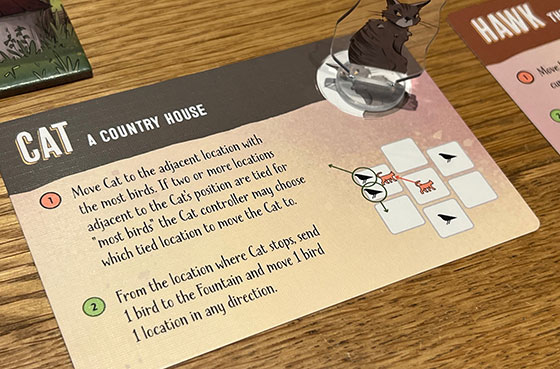
The premise is simple: players deploy birds across a series of locations, each with its own scoring rules. Some locations reward first place heavily, others give more points to second or even third place, and still others offer powerful abilities instead of raw points. These abilities include control of animals such as the local hawk, dog, cat or squirrel – and these can be used to influence the board in dramatic ways. The modular nature of the locations means that not every perch is used in every game, ensuring variety and replayability.
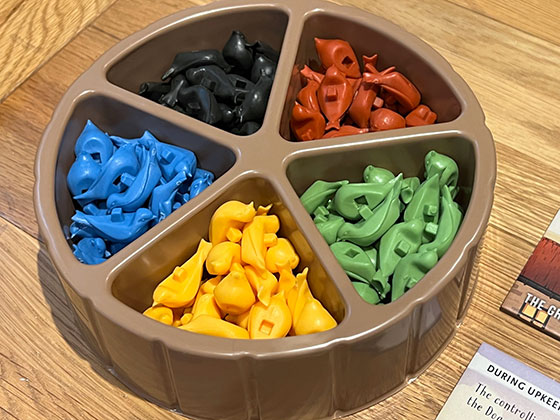
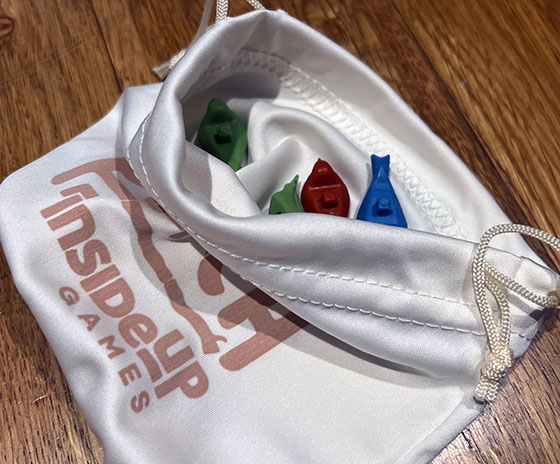
The real innovation in Perch is its bag-drawing system. Each round, players fill a bag with their own birds and those of their opponents, then draw randomly to determine which birds they can place. In addition, each player always takes two of their own birds from the roost. This creates a dynamic mix of certainty and chance: you know you’ll have some control, but you’ll also be forced to work with whatever birds you draw. Crucially, you can place opponents’ birds as well as your own, which opens up a whole world of tactical disruption.
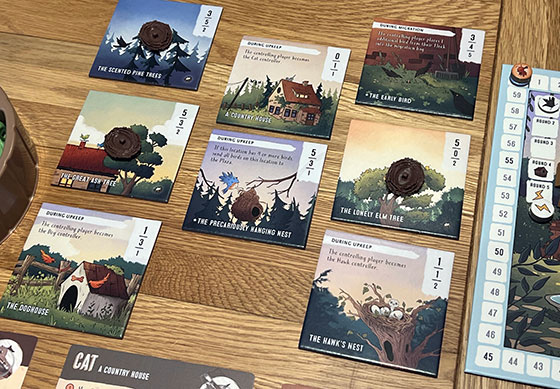
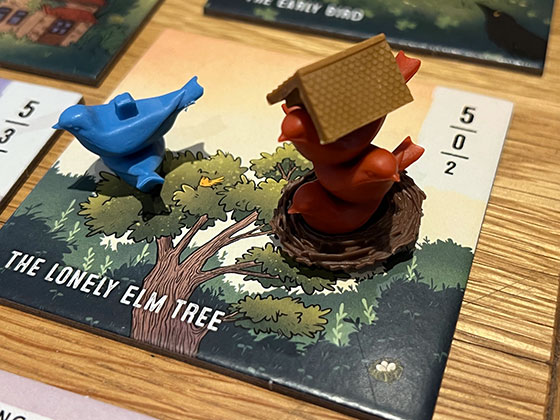
This mechanic is what makes Perch sing. Imagine an opponent sitting comfortably in second place at a location that scores five points for second and only one for first. By placing one of their birds there, you can push them into first – effectively robbing them of four points. Or perhaps you want to clog a location with rival birds to prevent them from spreading elsewhere. Every placement is a decision not just about your own scoring, but about how to interfere with others.
The flow of play is brisk, but the decisions are layered. Do you invest heavily in a high-value perch, risking that others will sabotage you? Do you spread wide to hedge your bets, knowing that second or third place might be more lucrative than first? Do you chase abilities like the Hawk or Dog, sacrificing points now for powerful bonus actions on later turns? These questions arise constantly, and they ensure that the game remains engaging from start to finish.
The bird-related theme is charming and well-integrated throughout all aspects of Perch. The idea of flocks competing for dominance across a landscape of perches feels natural, and the animal abilities add flavour without overcomplicating the rules. The artwork is bright and inviting, reinforcing the accessibility of the game. Yet the tone is not frivolous – the decisions are sharp, and the interaction is constant.
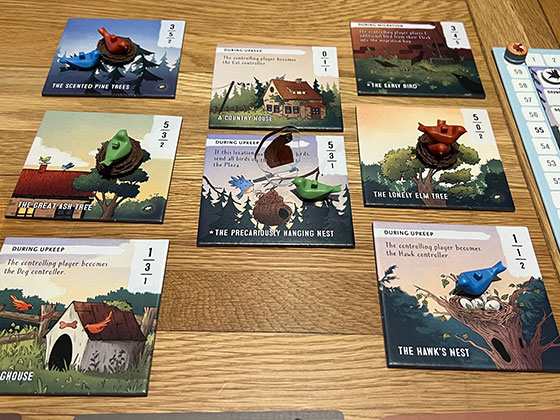
Replay value is strong thanks to the highly modular locations and the variability of the bag draws. No two games unfold the same way, because the scoring incentives shift depending on which perches are in play, and the bag system ensures that players are always adapting to unexpected draws. This makes Perch more dynamic than many area-control games, which can sometimes feel scripted once optimal strategies are known.
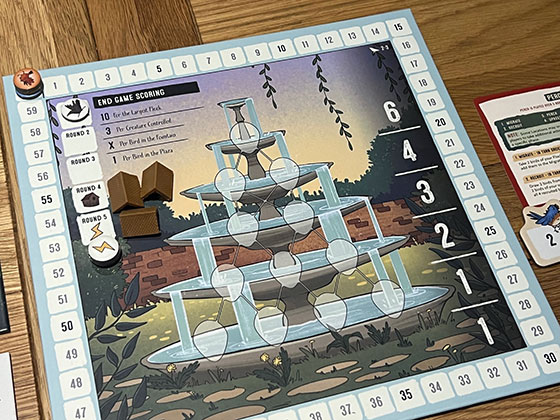
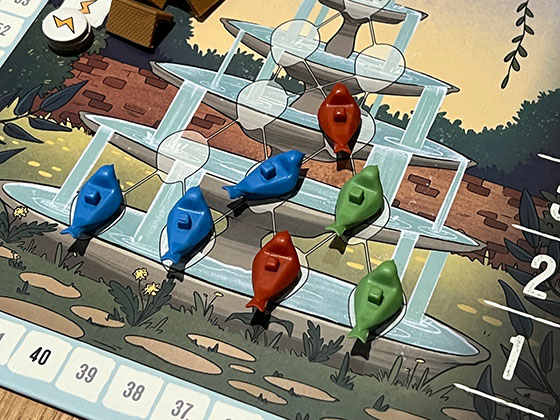
As birds begin to, erm, shuffle off the mortal coil (for example, because the hawk moves onto their location, or a zap token is used to remove one) they go to a separate scoreboard that spans around a plaza with a fountain in it. Birds can be moved to either The Fountain or The Plaza, specifically, with The Plaza providing one point per bird, but The Fountain offering limited spaces and higher point values. The trick with The Fountain is that birds can only be placed in higher spaces if the two connected (lower) spaces are filled. This introduces another interesting timing mechanic where often, you’ll want someone else to fill out the lower spaces so that you can ascend, and yet, they’ll be thinking exactly the same.
For me, Perch succeeds because it combines accessibility with depth. It’s easy to teach – the rules can be explained in minutes – but it offers meaningful decisions that keep experienced players engaged. The bag system ensures unpredictability, while the modular setup and scoring keep the game fresh. Most importantly, the ability to place opponents’ birds creates a level of interaction that is both playful and strategic, leading to moments of laughter, frustration, and triumph.
Perch is a clever design that uses its bird theme to mask a deeply tactical experience. It’s approachable, replayable, and interactive, making it a standout in the area-control genre. For players who enjoy games of disruption, timing, and direct competition, it offers a fresh and engaging challenge — one where ruling the roost means not just building your own flock, but meddling with everyone else’s.