
‘Barrage’ & ‘The Leeghwater Project’ Board Game Review

Barrage and its expansion, The Leeghwater Project, together form one of the most mechanically rich and thematically cohesive Eurogame experiences of the last decade. With layered resource management, brutal competition, and a refreshingly original theme, this is a game that rewards precision, foresight, and adaptability – and the expansion only deepens that challenge (if you’ll excuse the watery pun.)
Barrage, designed by Tommaso Battista and Simone Luciani and published by Cranio Creations, is a heavyweight Eurogame set in an alternate 1930s where water, not oil, is the world’s most coveted resource. Players take on the role of competing energy corporations, each racing to harness the power of rainfall through dams, conduits, and turbines. The goal is simple: generate electricity, but the path to doing so is anything but.
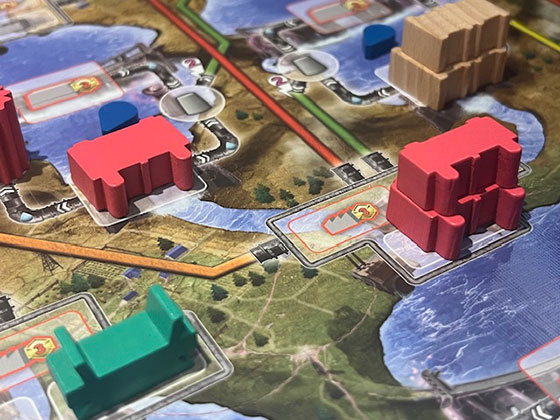
At its core, Barrage is a game of spatial control and economic optimisation. The board is a network of mountain basins and rivers, divided into elevation tiers. Water flows from the top down, and players must build dams to capture it, conduits to channel it, and powerhouses to convert it into energy. Each of these structures requires resources – excavators, concrete mixers, and money – and once built, they become permanent fixtures on the board. This permanence is key: once a dam is placed, it blocks water from reaching downstream opponents. Once a conduit is built, it can only be used by its owner. The result is a game of intense territorial competition, where every placement matters and every drop of water is contested.
The game’s most distinctive mechanic is its construction wheel. When players build a structure, they must place the required resources onto their personal wheel, which then rotates each round. Only after a full rotation do those resources become available again. This creates a delayed economy that forces players to plan several turns ahead. Want to build a dam now? You’ll need to make sure you have enough excavators, not just for this turn, but for the next few as well. It’s a brilliant system that adds tension and depth without relying on randomness.
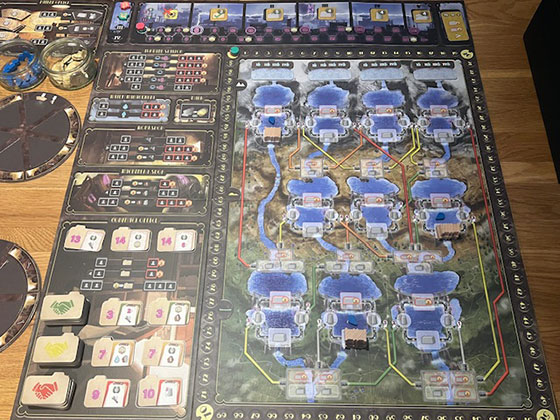


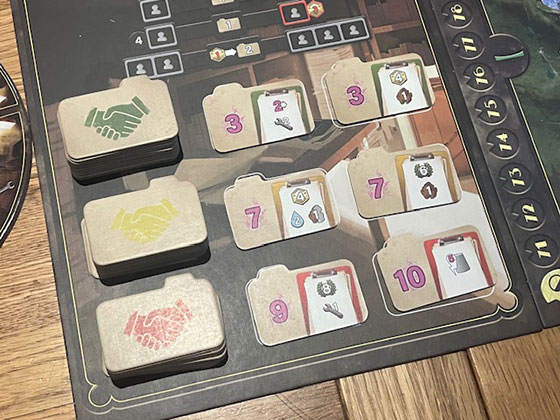
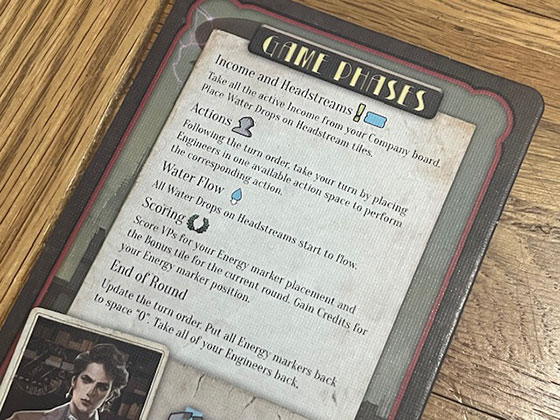
Each round, players take turns performing actions: building structures, upgrading technology, producing energy, or claiming contracts. The game uses a tight action selection system, with limited spaces for each type of action. If someone builds a certain building before you, you may be locked out for the round. This scarcity drives competition and forces players to prioritise ruthlessly. Should you rush to build a conduit before someone else claims the best spot? Or should you wait and produce energy while the water is flowing, risking it being directed away?
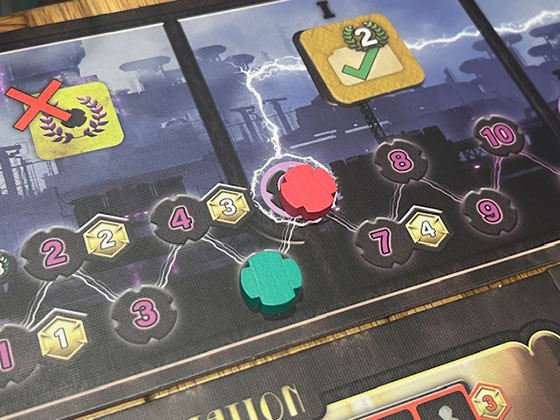
Scoring is based on energy production and contract fulfilment. Each round, players earn points based on how much energy they generate, with bonuses for hitting production thresholds. Contracts offer additional rewards for meeting specific conditions—producing a certain amount of energy in one turn, or using specific types of structures. These contracts are public and limited, adding another layer of competition.
The base game includes five asymmetric factions, each with its own special ability and starting setup. Some factions can manipulate water flow, others gain bonuses for building in specific regions, and others have more efficient construction wheels. These asymmetries are well-balanced and add replayability, encouraging players to explore different strategies and adapt to their opponents. A sixth faction is introduced in the expansion, but I’ll cover that later.


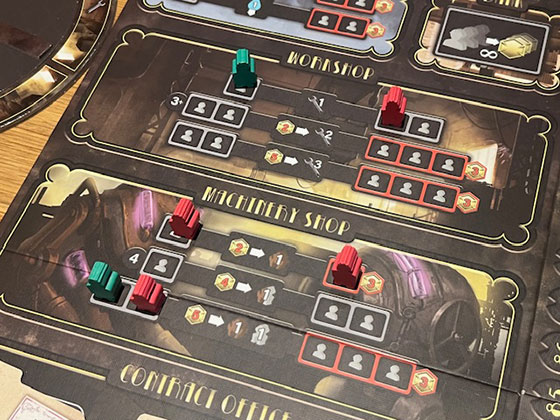
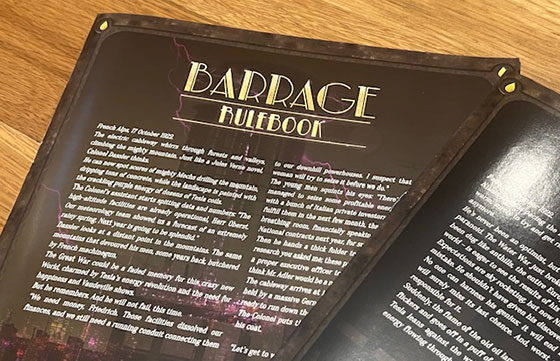
Visually, Barrage is striking. The board is a stylised map of alpine terrain, with crisp iconography and a muted industrial palette. The components are functional and thematic – plastic dams, cardboard conduits, and chunky resource tokens. The construction wheels are particularly satisfying, with rotating dials that track resource recovery. The graphic design is dense but readable, and while the rulebook has been criticised in earlier editions for clarity issues, more recent printings and community resources have helped smooth the learning curve.
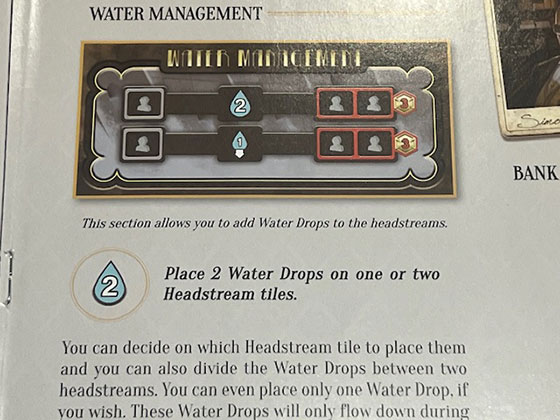
Now enter The Leeghwater Project, the first major expansion for Barrage, and one that integrates seamlessly into the base game while adding meaningful new layers. Named after Jan Leeghwater, a Dutch hydraulic engineer, the expansion introduces a sixth faction—the Netherlands—alongside new mechanics, executives, and technology tiles. The Netherlands faction, led by Ellen Vos, specialises in water management. Her ability allows players to manipulate water flow more effectively, making her a strong choice for players who want to control the board’s tempo. She also starts with unique building bonuses that encourage early expansion, making her a dynamic and aggressive option.
The most impactful addition in The Leeghwater Project is the technologies mechanic. These are powerful tiles that represent large-scale infrastructure projects – canals, aqueducts, and other public works. To activate them, players must sacrifice excavators and concrete mixers, representing the labour and materials required. These tiles offer potent effects: extra energy production, resource discounts, or strategic flexibility. They also introduce a new action space, creating more competition and decision points during the game.

In addition to the new technologies, the expansion adds five new building tiles, each with unique effects. These tiles can be used to customise your faction’s capabilities, allowing for more tailored strategies. For example, one tile might grant bonus energy when water flows through a specific conduit, while another might reduce the cost of building dams. These tiles are modular and optional, but they add depth and variety without overwhelming the core mechanics.
The Leeghwater Project also includes two new executive officers, each with abilities that synergise with the new mechanics. These executives offer alternative paths to victory and encourage players to explore different combinations of technology and infrastructure. Combined with the new faction and building tiles, they significantly increase the game’s strategic diversity and variability from one game to the next. That being said, they also increase complexity well beyond that which a casual gamer would likely feel comfortable with.
The expansion is well-integrated and doesn’t disrupt the balance of the base game. Setup time is only marginally increased, and the new components fit neatly into the existing framework. For experienced players, the expansion adds complexity and replayability. For newer players, it’s best introduced after a few plays of the base game, once the core systems are understood.
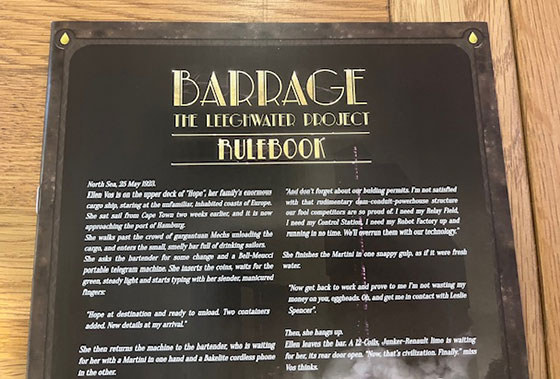
In terms of production, The Leeghwater Project matches the base game’s quality. The new tiles and components are visually consistent, and the iconography is clear. The expansion fits into the base game box with some organisation, and the rulebook is concise and well-structured. Feedback from my game group was overwhelmingly positive, with many players considering the expansion essential once they had grasped the base game.
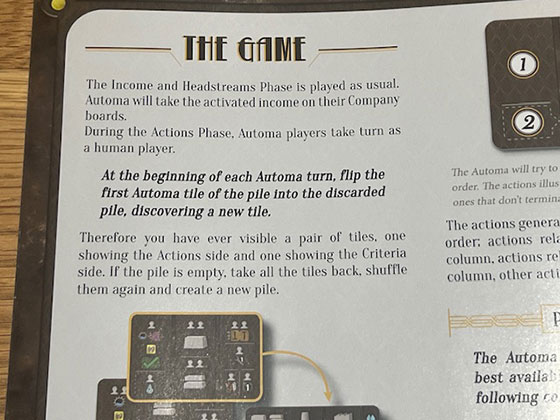
Together, Barrage and The Leeghwater Project offer a deep, competitive, and highly thematic Eurogame experience. The water management theme is not just window dressing, it’s embedded in every mechanic, from the flow of water to the construction wheel to the spatial tension of the board. The game demands long-term planning, tactical flexibility, and ruthless efficiency. It’s not for the faint of heart, but for players who enjoy tight economic games with high interaction and minimal luck, it’s a standout.
In the end, Barrage is a masterclass in design – complex, thematic, and deeply rewarding. The Leeghwater Project elevates it further, adding strategic variety and mechanical richness without bloating the experience. Whether you’re damming rivers, racing for contracts, or sacrificing resources for massive infrastructure, this is a game that flows with tension and satisfaction. For serious gamers, it’s a must-play and with the expansion, it becomes a must-own in my opinion.