
‘The Witcher: Path of Destiny’ Board Game Review

Everyone knows and loves The Witcher mythos these days – where monsters are just misunderstood apex predators, and the best-laid plans of the human inhabitants of the world are just one step away from disaster. The Witcher: Path of Destiny captures that chaos beautifully. It’s a tableau-building card game that feels like a narrative brawl- equal parts strategy, storytelling, and sheer bloody-mindedness.
Designed by Łukasz Woźniak and published by Go On Board, The Witcher: Path of Destiny is a competitive 1–5 player game that drops you into the boots of iconic characters from the Witcher universe. Geralt, Yennefer, Ciri, Vesemir, Dandelion – they’re all here, each with their own deck, their own playstyle, and their own tangled relationship with fate that makes them feel unique and diverse.
The premise is simple enough: retell three major tales from the Witcher saga – Striga, Edge of the World, and Lesser Evil – and try to come out as the hero. But this isn’t a cooperative experience. You’re all vying for glory, manipulating events, sabotaging rivals, and bending destiny to your will. It’s a knife fight in a narrative museum, and whether you know the lore or not, it’s pretty glorious.
Mechanically, The Witcher: Path of Destiny is a tableau builder with a twist. You’re drafting and playing action cards, building out your personal board, and triggering combos to gain resources, influence events, and score points. The real spice comes from the story cards. Each chapter introduces new dilemmas, branching paths, and consequences. You can follow the canonical route, or you can go rogue – change the course of history, rewrite endings, and steal the spotlight.
This non-linear narrative structure is what sets The Witcher: Path of Destiny apart. Most games with story elements give you a script. This one gives you a sandbox. You’re not just reacting to events – you’re shaping them, and because each character interacts with the story differently, the replayability is off the charts. Geralt might brute-force his way through a problem, while Dandelion charms his way around it. Yennefer bends magic and politics to her will, and Ciri? Ciri breaks the rules entirely. Even if you do run out of content in the base game, the expansions already available offer massive replay value.



The asymmetry is deep, but it’s not overwhelming. Each set of cards is tuned to feel distinct without being unbalanced. You’ll need a few plays to really grasp the nuances, but once you do, the strategic depth opens up. You start seeing the angles – how to time your plays, when to pivot, when to lean into your character’s strengths and when to bluff your way through a weakness.
And bluffing matters. The Witcher: Path of Destiny is competitive, and while there’s no direct combat, there’s plenty of interaction. You can manipulate shared story elements, block rivals from key actions, and even trigger events that hurt others more than they help you. It’s not mean-spirited, but it’s sharp. You’re all trying to be the hero, and there’s only room for one on the cover.
The game plays over three acts, each tied to a specific story. Within each act, you’ll draft cards, build your tableau, and resolve events. The pacing is tight – about 60 minutes for a full game – and the tension ramps up steadily. Early turns are about setup, mid-game is about engine-building, and the final act is a race for glory. It’s got that arc you want in a narrative game, but it’s driven by mechanics, not flavour text.
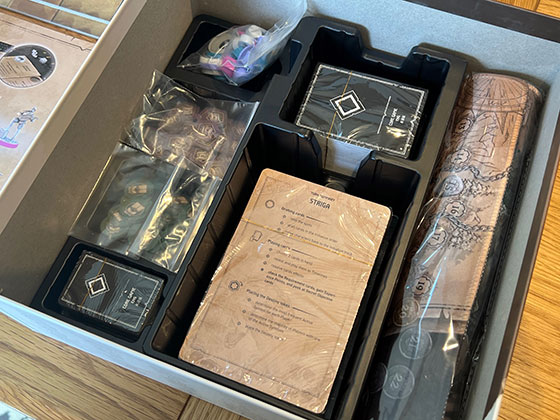
Speaking of flavour, The Witcher: Path of Destiny is dripping with it. The artwork is stunning – dark, moody, and unmistakably Witcher. The card design is clean, the iconography is intuitive, and the production quality is top-tier. Even the stretch goal boxes and expansions feel like they belong. Wild Hunt, Legendary Monsters, Naglfar – they may not all be core stories, but for players who really do know the world, there’s a load here to revisit.


The deluxe version adds acrylic tokens, upgraded components, and a general sense of “deluxification” but even the standard edition (which is what we were sent) feels complete. You’re not missing out on gameplay if you go for this – just a bit of bling. And if you go all-in via the secondary market, you’re getting a mountain of content. Multiple expansions, solo boards, miniatures, sleeves, artbooks – it’s a collector’s dream and a shelf’s nightmare.
Now, let’s talk accessibility. The Witcher: Path of Destiny isn’t a gateway game. There’s a lot to track – card effects, story branches, resource management, timing. The rulebook is well-written, but you’ll need a full playthrough to really internalise the systems. That said, once it clicks, it flows. Turns are snappy, decisions are meaningful, and downtime is fairly limited as well.
The biggest hurdle is the narrative complexity. If you’re not familiar with the Witcher universe, some of the story beats might feel opaque. You’ll still enjoy the mechanics, but the emotional punch won’t land as hard. On the flip side, if you’re a Witcher fan, this game is a love letter. It doesn’t just reference the lore – it engages with it. You’re not just playing through stories. You’re interrogating them.
And that’s where The Witcher: Path of Destiny shines. It’s not just a game about winning. It’s a game about choices and narrative. Do you follow the path laid out for you, or do you forge your own? Do you play to the crowd, or do you chase personal glory? The game doesn’t judge – it just records. And at the end, it tells you who (and possibly what) you became.


There are some rough edges. The asymmetry, while brilliant, can lead to uneven experiences if players aren’t equally familiar with their decks. The story cards, while rich, can sometimes feel disconnected from the mechanics. And the sheer volume of content – especially if you were to go for the all-in – can be intimidating. But I think these are minor quibbles in a game that’s swinging so hard to recreate a fantastic narrative experience that, personally, I already love.
So, where does The Witcher: Path of Destiny land? It’s not a traditional euro, not a pure narrative game, not a deck-builder. It’s a hybrid – a strategic sandbox wrapped in a storybook. It’s bold, ambitious, and unapologetically Witcher. If you want clean lines and predictable outcomes, look elsewhere. If you want drama, depth, and a bit of destiny? This is probably your game. The Witcher: Path of Destiny is a triumph of thematic design. It’s messy, moody, and magnificent. Whether you’re slaying monsters, rewriting fate, or just trying to outshine Dandelion, you’ll find a game that rewards clever play and embraces narrative chaos. It’s not perfect, but it’s unforgettable.