‘Star Wars Unlimited: Legends of the Force – Spotlight Decks: Darth Maul & Qui-Gon Jinn’ Review

With Legends of the Force, Fantasy Flight Games delivers its most thematically focused and mechanically refined Star Wars: Unlimited set to date. As the third expansion in the series, Legends of the Force narrows its lens to explore the Force itself – not just as a narrative device, but as a fully integrated gameplay mechanic. The result is a set that feels both intimate and expansive, offering new tools for deckbuilders, new challenges for competitive players, and a pair of Spotlight decks that are among the most flavourful and mechanically distinct in the game so far.
The set introduces a new Force mechanic that adds a layer of strategic depth without overwhelming the core gameplay loop. Each player now has access to a Force token – assuming they choose one of the new bases that enable it. Cards with the new “Force” keyword allow players to interact with this token, with some allowing it to become active and others allowing it to be spent. It’s a clean, elegant system that rewards planning and opens up new archetypes, particularly for decks built around Force-sensitive characters.
This thematic focus is brought to life most clearly in the two new Spotlight decks featuring Darth Maul and Qui-Gon Jinn respectively. These decks are designed to showcase the new mechanics while offering a complete, out-of-the-box experience for new and returning players alike. They’re also a fascinating study in contrast – one aggressive and volatile, the other patient and reactive – and they reflect their characters’ philosophies with impressive clarity.
Qui-Gon Jinn

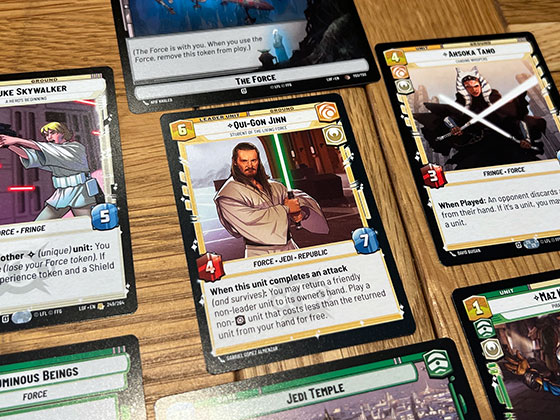
The Qui-Gon Jinn deck is a masterclass in balance and resilience. Built around the new Force mechanic, it rewards players who can maintain stead use of the Force token whilst also controlling the board with efficient, value-driven plays. Qui-Gon himself is a Leader who manipulates the board state often, with an ability that allows him to return a friendly card to its owners hand and then to play a cheaper card for free. This can often be used to trigger Force keywords one way or another.
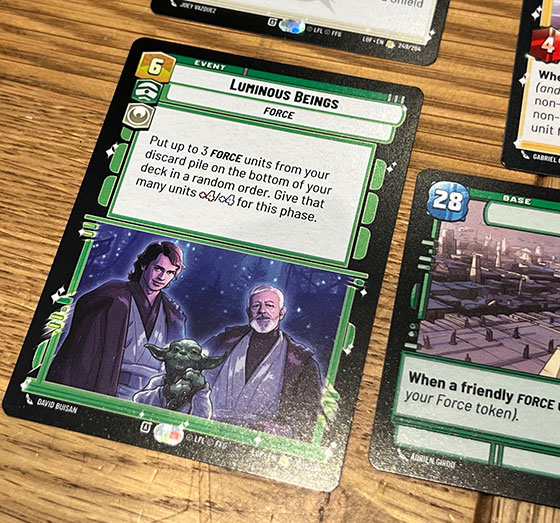
Whilst there are quite a few cards that interact with the Force keyword, cards like Luminous Beings (Rare) double down on it. This one allows the player to bring back up to three Force units from the discard to the bottom of their deck (allowing for later searching), but also adds the upside of +4/+4 to as many units as you bring back. Priestesses of the Force is another example which allows the player to spend their Force token to place a shield token on up to five (yes, really) units.
In play, the Qui-Gon deck is deliberate and methodical. It’s not the fastest deck, but it excels at stabilising the board and grinding out value over time. It’s a great choice for players who enjoy midrange strategies, and it offers plenty of room for customization – particularly in Force-centric builds that want to lean into the new mechanics.
Darth Maul

If Qui-Gon is about balance, Darth Maul is about disruption. His deck is aggressive, tempo-driven, and built to punish opponents who fall behind. Maul himself is a Leader who deals damage to enemy units when he enters play, and his deck is packed with cards that reward early aggression and Force manipulation.
A good example of how Darth Maul uses the Force keyword is with his Fallen Lightsaber item. As with most items, anyone can equip the lightsabre, but if the equipped unit has the Force keyword, then the Lightsaber deals one damage to each defending creature – which is always useful, but very effective against decks that use smaller units to overwhelm the opponent.
In terms of gameplay, the Maul deck is fast and punishing. It’s ideal for players who enjoy proactive strategies and high-impact plays, and it offers a compelling contrast to the more measured pace of the Qui-Gon deck. It’s also a great introduction to the red-black archetype, which continues to evolve with each new set.
The Force Mechanic and Set Identity


The introduction of the Force token is the defining feature of Legends of the Force, and it’s implemented with impressive restraint. Rather than overhauling the game, it adds a new axis of decision-making that complements existing mechanics.
This mechanic is particularly well-suited to decks built around Jedi, Sith, and other Force-sensitive characters, but it’s flexible enough to support a wide range of strategies. Some cards, like Crystal Caves, help the player generate the Force token, while others, like Obi-Wan Kenobi allow the player to spend it. In this case to purchase an experience token for any unit that doesn’t have one.
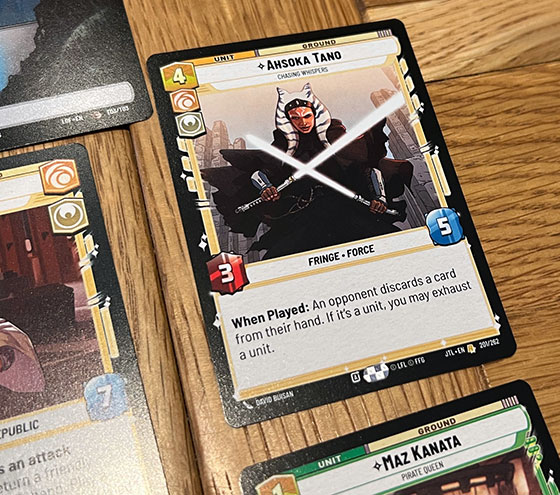
The Force token also interacts with new Leaders and especially Bases introduced in the set. Ahsoka Tano and Count Dooku – are both designed to leverage the Force mechanic in different ways, and they offer new archetypes for players to explore. The set also includes new neutral cards that support Force strategies, making it easier to splash the mechanic into existing decks.
Card Highlights and Deckbuilding Potential


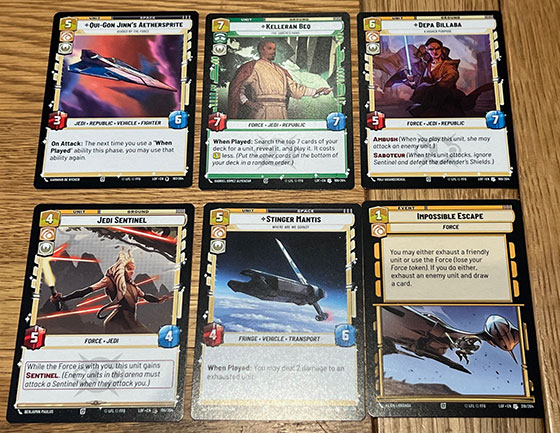
Beyond the Spotlight decks, Legends of the Force includes several standout cards that are already making an impact in constructed play. Jedi Sentinel is a mixed colour unit with 5/4 stats and Sentinel whenever the Force is with you, making it a strong defensive option for control decks. Baylan Skoll (not included in either starter deck but printed as part this set) is a 5/5 uncommon that allows the controller to use the Force to return a cost 4 or less card back to its owners hand, and then allows that same card to be replayed for free.
The set also includes new upgrades, supports, and events that support tribal synergies, particularly for Jedi, Sith, and Force users. This opens up new deckbuilding possibilities and encourages players to experiment with hybrid strategies that blend old and new mechanics.
As with previous sets, the production quality of Legends of the Force is excellent. The card art is consistently strong, with a mix of cinematic stills and original illustrations that capture the tone of the universe. The new Force cards are clearly marked, and the Force track itself is easy to understand and use.
The Spotlight decks are well-packaged and include everything needed to play out of the box, including tokens and a play guide. They’re ideal for new players, but also offer enough depth to be interesting for veterans. The balance between accessibility and complexity continues to be one of Star Wars: Unlimited’s greatest strengths, and Legends of the Force maintains that standard.
Legends of the Force is a confident, thematic expansion that deepens the Star Wars: Unlimited experience without overwhelming it. The new Force mechanic is elegant and impactful, the card pool is diverse and well-balanced, and the Spotlight decks offer compelling, character-driven gameplay that reflects the personalities of their stars.
Qui-Gon Jinn’s deck is a thoughtful, resilient midrange build that rewards patience and planning. Darth Maul’s is a fast, aggressive deck that thrives on pressure and disruption. Both are excellent introductions to the set’s themes, and both offer meaningful paths for customisation and competitive play.
Whether you’re a long-time fan of the franchise or a newcomer to the game, Legends of the Force offers something worth exploring. It’s a set that respects its source material, challenges its players, and continues to push the game forward in exciting ways.
______