‘Great Western Trail: Second Edition’ Board Game Review

Here at Nerdly, we were a bit late to the party when it came to our review of the original Great Western Trail back in mid-2019. By then, the game had already been out for around 3 years, and it was already well inside the BoardGameGeek top ten rated board games. The thing is, the original version left a bit of a bad taste in the mouths of a lot of players. Every character in the game was a white male, Native American people were seen literally as “obstacles” and there were a number of purely functional issues – fiddly player boards and a very strong early-game strategy that was virtually impossible to counter.
With these issues on the table and such a popular following, it made sense that Great Western Trail would receive an updated edition – and the changes are noticeable, albeit largely cosmetic. The first change is the box, which is now a bright, colourful and slightly more diverse affair, with the three grim white faces that the original featured now replaced with a more rich, thematic image of a pair of cowboys (one black, one white) surveying the range. This new paint job continues on the board and elsewhere on other components, with a generally brighter palette used across the board.
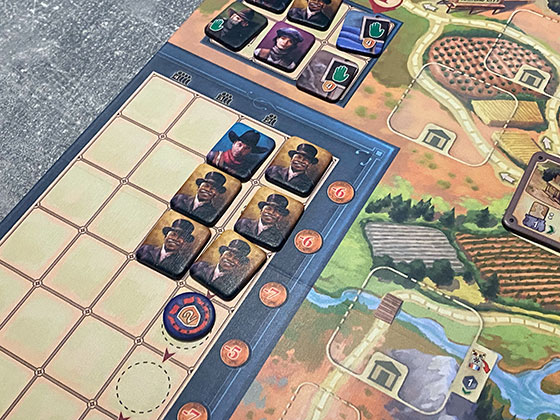
Where the original game featured three characters at the heart of its mechanical flow (cowboys, engineers and builders) so too does Great Western Trail: Second Edition. In this version, however, rather than those three white dudes from the original cover, we have a white man, a black man and a white woman. There is no overt LQBTQ representation, but the game never describes the characters in detail, so players are certainly welcome to invent their own backstory for each one. Regardless, I am now considerably less embarrassed by taking Great Western Trail: Second Edition down from the shelf to play with either female or black friends, simply because I don’t have to explain the content in Great Western Trail.
Moving on to the more functional updates; there are perhaps two major quality of life updates to consider, and one rather welcome mini expansion. Firstly, as I mentioned before, the player mats in the first edition were a bit frustrating to use. Great Western Trail uses a lot of disks to reflect player progress, and one knock to the table could send them skittering all over the place. Great Western Trail: Second Edition features double-layed cardboard mats, meaning that those same disks can now be indented – keeping them firmly in place. The other quality of life upgrade is that Great Western Trail: Second Edition comes with cloth bags labelled one, two and three to assist in setting up a particular phase of the game – with the original, players had generally made this upgrade themselves.


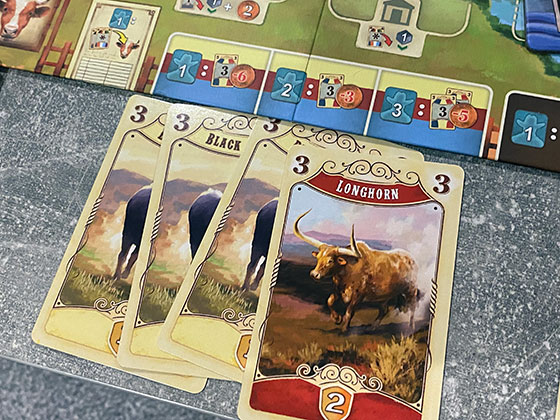
The mini-expansion that I’ve just mentioned is rather an interesting one, and it’s not something that we have seen before, including in the Rails to the North expansion which was added to the first edition a few years ago. This mini-expansion (which is optional) adds a new breed of cow to the cattle market. This new breed – the Simmental – adds an initial two value cow (or calf, rather) which is automatically upgraded one level each time it is sold at Kansas City. This is the first we’ve seen such a mechanic used in Great Western Trail, and the effect is a rewarding and welcome mechanism that adds a little variety without a ton of rules.
Another major addition, perhaps reflective of board gaming generally over the past two years, is a deck of solo AI cards and a well featured solo mode called “Lonely Are the Brave.” In this mode, a single player tackles an opponent called Sam, who builds frequently, disrupts the cattle market and aggressively fills out both stations and cattle markets when he reaches the end of the track. I haven’t had a lot of opportunity to play this mode so far, but I have had a couple of goes – and on both occasions, Sam beat me fairly easily. As always there is a chance that I’ve misinterpreted the rules a bit, but I think it’s equally possible that Sam is designed to face off against more experienced Great Western Trail players, which will be welcome news for many.
Now, I hope that if you’re still reading this review at this point, you will already be very familiar with Great Western Trail because otherwise you’re probably wondering what this is all about. I think by now, rather than explaining the game in detail, I would just refer any unfamiliar players back to my original review – since the fundamentals of the game haven’t changed. As a brief recap though, Great Western Trail: Second Edition is a game in which up to four players make their way around the perilous trail with a herd of cows (their deck) which they will attempt to expand and upgrade as they go, all the while also constructing buildings, building a train line and hiring staff.
This is a classic “so much choice, so little time” style eurogame, and Great Western Trail: Second Edition mirrors the original in that players are always short on both time and money. There’s a racing aspect to reaching the end of the board first because you will sell your cows there for a tidy sum, but you’ll also (usually) be able to drop disks on the cattle markets you deliver to, which leads to faster movement, a bigger hand, more powerful actions and so on. Of course, you can’t rush through the trail too fast, because it’s only by stopping on spaces that you will get the chance to build or add new cows, or whatever. All of this costs money, so sometimes you’ll sell cows in your hand in the hopes of drawing up better ones – earning money when you do so. Sometimes, drawing a perfect hand of cards straight after you deliver can be the worst thing, since you’ll develop a level of conflict over selling them.

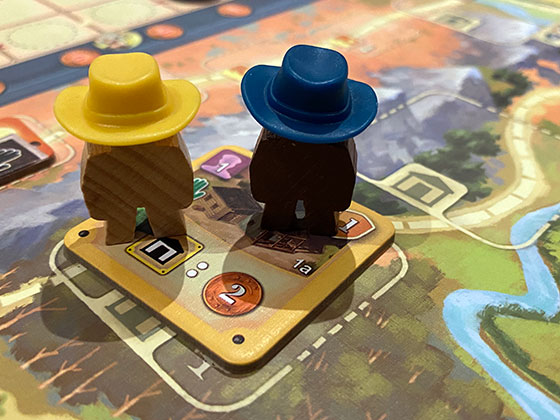
Unfortunately for some players, what Great Western Trail: Second Edition doesn’t correct is how complex the game is, in particular for new players. There’s a steep learning curve here in respect of both mechanics and strategy. Mechanically, moving around the board with the intent of selling cattle is simple enough, but coping with that alongside the limited options, need to build, desire to improve your stock, advance your train etc – it’s a lot to take in. Even when you know how it all works, deciding how best to score points is another matter altogether. Bear in mind that whilst I have mentioned moving your train, I haven’t mentioned dropping off engineers to claim stations, clearing obstacles or achieving objective cards yet. Great Western Trail really has always been a tactical smorgasbord.
Even so, Great Western Trail: Second Edition is a worthy, welcome and modern update to a game that was already fantastic. It’s a shame that Rails to the North isn’t bundled in there (or even available as a day one expansion) but I guess it will follow at some point. The Simmental cows and solo expansion are decent, sizeable additions that enhance the overall package, whilst all of the cosmetic updates add up in a really positive way. There are a few minor balance tweaks to scoring and suchlike, but as a casual player I’ve never really focussed on min/maxing the strategies that hardcore players might otherwise exploit. As a result of all of these changes, Great Western Trail: Second Edition remains an excellent choice for players who are looking for a reasonably complex, yet thematic eurogame experience.
****½ 4.5/5
Great Western Trail: Second Edition is available online at 365Games.co.uk, or at your local games store. Don’t know where yours is? Try this handy games store locator