‘Knitting Circle’ Board Game Review

Knitting Circle is a cosy, accessible evolution of Calico’s spatial puzzling – retaining the satisfying tile-laying core while softening the difficulty curve and introducing charming new mechanics like yarn drafting, garment knitting, and button collection. There’s also a slight edge to Knitting Circle that gives it another dimension – thanks to the cutthroat way in which you can push your opponents towards “ugly garment” tokens, which cost valuable points.
Designed by Emily Vincent and published by AEG and Flatout Games, Knitting Circle is a standalone follow-up to Calico, the beloved 2020 puzzler about quilting and cats. Where Calico challenged players with tight constraints and brain-burning optimisation, Knitting Circle offers a more relaxed, forgiving experience that means you’ll almost always be able to do something – but the drive to make appealing garments and avoid those ugly tokens maintains a level of compelling attention to detail.
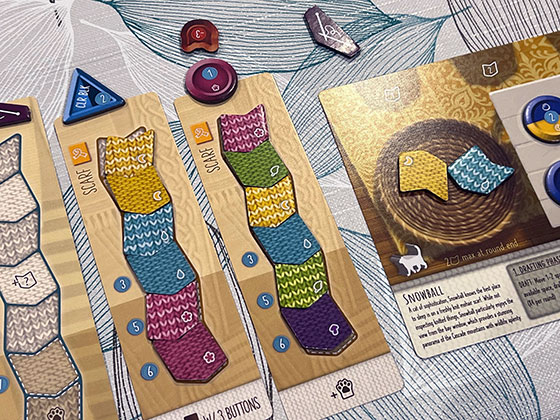
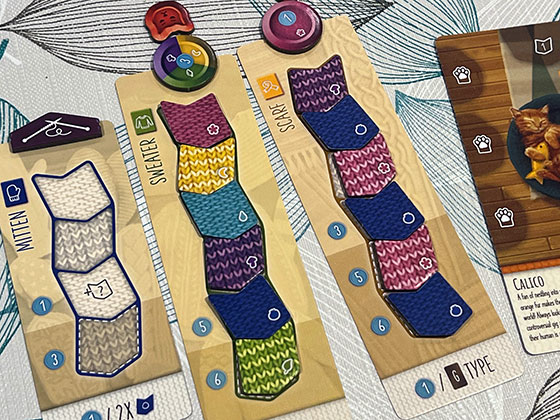
The premise is simple: players are knitters competing to create the cosiest and most beautiful assortment of garments. Each turn, you’ll draft a yarn tile from a central board that varies in size by player count, and then you’ll place it into a slot on your personal board. You’ll start the game with two garments (and can buy more by trading a yarn token). Each garment has a mandatory length (in yarn tiles) and sometimes 1-2 bonus spaces for additional points.
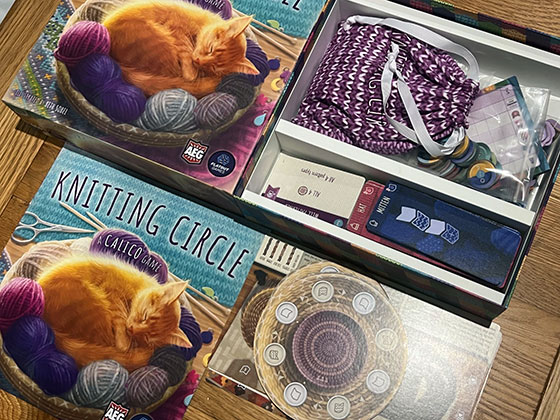
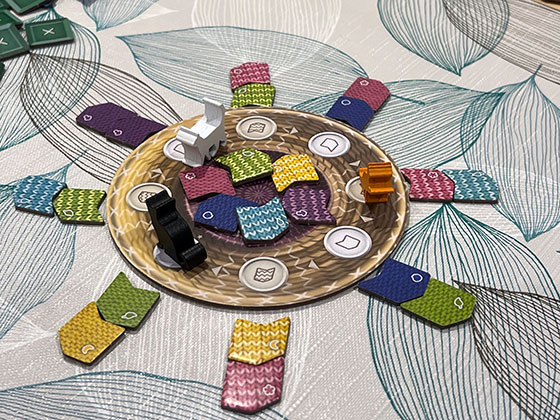
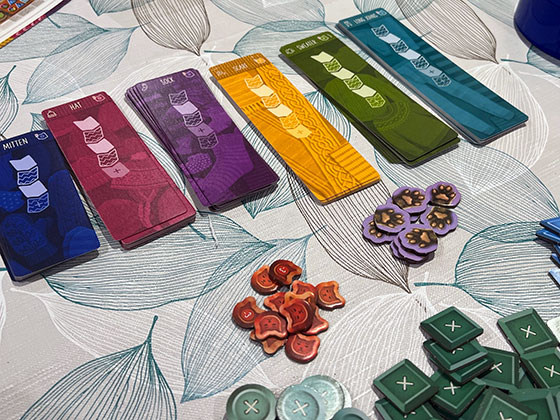
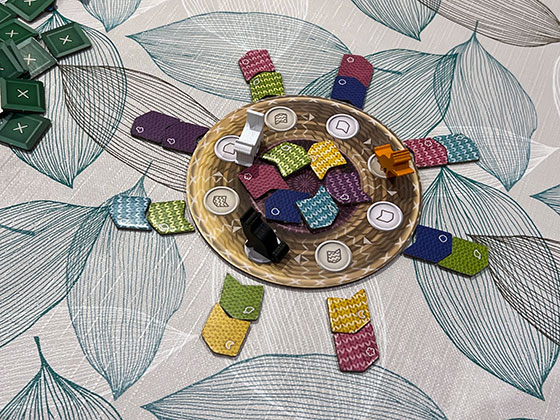
What makes Knitting Circle so interesting is that players each have six buttons on their board – and these come in three shapes (two of each.) Each shape of button corresponds to some feature of a garment – the type, the colours used and the pattern. When completed, a garment can earn a single button of each kind if the features on the garment match the button, for example, because you used the right colour. However, if you fail to match one of the available patterns, you’ll take an ugly garment token worth minus three points – and this means that you can’t simply smash out garment after garment.
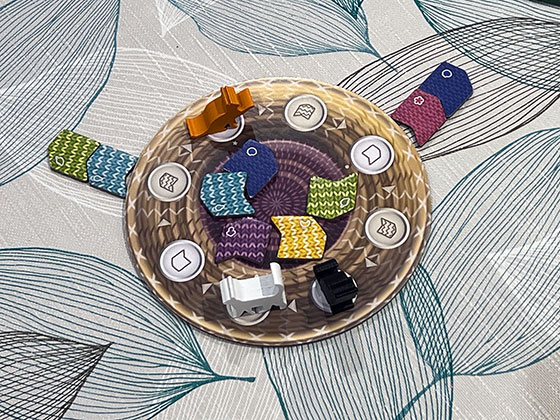
The drafting system is also more interactive in Knitting Circle than it was in Calico. Yarn tiles are drawn from a central circle, with two yarn tiles branching out from several locations. On a turn, the active player will move their cat meeple one or two spaces and then take the outside yarn tile, which must remain on its knit or pearl facing. This adds a layer of planning and tension — because you may not be able to get every time you want. Garments require tiles to be placed knit then pearl, so taking too many of one kind (bearing in mind the colour and pattern requirements of your buttons) is key.
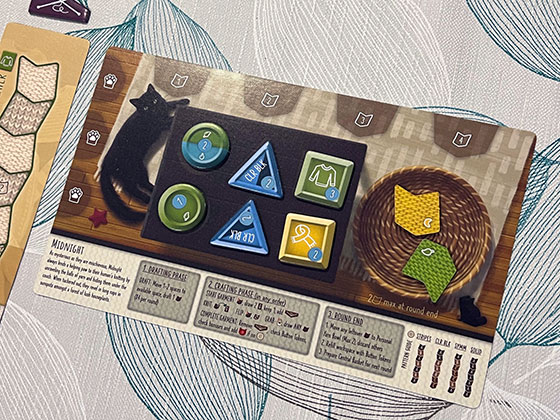
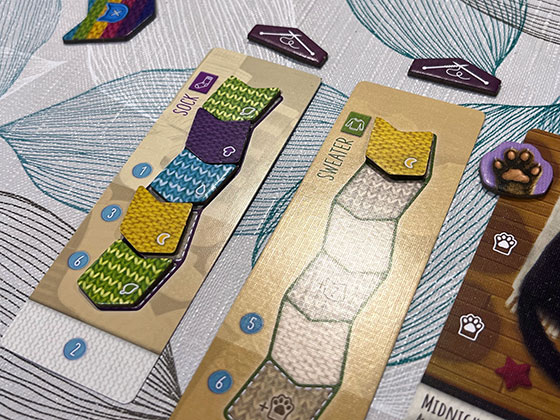
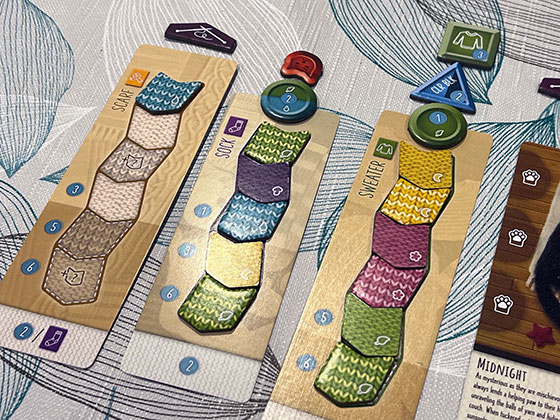
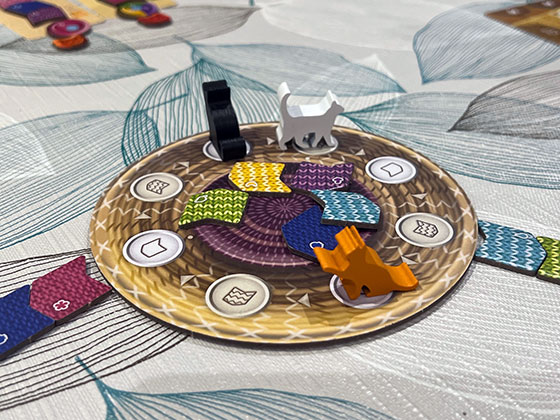
The game supports 1–4 players and plays in about 30–45 minutes. Solo mode includes a dedicated AI opponent with its own decision deck, offering a satisfying challenge without excessive upkeep. At higher player counts, the drafting tension increases, as competition for specific tiles becomes more intense. Thankfully, there are two double-sided central boards that scale the number of drafting options based on player count, and I think that makes a big difference to the way the game plays.
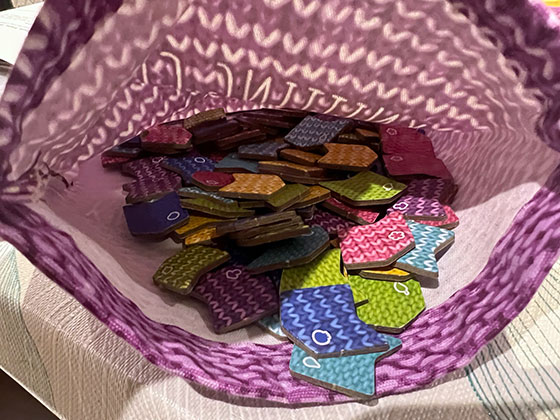
Visually, Knitting Circle is a delight. Beth Sobel’s artwork is warm, inviting, and richly textured, with yarn tiles that pop against the soft backgrounds. The components are high quality, with thick tiles, colourful buttons, and a well-organised instruction manual. The theme is lovingly integrated – from the knitting needles that represent your working garments to the cat curled up in the rulebook margin, every detail reinforces the cosy, creative atmosphere.
Despite the large number of components and complexity at first glance, I have to praise Knitting Circle for its accessibility and charm. It’s an incredibly cosy game that seems to capture the theme perfectly. Where Calico was quite the robust spatial puzzle, Knitting Circle is more of a smooth pattern-building experience. It’s less punishing than Calico, but no less satisfying – not quite a gateway game, but not far from it either.
Knitting Circle is a gentle, engaging puzzle game that captures the spirit of Calico while carving out its own identity. It’s approachable without being simplistic, strategic without being stressful, and beautiful without being overproduced or stupidly expensive. Whether you’re a fan of the original or just looking for a cosy game night companion, Knitting Circle might well be worth adding to your collection.