
‘Nucleum’ & Nucleum: Australia Expansion’ Board Game Review

I know that most people won’t believe me when I write this, but reviewing board games can often be quite difficult. Sometimes, I accept, it’s dead easy. You love the game, it’s nice and simple, the components are good and the words just flow. On other occasions, I find myself reviewing a game like Nucleum, along with its fairly recent expansion Australia expansion. So why is Nucleum so hard to review? Is it because it’s rubbish? No, not at all – it’s because it’s brilliant – but how on Earth I am going to write about it in a sensible amount of words is going to be…. Interesting!
Designed by the legendary pairing of Simone Luciani and Dávid Turczi and published by Board & Dice, let’s start with the basic premise of what Nucleum is all about. In an alternative universe 20th Century Europe, Elsa von Frühlingfeld has discovered the power of Uranium and harnessed it through her invention – the Nucleum. The theme feels kind of Steampunk, but calling it something like “Nuclearpunk” would be more representative thanks to the luminous green hue that features on most components.
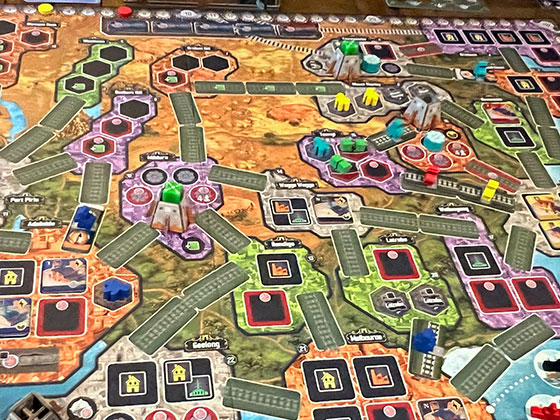

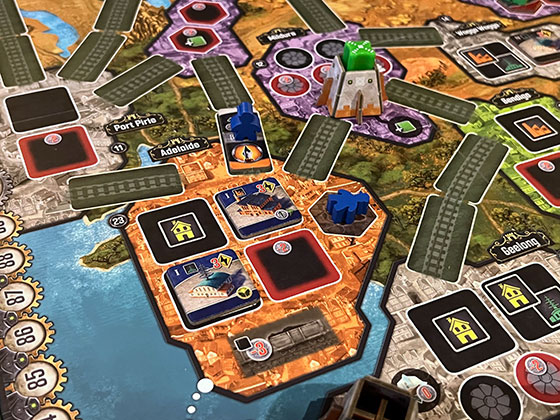
Nucleum can be played by one to four players and each player count has its advantages, but most of my plays have been with four players, and I’ve played it a few times without Australia and probably twice that with the new expansion in play. I’ll talk about both the base game and the expansion relatively interchangeably throughout this review simply because one of the key parts of the expansion is a new board, and many of the basic ideas remain the same with or without the expansion.
In Nucleum, the players act as industrialists in this alternative nuclear era. With very clear nods towards the route building and construction of Martin Wallace’s legendary Brass, Nucleum has players placing railway tracks, mining and transporting coal, powering cities with turbines and then building and flipping buildings once they receive power. Some players also draw likenesses between Nucleum and another Luciani game – Barrage – but I haven’t played that so I can’t really comment about it.
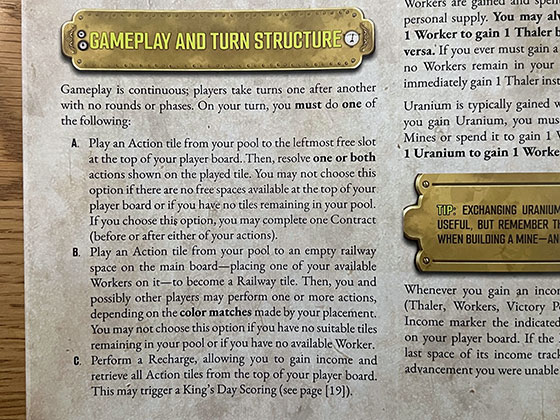
And I guess with that said, I am finally going to have to stop stalling and try to describe what you do in this massive game which – by the way – carries a BoardGameGeek weight rating of 4.13 out of five. Gameplay is continuous in Nucleum until the game end trigger occurs – and this means that there are no rounds with formal income phases or similar, it’s simply incumbent on the players to play action tiles and take actions until they either cannot or do not want to place any more, at which point they must take a brief, personal income phase.
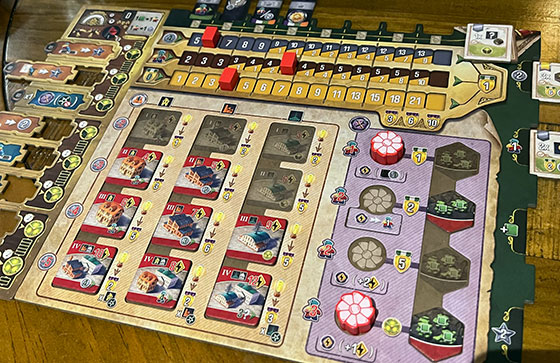
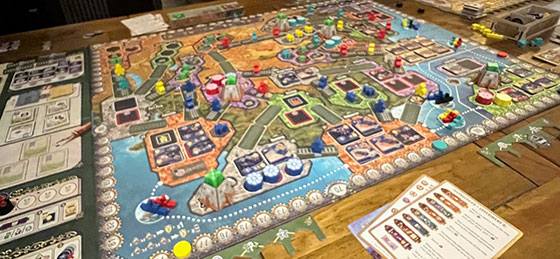
On a normal turn, the player will assess the action tiles they have – which more often than not feature different colours and action symbols on each end – and then play them. There are two ways to play these, which are either on top of their player board or onto the board as track (which requires them to put a meeple down as well.) In the player board version, both actions can be taken in either order and then later (during the next income turn) they will return to the player to be used again.
If a token is used like this for track, however, then it will only trigger the actions that match the same colour as it on the board. So for example if you play a piece with a green end adjacent to a green city, it will trigger the action on that end of the tile. If the other end is white (for example) and matches a previously played piece of white track, then that effect will also trigger (as will the effect on the other piece of track, whether it belongs to you or another player.) When track joins up like this, it flips and that route is then “complete” and will connect the locations at either end (many things require connections to work.)
Actions taken during these turns include things like constructing buildings, recruiting meeples, powering buildings, taking new technology tiles and lots, lots more. Whilst each player begins with basic (and asymmetric) set of action tiles, the “Take Action Tiles” action allows players to draw more from a common market. As we’ve seen in so many other games, newly drawn action tiles cost more, whilst those that occupy the “oldest” slot in the market being cheapest. These purchased action tiles are very often a lot more powerful than the basic ones, so this is a key early game action.
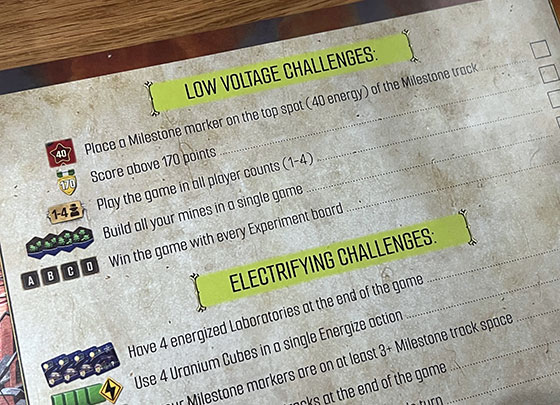
In terms of scoring, Nucleum has many ways to do it – again, all of which are laborious to explain so I will try not to bore you. Firstly, there are contracts – and these can be taken as an action, slotted into your player board (for a specific bonus) and then completed whenever you meet the criteria. There’s also a large amount of end game scoring that gives players points for things like connected track, powered buildings and so on – all of which is fairly straightforward.
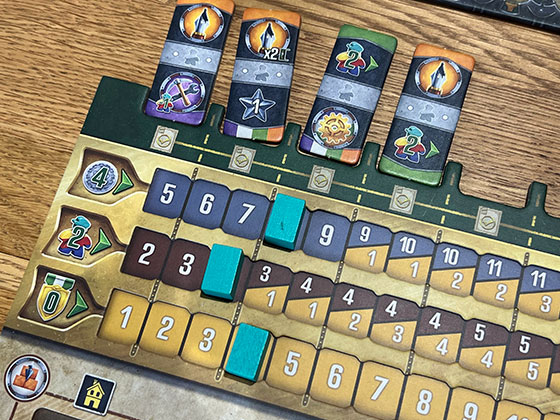
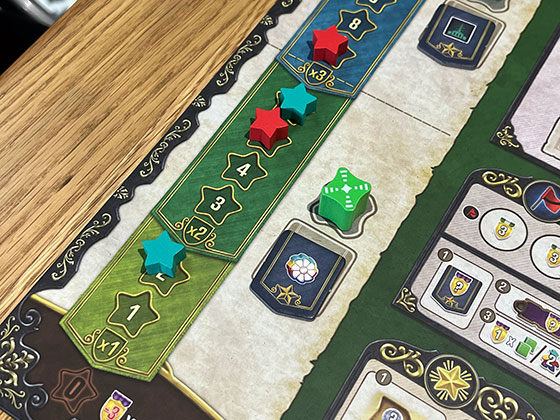
Perhaps the most interesting thing about scoring in Nucleum is the midgame scoring. Each player has a number of star tokens that will be placed on a scoring multiplier track based on how much prestige the player has at the point where they take an income turn. These tracks are scored each time the final player takes their income turn for that particular “round” of income turns. IE, effectively this scoring happens after one complete round of incomes, then again after two and so on.
The idea is that each time you do this, your star will move further up the multiplier track and will relate to a different scoring criteria – whether that be powered buildings, number of retained meeples or whatever else it might be. This can take a bit of time to get used to and it’s unlikely you’ll “get it” on your first game, but nonetheless it’s a clever, transparent and interesting way to drive scoring that everyone can understand after you’ve finished a few learning games.
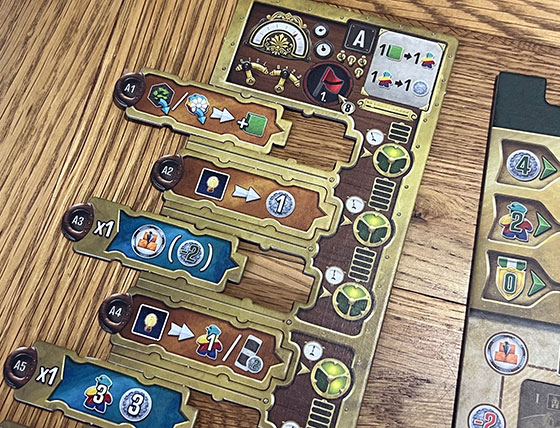
There is, admittedly, a lot more to discuss about Nucleum and Nucleum: Australia that I am simply not going to cover here. To name a few examples, I haven’t discussed the asymmetric technology trees that each player has, with level one, two and three techs that affect the rules of the game or offer powerful one-off effects. I haven’t mentioned how the income phase gets more powerful with the more action tiles you slot into your player board and I haven’t gone into detail on how some of the power mechanics work and how wooden turbines are essential for powering bigger buildings.
That said, I hope I’ve given you enough insight into Nucleum to determine whether or not it sounds like the kind of game you might be able to get to the table – but how you actually play a game like Nucleum is only half the story. The other half is how you feel when you play it, and when considering this, context is everything. Nucleum is a super heavy game – the rules, the iconography, the mechanisms and the scoring are all complex in their own right, and that will definitely affect the level of enjoyment players get from Nucleum.
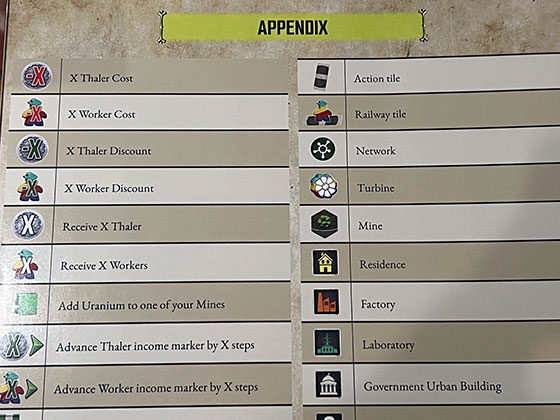
So let me be straight with you – if you have no experience of heavy or even very heavy games, Nucleum is going to be very hard work. Not impossible as there are some great videos out there, but nonetheless it will be tough to learn and to teach. Once you actually start playing, the game is actually very streamlined and it flows well, but the possibility for mistakes is large and there are many smaller rules to consider (and easily miss.)
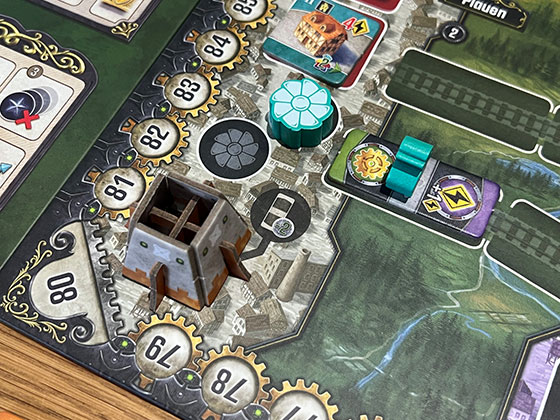
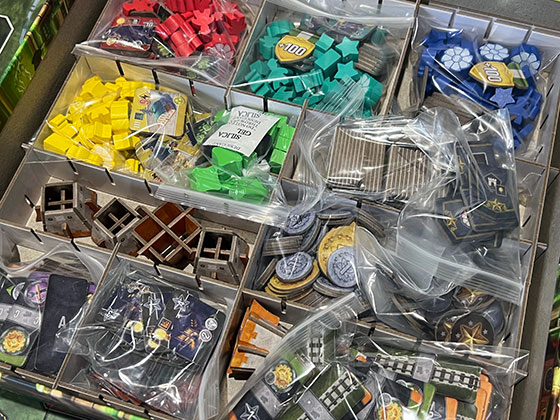
If you like heavy games though, then Nucleum is a dream. It is good looking and engaging theme, it has tons of excellent quality components that enhance the way the game feels to play – with cardboard and wood in all the right places. Most importantly, the decisions are chunky, and you are almost always planning for two or three turns in the future. Interaction is relatively high with competition for spaces and for power continuous throughout. It really is a smooth, mechanically satisfying experience that gets you thinking in ways that relatively few games can manage.