Modern Lifestyle in Nepal 2026: Work, Entertainment, and Free Time
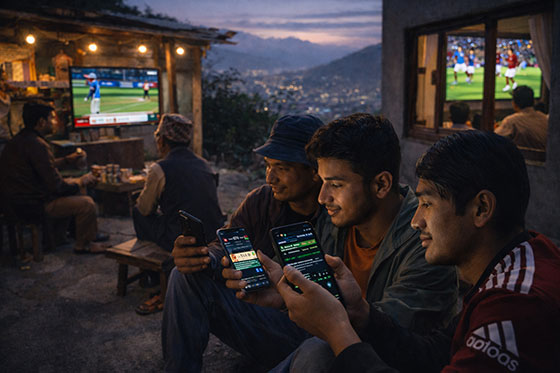
Nepal’s modern lifestyle in 2026 is not a clean break with older habits. It is a rearrangement of them. DataReportal’s latest Nepal profile puts the country at 29.6 million people, 16.6 million internet users, 14.8 million social media user identities, and 32.4 million mobile connections at the end of 2025, while 77.0 percent of the population still lives outside urban areas. That combination explains a lot: people still gather in tea shops, courtyards, grounds, and living rooms, but the phone now sits inside almost every one of those scenes, carrying score alerts, clips, messages, and one more layer of company as the crowd starts to thin out.
The workday leaks into the evening
The workday now runs later, even when the office does not. A bus ride home, a short stop for tea, or a break between errands has become part of the leisure window, because the same handset that handled calls and payments an hour earlier is already carrying video, chat, and sport. DataReportal’s numbers matter here not as a headline, but as a clue to tempo: with mobile connections exceeding the population and more than half the country already online, free time is increasingly made of short, repeatable checks rather than one fixed block after dinner. Crowds still matter. The difference is that the crowd now survives the walk home.
Kirtipur still gets the first call
Offline sport still has first claim on attention, and cricket remains the clearest example. On 7 April 2026, the ICC confirmed that Nepal would host Oman and the United Arab Emirates from 25 April, then the United States and Scotland from 12 May, all in League 2 matches at the Tribhuvan University International Cricket Ground in Kirtipur. That matters because Kirtipur is not just a venue; it is still a social engine, a place where families, friends, and casual followers gather before the conversation spills onto phones. One small observation from Nepal cricket culture keeps repeating: reaction now spikes not only at the finish, but at powerplays, bowling changes, and net-run-rate turns, because the scorecard has become part of the entertainment rather than a summary of it.
Team news now starts the match
Football follows a similar pattern, even when the match is being watched far from the ground. UEFA’s match page for Arsenal 3-0 Real Madrid on 8 April 2025 records a result that was discussed in Nepal long before full time, and the Premier League’s own app now pushes team lineups from 75 minutes before kickoff while Matchday Live covers every fixture. That timing has changed the rhythm of free time. One small observation is hard to miss on major nights: the loudest burst of chatter often comes when the XI drops, because fantasy picks, injury talk, and tactical guesses all arrive at once, before the first pass has even been played.
The spare hour got shorter
Entertainment has also become shorter, faster, and more willing to sit beside other activities rather than replace them. Netflix still treats mobile viewing as portable and interruptible, with Downloads for You automatically placing recommended shows and films on phones and tablets, and that logic aligns with a country where travel, signal quality, and shared living patterns still shape how long a session can last. The same digital habits help explain why online casinos fit into the modern leisure mix: the appeal often lies in a brief, controlled session between overs, halftime, or on the ride home, not in an all-night commitment that pushes everything else aside. Convenience wins more often than ceremony now, and that applies as much to entertainment as it does to work, shopping, or sport.
When the feed becomes the square
Community interaction is no longer limited to the event venue. Meta says Facebook Feed is ordered by AI systems that predict what each user is most likely to find valuable and relevant. When major platforms were shut down, activists shifted to still-available apps such as Viber and TikTok to rally thousands, and the ban was lifted overnight after deadly protests forced the government backward. The event was political, but the lesson was broader. One more small observation belongs here: once people are used to gathering around the same screen for sport, jokes, clips, and local news, the platform starts to function less like a tool and more like the square itself.
One download can carry the whole evening
The services that hold attention longest are usually the ones that survive interruption. MelBet’s own product material emphasizes cross-platform access across iOS, Android, web, and mobile web, along with more than 30K daily events and 9M+ downloads per month, which is why melbet download fits naturally into a lifestyle built on pauses, restarts, and second screens rather than long unbroken sessions. The point is not brand spectacle. It is continuity: a fan checking a line on the bus, reopening the same event after dinner, and returning before sleep expects the session to still be there, in the same state, without friction or explanation.
The crowd still matters most
For all the new software, the older pattern is still standing. People in Nepal still gather around matches, live events, local celebrations, and shared screens because the social part has not lost value; it has only gained a digital afterlife. The phone stayed. Modern free time now moves in two directions at once: toward convenience, speed, and private control on one side, and toward louder, shared, culturally familiar moments on the other. The strongest communities are the ones that can do both, meeting first in person and then refusing to end when the walk home begins.