
Berlinale 2026: ‘The Blood Countess’ Review
Stars: Isabelle Huppert, Birgit Minichmayr, Thomas Schubert, Lars Eidinger, André Jung, Marco Lorenzini, Karl Markovics, Felix Oitzinger, Tom Neuwirth | Written by Elfriede Jelinek, Ulrike Ottinger | Directed by Ulrike Ottinger
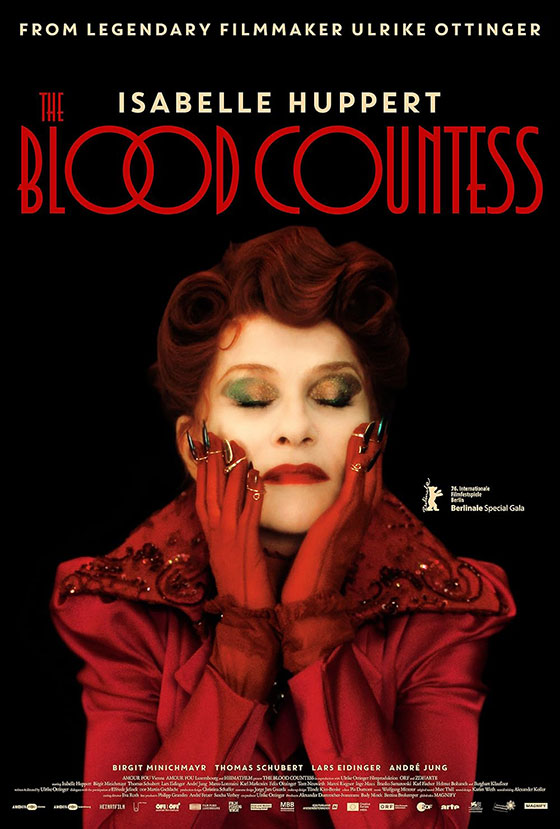
Isabelle Huppert stars as Countess Elizabeth Bathory in this ultra-stylish vampire comedy, co-written and directed by cult German filmmaker Ulrike Ottinger. Effectively, it’s something of a one-joke movie, but the joke is good enough to carry it through.
The Blood Countess begins with a jaw-dropping shot of Huppert, as Bathory, swathed in a long, flowing red gown, moving slowly through Vienna’s dark green underground cave system on a blood-red barge. That impressive shot ends with the comedy punchline of a tourist boat passing by, indicating that we’re actually in 21st-century Vienna.
Shortly afterwards, Bathory has a brief stop-off in a public toilet, where she bites the neck and drains the blood of a lovely young lady before heading to her old hotel and reuniting with her loyal, black-bobbed maid Hermione (Birgit Minichmayr), who is, of course, also a vampire. It transpires that the Countess has heard tell of a book that can turn vampires human if they shed tears onto its pages, so she recruits Hermione on a mission to destroy the sacred tome.
Along the way, the Countess and her servant receive help and hindrance from a variety of oddly-named characters, including: foppish, green-clad vegetarian vampire Baron Rudi Bubi von Strudl (Thomas Schubert), the Countess’ black sheep of the family nephew; his therapist Theobald Tandem (Lars Eidinger); ineffectual vampirologists Theobastus Bombastus (André Jung) and Nepomuk Afterbite (Marco Lorenzini); and a pair of not-so-bright cops, Chief Inspector Unbelief (Karl Markovics) and his assistant, Guido Doppler (Felix Oitzinger).
Those admittedly not very funny character names are indicative of the general level of humour in the film, which basically involves a lot of mugging and trying too hard with very little result. There are, in fairness, a couple of good gags and a handful of nice touches (such as Bathory’s bat), but they are largely few and far between.
That’s not to say there aren’t multiple other pleasures to be had in The Blood Countess, however. Chief amongst them is Huppert’s performance, which is deliciously camp. Even more amusingly, because she delivers the majority of her lines in French – barring the occasional Hungarian exclamation like “Fantasztikus!” – it often feels like she’s just playing herself and having a lovely time.
Similarly, the production design and costumes – by Christina Schaffer and Katarina Forcher, respectively – are to die for, since they are outrageously, fabulously over the top in every detail. Indeed, if the film winds up with a cult following, it will likely be as much to do with the visual aesthetic as with anything else.
Perhaps the biggest frustration with The Blood Countess is that there are so many missed opportunities. The Vampire Ball, for example, which is one of the film’s key set-pieces, could have used a lot more imagination in its conception, although it is a giggle-inducing treat to hear Huppert’s Bathory announced as “a woman untouched by virtue”.
In short, though The Blood Countess fails to properly satisfy as a comedy, it does at least deliver plenty of campy fun, from the jaw-dropping visuals to an utterly random cameo for a musical number. A cult movie in the making.
*** 3/5
The Blood Countess screened at this year’s Berlinale International Film Festival.