
Romford Film Festival 2025: ‘The Transgressive Legacy of Clasificada S’ Review
Featuring: Iggy Pop, Gaspar Noé, Álex de la Iglesia | Directed by Alberto Sedano
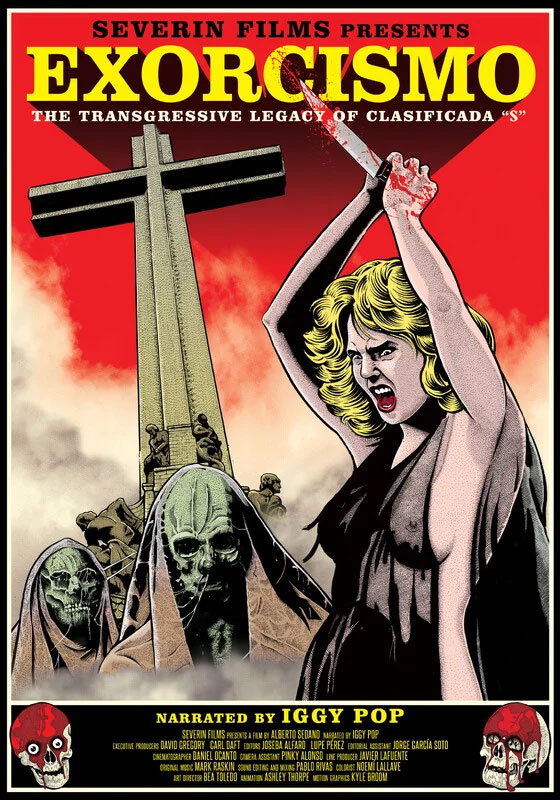
Exorcismo: The Transgressive Legacy of Clasificada S is a striking and illuminating documentary that delves deep into one of the most controversial and overlooked chapters of Spanish cinema history, the rise and fall of the “Clasificada S” film industry. Directed with both academic rigour and stylistic flair, the film acts as both a cultural autopsy and a celebration of a chaotic yet formative period in Spanish film, where sex, violence, and exploitation were both a mirror and a reaction to the nation’s shifting socio-political landscape.
The documentary explores the boom of “Clasificada S” cinema – so named for the adult-only rating these films received – in the 1970s and early 1980s, a time filled with societal and economic changes and new-found freedom following the end of Nationalist rule. These movies, often dismissed as trash or pornography, were actually part of a more complex phenomenon. They represented rebellion, survival, and in some cases, innovation. Exorcismo does an excellent job of peeling back the layers of stigma to examine what these films really were: sometimes exploitative, yes, but also daring, political, and strangely poetic.
Interviews with scholars, former actors, and directors are used to great effect, offering a diverse range of perspectives on the era. What emerges is not a monolithic portrait of exploitation cinema, but a complex ecosystem of cultural production. Directors like Eloy de la Iglesia, León Klimovsky, José Ramón Larraz, Ignacio Iquino and the legend that is Jess Franco are remembered not just for their sometimes risqué content but for the boundary-pushing risks they took in a conservative climate. The documentary captures this spirit with archival footage and behind-the-scenes stories that are as shocking as they are revealing.
One of the most compelling aspects of Exorcismo is how it connects the visual and thematic elements of “Clasificada S” films to Spain’s broader societal changes in the post-Franco era. These films didn’t emerge in a vacuum, they were born from a society increasingly disillusioned with the repressive institutions put in place by Franco (coupled with extreme violence and oppression) in the previous years. The documentary also raises important questions about censorship, hypocrisy, and the role of film as both escapism and critique. Stylistically, Exorcismo is dynamic. The editing is sharp, the soundtrack is an eclectic mix that evokes the era, and the narration, by Iggy Pop, walks the fine line between critique and empathy. The result is a film that doesn’t mock or moralise, but rather seeks to understand.
In sum, Exorcismo: The Transgressive Legacy of Clasificada S is essential viewing for cinephiles, scholars, and anyone interested in how marginal art forms reflect a nation’s anxieties and desires. It’s provocative, informative, and ultimately redemptive – a long-overdue reexamination of a dirty, dazzling, and oftentimes forgotten slice of Spanish film history.
**** 4/5
Exorcismo: The Transgressive Legacy of Clasificada S screened as part of this year’s Romford Film Festival.