From Ring Legend to Screen Struggle: Queen of the Ring Divides Audiences & Critics
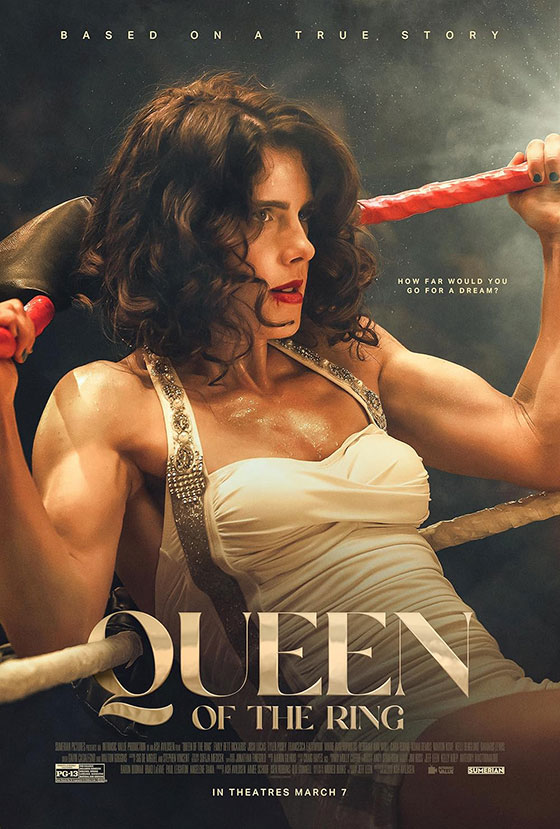
With critics divided and box office numbers falling short, Queen of the Ring steps into the wrestling film arena with heavy expectations.
Released March 7th, Queen of the Ring tells the true story of Mildred Burke, a pioneering figure in women’s professional wrestling whose dominance in the ring paved the way for generations to come. Played by Emily Bett Rickards, it’s a story about one of the most iconic female wrestlers in the United States at a time when professional wrestling for women was illegal in the US.
Burke is regarded as one of the toughest and most influential competitors ever to step into the ring. Her relentless drive, physical grit, and unshakable charisma ultimately earned her a place in the WWE Hall of Fame, cementing her status as a true icon of the sport. She didn’t just wrestle—she fought her way into the history books, defying both societal expectations and industry politics to become a legend in her own right.
Directed by Ash Avildsen, son of Rocky’s legendary director John G. Avildsen, the film promised an emotionally driven, underdog sports drama that would do justice to Burke’s little-known but extraordinary life.
But while this Mildred Burke movie is packed with cinematic potential, its reception has proven more divisive—raising the question of whether Queen of the Ring lives up to the extraordinary legacy of the woman at its centre.
A powerful story with flawed execution
From the outset, Queen of the Ring seemed destined to provoke debate. ScreenRant gave the film a respectable 7/10, applauding its attention to historical detail and strong lead performance, calling it a “…must-see biopic that’s perfect for those who want to learn about women’s wrestling history.” The IMDb score has echoed that sentiment, currently sitting at a 7.0/10, indicating a solid, if not stellar, audience response.
But other Queen of the Ring reviews haven’t been so kind. Variety criticised the film’s “muddled storytelling” and classed the new release as “…a montage of the highlights of Burke’s illustrious life, rather than an entertaining film.” Paste Magazine’s review backed this up by saying that “Burke’s life could make for a genuinely great movie, but this isn’t it.”
Box office struggle & AEW controversy
Despite telling a story steeped in wrestling history and empowerment, the Queen of the Ring film failed to make a splash at the box office. The new wrestling movie brought in under $400,000 during its opening weekend—a disappointing figure for its release.
It didn’t help that the film opened against much stiffer competition. Other new releases like Mickey 17, Novocaine, and Black Bag performed significantly better, drawing broader audiences with bigger marketing pushes and more mainstream appeal. In comparison, Queen of the Ring struggled to break through despite its unique subject matter and real-world wrestling connections.
According to Slam Wrestling, the film also generated controversy backstage at AEW’s Revolution. Damaris Lewis, starring as Babs Wingo, shared what she learned about pro wrestling while shooting: “One thing I learned about pro wrestlers, you all know you’re going to win before anybody else does. So thank you for teaching me that.”
Backstage reports suggested that many AEW stars were unhappy with her comments, exposing the business in such a way right before the AEW World Championship main event between Jon Moxley and Cope.
How Queen of the Ring measures up against genre giants
Ash Avildsen’s name brings with it no small weight of expectation. As the son of John G. Avildsen, the Oscar-winning director behind Rocky, Ash steps into a legacy built on powerful underdog stories and genre-defining sports films. Naturally, that connection raised hopes that Queen of the Ring would carry similar emotional resonance — a gritty, triumphant portrait of a forgotten legend. But while the intentions are heartfelt, the Queen of the Ring film struggles to rise to that pedigree.
That’s particularly noticeable when you stack Queen of the Ring against other standout wrestling films of recent years.
One of the most beloved is 2019’s Fighting with My Family, the story of Paige as she strives to achieve her dream of joining WWE. Praised for its humour and heartwarming moments, the film boasts a 93% score on Rotten Tomatoes and a 7.0/10 rating on IMDb — matching Queen of the Ring on IMDb but outperforming it in critical consensus. It’s considered one of the best sports movies of the last decade, striking a balance between entertainment and heart.
Other films in the genre have gone even further and have broken into Oscar territory:
- The Wrestler (2008), starring Mickey Rourke, earned two Academy Award nominations and remains a high watermark for wrestling cinema. With a 7.9/10 IMDb rating, it offered an unflinching, raw portrayal of life after the spotlight.
- Foxcatcher (2014), based on the true story of Olympic wrestling champions and brothers Mark Schultz and Dave Schultz and the eccentric billionaire John du Pont, was even more decorated — earning five Oscar nominations. Though more psychological than inspirational drama, it’s still a benchmark, holding a 7.0 IMDb rating and a place in serious film discussions.
- More recently, The Iron Claw (2023) was a new wrestling movie which gave audiences the tragic true story of the Von Erich brothers. Acclaimed for its performances and emotional impact, it earned a 7.6/10 on IMDb and an 89% Rotten Tomatoes score, solidifying its place as one of the genre’s best-reviewed entries.
In comparison, Queen of the Ring sits at a 7.0/10 on IMDb and a more modest 74% on Rotten Tomatoes. While respectable, those numbers suggest a film that hasn’t quite captured hearts or headlines the way its peers have. It lands closer to average than exceptional — not a failure by any means, but not the breakout story its subject or its lineage might have deserved.
The right legacy, the wrong execution
There’s no question Mildred Burke deserves to be known. Her legacy, both in terms of wrestling and gender equality, is monumental. And Queen of the Ring deserves credit for bringing her back into the spotlight. But the film itself seems caught in its own identity crisis—too subdued to thrill, too conventional to inspire.
Whether it was the challenge of balancing wrestling realism with cinematic storytelling or simply a misfire in execution, the result is a film that lands a few emotional blows but never quite goes the distance.