
‘Art Society’ Board Game Review

In the rather beautiful-looking Art Society, players compete for the most prestigious art collection as they bid in a dynamic auction system that keeps everyone interested in each and every round. From complete novice designer Mitch Wallace and publisher Mighty Boards, Art Society is an impressive debut. The systems are simple to teach and to learn, yet Art Society also includes features that take it beyond a simple gateway game. There are aspects of luck and variability, but there are many ways to mitigate these and for experienced players to control the flow of the game.
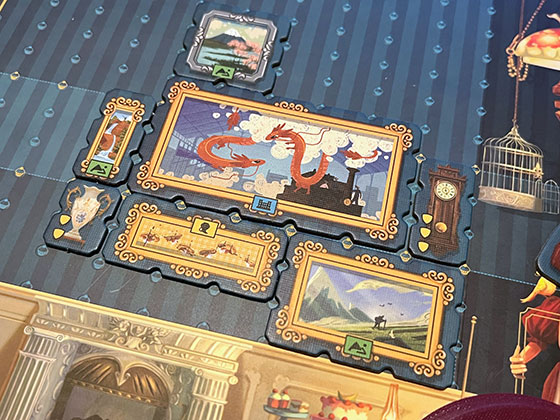
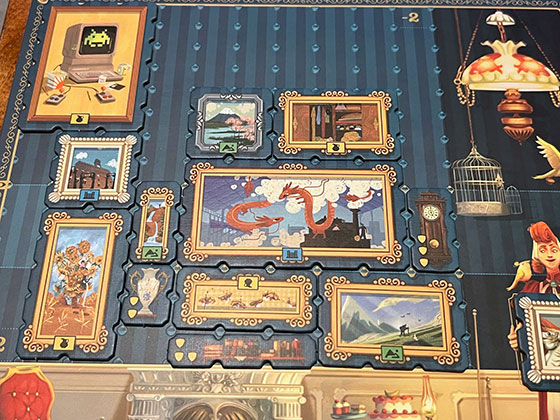
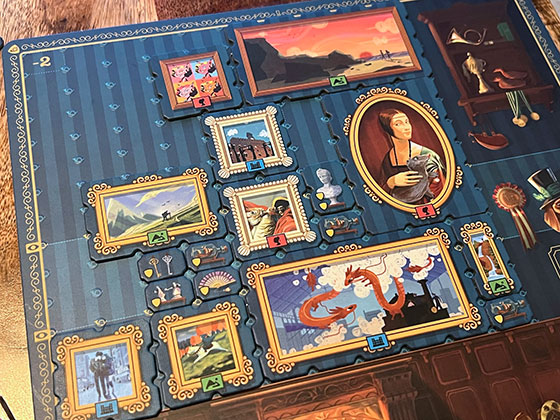
Each player takes a board that represents their own display wall. A great design choice here adds little textured bumps to these boards so that when art is placed on it, it isn’t really “stuck in place” as such, but it does hold in place a bit better than if the boards were simply flat. This is important, because in more games than not, most players will completely fill their boards (or very nearly so at least.) Given this means about twenty or more individual pieces will be on the board, any knock could upset the whole thing – the textured board design does just enough to prevent light knocks from being a problem.
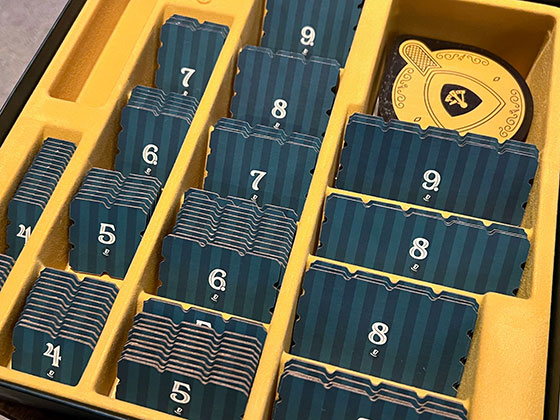
On a turn, the first player (who holds a little cardboard gavel) will choose which artworks go under the hammer. In another clever design choice, the box doubles as a dispenser for artworks – with numbered art of various different sizes presented to the players in facedown stacks. The auction for each round will consist of one artwork for every player plus one extra – and these are drawn blindly from the stacks. Each artwork has both an art style and a frame, and these will score in different ways depending on where you place them.
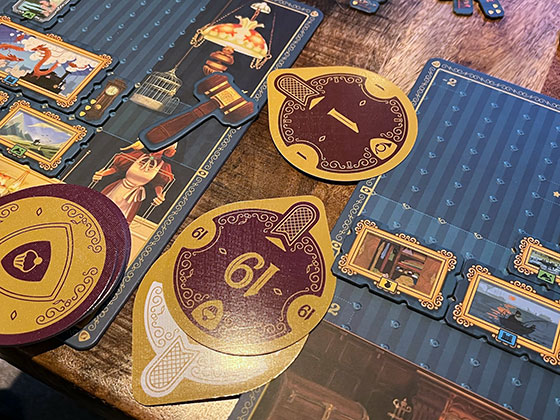
With the artworks now on the table and face up, each player chooses what bid they wish to place. Everyone begins with bid values from one to twenty, but a bid value can only be used once – meaning that if you simply “must” win an auction, then you’ll need to pick your highest number, but bear in mind that if you don’t use your twenty and someone else does, you may still go second or lower. When two bids match, the player to act first will be the one who bid higher in the prior auction, and one thing you need to know about Art Society is that it is all about the auction and deciding when to commit (or not).
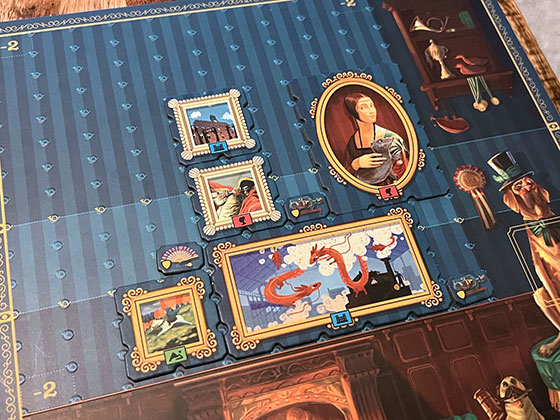
In bid order, players will now take the artwork of their choice and in most cases, will play it directly onto their board. There is an option to place one painting at a time into the hands of the assistant to be placed later, but that tends to come later in the game and will only happen one or two times per player. A painting must be placed orthogonally adjacent to another painting, and with its “label” edge in the correct orientation. If the frame of the painting matches one or more frames of the same kind, then the player can take ornamental tiles up to the value of the number of frames matched. Ornaments don’t score, but they do create space between paintings which matters because a painting cannot be placed next to a painting of the matching type or else a “faux pas” will occur
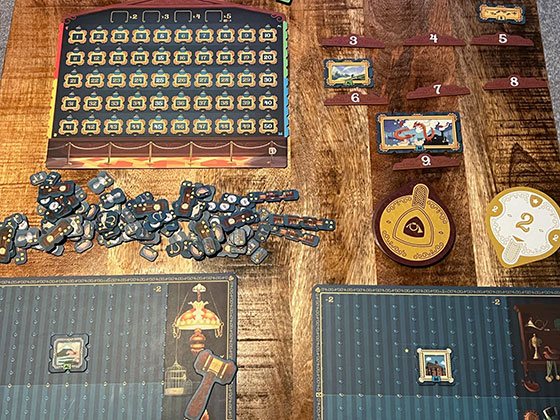
When all players have chosen and placed their paintings, the final painting will be discarded to a specific space beside the scoreboard. The value of this painting will then increase the prestige associated with other paintings of the same type. So for example, if you have five red paintings and the current value of red paintings is low, then when you come to bid, you’ll be slightly torn between taking another red painting (to score a lot of the multiplier increases) and actually leaving the red painting to try and push up the overall prestige of red paintings to increase that multiplier. This is one of the best things about Art Society, and leads to some very crunchy choices.
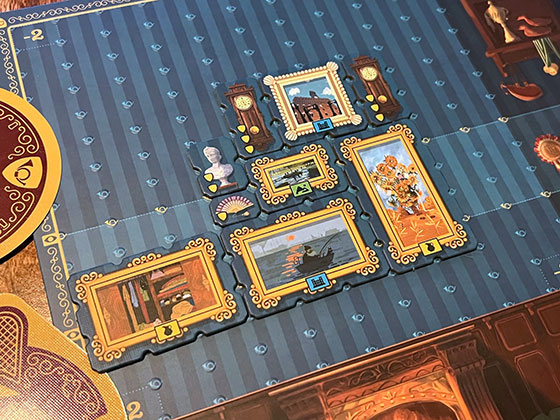
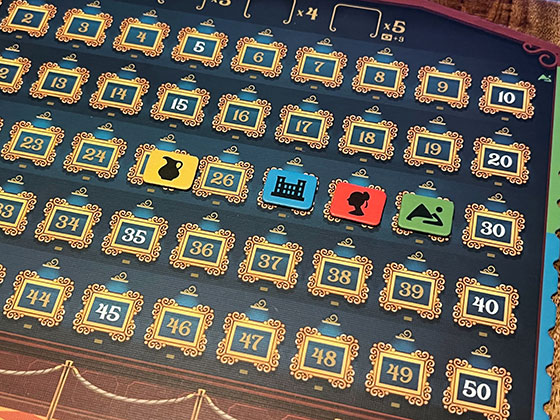
In addition to the actual multiplier scoring (which is the main focus) there are also bonus points for placing paintings in the viewers “eyeline” which is a printed space across the centre of the board. Additionally, each corner not covered will result in negative points, as will faux pas and paintings that ultimately you have to take but cannot place. Whilst this is a lot to think about for new players, all these aspects become increasingly interesting as you learn the game, figure out the “feel” of how much total space you need to cover and generally gain experience.
The gameplay in Art Society is absolutely fantastic. Bidding is quick and simple, with everyone getting a choice of at least two paintings and having a role in that decision between choosing a painting and adjusting the prestige. Even the last bidder makes this choice – if anything having the most influence over it on some occasions – because the difference between bumping the prestige for say red or blue can have a massive impact. Bidding is quick too, with just one offer made per player, and the resolution happening at a glance.
Placement also leads to interesting decisions. There’s the need to consider grabbing multiple paintings of a certain colour, but that also means you need to find the right time to push up the multiplier – and you need to avoid faux pas. Matching frames add another interesting and welcome distraction, tasking players with matching frames whilst doing the exact opposite with painting colour/type. Adding small ornaments in key locations is very often the difference between making a faux pas and not, and the importance of these little elements cannot be overstated.
Art Society is the rare kind of game that balances entry-level rules and accessibility with real long-term potential. It is simple to teach and learn, but tough to master, and it feels as though every turn is engaging, exciting and rewarding. Games last about an hour or so with experienced players, and so Art Society never really outstays its welcome. Over analysers can occasionally get stuck in the decision space when valuing a tile or deciding which one to let go for prestige valuation, but to be honest the worst this gets is to make a turn last a minute or two among other turns that take maybe 30 seconds. I really do think that Art Society has something for everyone, as long as you enjoy games on the lighter side of medium weight.