‘Marvel Champions: The Card Game’ Updated Review
Fans of Fantasy Flight Games will be extremely familiar with the concept of the Living Card Game, an idea that takes the deckbuilding and customisation aspects of a Trading Card Game, but rather than selling products to customers in random boosters or similar, Living Card Games are sold in preset packs or bundles, each of which contains a specific list of cards. Marvel Champions: The Card Game is now one of the most well-established Living Card Games out there, and for some, it is without doubt the most exciting.
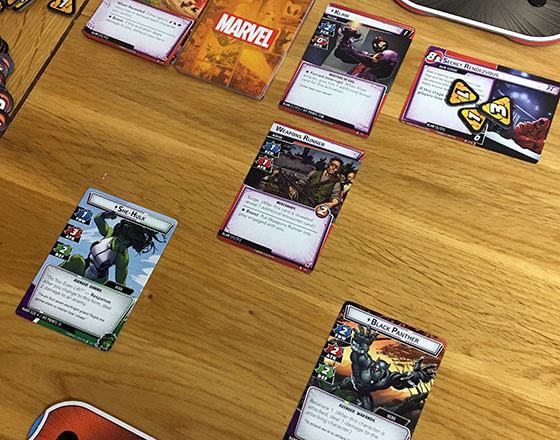
The base game includes five hero decks and three villains, allowing from one to four players to tackle each villain with a wide variety of different configurations. Each villain has their own scheme and can be played in either an easier or a harder mode depending on the experience level of the players. Whilst the set contains a completely prebuilt deck for each of Spider-man and Captain Marvel, as well as one for the basic setup for Rhino, you’ll have to build the Iron Man, She-Hulk and Black Panther decks yourself, as well as the Klaw or Ultron villain decks.
One slight issue with the base set is that there aren’t enough cards in it to actually meet the requirements of all five of the basic hero decks that the game suggests. This is because each hero deck is made up of fifteen cards that are specific to that hero, plus at least one set of specific cards from a named group, such as Aggression or Justice. She-Hulk and Iron Man both require the Aggression cards, and if you wish to play with them side by side, you’ll need to substitute that set of cards for one of those not in play. Since the core box was released, there have now been many expansions that increase the number of cards in these basic decks, and deckbuilding is fundamental to the Marvel Champions: The Card Game experience.
The five heroes in the base set are pleasingly diverse and it’s nice to see a character like She-Hulk (who is quite often absent from games like this) take a starring role. If you cast your mind back to my review of Marvel: Legendary (which is a completely different system from a different publisher) you’ll recall that I wasn’t overly impressed with the villains on offer. The same is true for Marvel Champions: The Card Game, and again, but thankfully various scenario packs and large expansions (some of which I’ll discuss below) are already available.

With deckbuilding and game setup (which can be fiddly the first few times you do it) done, gameplay can begin. The players will always control one or more heroes each, with the villain driven by the chosen scheme deck and a basic set of rules that will always be followed. Whilst learning the game is a little clunky, it won’t be long before players understand the basic flow and can rattle through turns quickly. Most of the actual gameplay is similar to that of other complex card games like Magic: The Gathering or one of the other Fantasy Flight LCG’s, should you have played them.
On their turn, a player will assess their hand of cards (which is determined by the hand limit of their hero or alter-ego) and decide what to do. They can switch form from the hero side of their character card to the alter-ego (or vice versa) once, and if applicable, they can use an action on either side by exhausting the card (by turning it sideways.) Broadly speaking, the hero side may have a special ability and can usually attack the villain, or thwart their plans by taking scheme tokens off it. The alter ego side can usually only heal or use a printed action, but on the plus side, the villain will never attack an alter-ego.
In addition to flipping their card and/or using an ability, thwart or attack, a player can also play any number of cards from their hand, as long as they can afford them. To purchase a card, the player will assess its cost and then discard cards that generate sufficient resources of the correct kind, as shown on their bottom left hand corner. Some cards also specifically produce energy when played, and can therefore also contribute to this spend. Some cards can be played as the result of any kind of resources being spent, whilst others need a specific resource – like Strength or Science.
Once the players have all had their turns, the villain will act. Firstly, they will scheme – usually involving the placement of a number of threat tokens onto their current scheme card. The number of tokens placed will be affected by how many heroes are playing, and usually if a scheme card reaches its threat limit, it will advance the game in a bad way for the heroes. As with any complex card game like this, some villains scheme in different ways – so one of the things you’ll need to understand during setup is what makes the heroes and villains in play “different” from others, and how they affect the basic rules in turn.
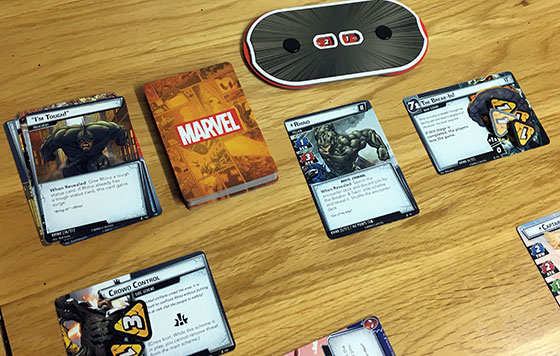
As you might expect, if the villains scheme succeeds – the players will lose. More often then not though, then once scheming is done, a card will be drawn from the villain deck, and it may be a minion, an attack or something else like a side plot that has to be defeated before the heroes can once again focus on the villain and their plan. One really nice feature of each hero deck is that every hero has both a nemesis villain and a personal obligation that may or may not appear. The personal obligation item is shuffled into the villain deck and might be drawn, whilst certain cards in each villain deck could trigger a nemesis encounter, introducing new cards.
I particularly enjoy the way that the different combinations of heroes, villains, schemes and villain decks come together to create different outcomes (which to be fair is exactly what I liked about Marvel: Legendary as well.) Whilst the possibility of a personal obligation or a nemesis is always present, you never know if it will turn up or who it will affect. Similarly, the villain decks themselves are filled with fun distractions and interesting surprises that twist the gameplay in interesting directions. Many main villains also have minions in their decks, which can include some fun cameos from various comic book series.
Each hero also plays in a very unique way. Iron Man, for example, is fairly weak at the beginning of the game, but a lot of his specific cards represent him building and improving his suit, adding permanent upgrades that make him more and more powerful when played. She-Hulk on the other hand has a very interesting mixture of cards that slow the villains progress and deal damage, making her feel very authentic. Spider-man is relatively poor on direct damage (except his now infamous Swinging Web Kick card), but he has a lot of healing skills that help allies, and abilities that slow the villain and/or place effects on them. Captain Marvel is an absolute sledgehammer, and Black Panther is also very powerful on offence.
As is so often the case in FFG products these days, the rules are presented in two ways – firstly in a Quick Start Guide, which aims to get players into their first game as fast as possible, and then via a Rules Reference which is an aide for more advanced play. I really like this was of teaching a complex game like Marvel Champions, since such games require a fair bit of organic growth for players to become fully proficient at them, and practice makes perfect. It’s also nice to see such a straightforward description of the deckbuilding elements as the one in the back of the Quick Start Guide – this will be a great help to players who are new to this kind of game.


The actual component quality on offer here is good, and the box (very rarely for an FFG product) comes with a plastic insert that can be used to organise sleeved cards into decks. Of course, there are no sleeves included so if you don’t intend to sleeve your cards, this storage solution won’t help you. The quality of the artwork is good, with most cards featuring some of the classic artwork from the Marvel comics and a lot of evocative imagery.
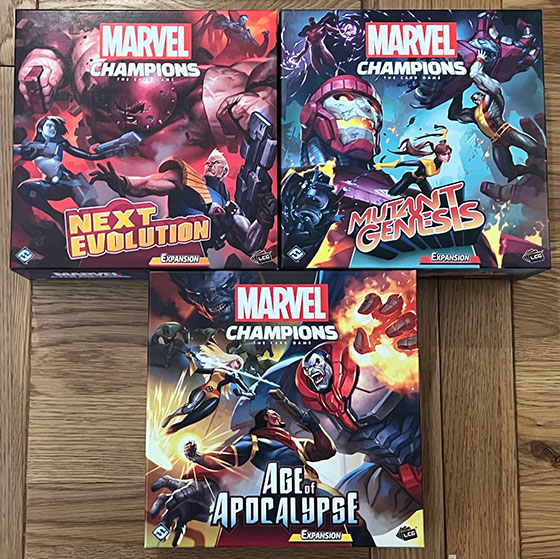
High quality artwork continues to be a theme that has expanded into the various additional hero and scenario packs, as well as the major expansions. Having first played Marvel Champions back in 2019, I have recently been able to dive into three large expansions that focus on the X-Men side of the Marvel comics.
First up is 2022’s Marvel Champions: The Card Game – Mutant Genesis
In the first of the X-Men trilogy of expansions, Colossus and Shadowcat take centre stage from the hero perspective. Colossus – as you would expect – hits hard and defends himself well, with many ways to make himself “tough” and to stay in the fight. Shadowcat offers a relatively complex deck that needs lots of management between her phased and solid form in addition to her superhero and alter-ego modes. There’s a lot of power and fun to be had with Shadowcat, but she’s not a character that I would recommend for new players.
In terms of enemies, Sabretooth is perhaps my favourite here, given I have always loved the rivalry between him and Wolverine throughout the X-Men comic series. Here, he takes the role of a hugely powerful and aggressive enemy that will rapidly punish heroes that don’t build up a strong defense and tackle his scheme quickly. The Sentinels also feature, as do Master Mold and Magneto. Scenarios like Project Wideawake and Mansion Attack make for some fun situations, but Sabretooth and Magneto are the standout encounters in Mutant Genesis for me.
Next, we have Marvel Champions: The Card Game – Next Evolution
With Domino and Cable in the box, we have a fairly obvious but super exciting continuation of the X-Men expansions. Cable introduces a new mechanic where he brings his own side schemes that can be thwarted in order to provide buffs and enhancements for all players. This is in keeping with his general role as a support hero, and one that works really well in multiplayer games. Domino feels very different – with mechanics based on her superpower of being lucky. A lot of dominoes effects involve drawing cards and looking for wild card symbols that will enable her attacks to become more powerful, or to trigger other features.
There are also five villains in Next Evolution, including the likes of Mister Sinister (who brings a load of mod sets that make him stronger during the game), as well as Juggernaut and the Marauders. There’s also an interesting scenario called the Morloch Siege, which actually delivers mechanics that will bring in different villains from this or other sets to round out the story. Juggernaut is a great adversary, with a huge amount of toughness early on until you can remove his helmet – after which he is vulnerable until he returns in second or third form. Stryfe is also present here, and presents one of the toughest threats I’ve seen thanks to progression of the scheme (somewhat countered by some of Cable’s abilities).
Finally, it’s Marvel Champions: The Card Game – Age of Apocalypse
With the addition of Bishop and Magik, we have two really cool heroes in this box. Magik is without doubt my favourite given that she has the much-coveted “Mystic” keyword, which allows her to leverage a load of cards that first appeared in association with Doctor Strange, and allow her powerful abilities such as being able to draw extra cards and sort through her deck. Whilst not quite as powerful, I also really enjoy playing with Bishop. He converts damage directly into resources (assuming you have them in your deck) and he has lots of ways to do extra things with resources – by powering his rifle or some of his other cards for example.
In terms of enemies, Age of Apocalypse features probably my favourite villains in any large expansion to date. Unus and En Sabah Nur are both great fun and bring lots of different options for dealing with your heroes – meaning that traditional deckbuilding approaches are severely tested. The Four Horsemen are just amazing though, with multiple (four) villains and each of them doing different things to the player and their allies. That might actually be enough, but Age of Apocalypse also has Dark Beast and Apocalypse in there as well – and Dark Beast brings a whole mechanism for changing the setting of the fight that I just love. Apocalypse (as the big bad here) is a tough fight with a great scheme and even a “new” set of Standard cards that are added to the villain deck. All in all, these guys add tons of variety and a challenge for any hero you might build.
Even though it’s almost five years old, I’m still excited about what Marvel Champions: The Card Game has to offer. The base game has a generous amount of content even if the villains are a bit second-rate, but the expansions rapidly ramp up the excitement. I expect support to continue over the next few years, and Marvel Champions could easily become a staple game for many groups, especially if cooperative play is your thing. Remember that there is no competitive mode, so if that’s a problem for you, it might be wise to try the game before you buy.
If you’re interested, you can check out our original review of Marvel Champions: The Card Game right here.
______