‘Papaya: Love Goddess of the Cannibals’ Blu-ray Review
Stars: Sirpa Lane, Melissa Chimenti, Maurice Poli, Nat Bush, Dakar, Maria Grazia Smaldone | Written by Roberto Gandus, Renzo Maietto | Directed by Joe D’Amato
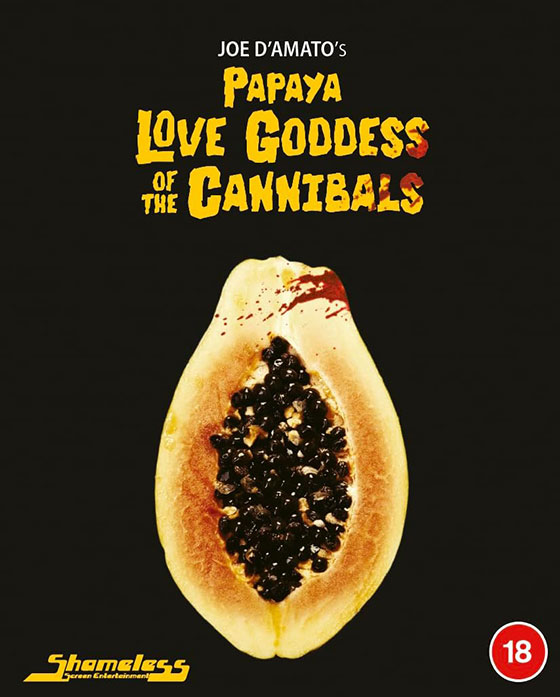
Joe D’Amato’s Papaya: Love Goddess of the Cannibals is a fascinating, if uneven, entry in both the director’s filmography and the broader canon of 1970s Italian exploitation cinema. Released in 1978, the film is emblematic of D’Amato’s fascination with the intersection of eroticism, violence, and the exotic—elements that dominated much of his work during this period. It serves as a prime example of the blend of exploitation genres that thrived in Italy’s B-movie industry, particularly the fusion of horror, sexploitation, and tropical adventure.
The film follows Sara, a journalist investigating a mysterious island where a foreign corporation plans to construct a nuclear power plant, disrupting the indigenous population. The central character of Papaya, a native femme fatale, seduces and kills white outsiders, invoking the tropes of both cannibal and erotic cinema. Much of the film’s narrative is thin, designed mainly as a vehicle for erotic set pieces, with Papaya using her sexual allure as a deadly weapon—a recurrent theme in D’Amato’s work.
What stands out about Papaya: Love Goddess of the Cannibals is its blend of eroticism and horror, a hallmark of D’Amato’s oeuvre. D’Amato had a gift for creating lurid, atmospheric visuals, and here he combines lush tropical scenery with unsettling violence. His direction is more interested in capturing sensuality and primal urges than in creating a coherent plot. The result is a hazy, dreamlike film that oscillates between softcore pornography and body horror, with gore scenes that are more suggestive than explicit, especially in comparison to the notorious cannibal subgenre that Italian cinema was embracing at the time (e.g., Cannibal Holocaust and Cannibal Ferox).
In terms of D’Amato’s larger body of work, Papaya: Love Goddess of the Cannibals is a precursor to his later horror-erotica films such as Anthropophagous (1980) and Erotic Nights of the Living Dead (1980), where he would further push the boundaries of on-screen violence and sexual content. D’Amato often explored taboos and primal instincts, and while this is not his most extreme film, it lays the groundwork for his further exploitation of these themes. His films rarely offered in-depth character development or moral complexity; instead, they thrived on visceral impact—something Papaya: Love Goddess of the Cannibals delivers, albeit in a subdued form compared to his later works.
What also places the film firmly within the tradition of Italian exploitation cinema is its use of exoticism and its portrayal of indigenous peoples. Like many films in the genre, it trades in stereotypes, positioning the island natives as both sensual and savage, a reflection of the era’s broader fascination with “otherness” as a source of fear and desire. This kind of problematic portrayal was common in Italian B-films, where exotic settings and non-Western cultures were often used to create a backdrop for erotic adventure or horror, reinforcing colonialist and sexist perspectives.
As a work of exploitative filmmaking, Papaya: Love Goddess of the Cannibals is less concerned with coherent political or social commentary than with appealing to base desires—sex, danger, and death. The environmental conflict over the nuclear power plant is touched upon but serves mainly as a pretext for the seduction and cannibalism plot, much like the superficial themes of anti-imperialism and rebellion in other films of the era.
In conclusion, Papaya: Love Goddess of the Cannibals fits comfortably within Joe D’Amato’s filmography as a melding of eroticism and horror, themes he would continue to explore in increasingly extreme ways. While not one of his most memorable films, it offers a snapshot of Italian exploitation cinema in the late 1970s—a moment when the boundaries between sex, violence, and taboo were constantly being tested. D’Amato’s visual flair, combined with the film’s lurid appeal, secures Papaya: Love Goddess of the Cannibals a place within the broader pantheon of Eurocult cinema, even if it falls short of the director’s more infamous works.
Special Features:
- Numbered Limited Edition with O-card with New Exclusively commissioned artworks + Original art.
- Alternative Italian opening credits + English opening credits
- ‘Love Goddess of the Cannibals’ & Alternative Trailers
- Legacy Shameless Trailer
Papaya: Love Goddess of the Cannibals is out now on Blu-ray from Shameless Films.