‘Final Frequency’ Review
Stars: Charles Shaughnessy, Lou Ferrigno Jr., Richard Burgi, Kirby Bliss Blanton, Luke Guldan, Nikki SooHoo, Abhay Walia, Josh Murray | Written by Penny Gibben, Christine Fry | Directed by Rachel Lowry, Tim Lowry
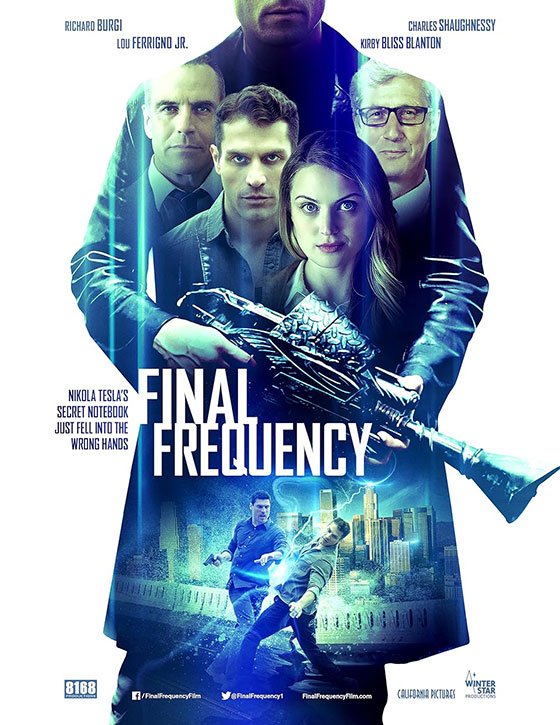
What if Nikola Tesla’s secret notebook fell into the wrong hands? This is the question that father/daughter directorial team, Tim and Rachel Lowry explore.
At the time of his death in 1943, the US government seized Nikola Tesla’s research in the hopes of turning the tide of war against the Nazis. While the majority of his work was apprehended, most of it was lost until it came into the possession of Final Frequency’s Dr Stuart Conrad (Charles Shaughnessy). Among other things, Telsa’s research contained knowledge regarding resonance frequency manipulation which, if in the wrong hands, could spell disaster for humanity. On the hunt for it, is a shadowy cabal of rogue scientists led by Dr Cyrus Slanton (Richard Burgi) who want Telsa’s research to execute their master plan: to rid humanity of weakness (particularly, any world leaders who do not share the cabal’s values) and build the world anew.
On paper, Final Frequency wants to tell an engaging story that focuses on societal issues such as climate change, political corruption, and cultural elitism. Thematically, therefore, Final Frequency asks: “are all humans of equal value or are some more valuable than others?” However, what we received, fell massively short of that, especially around the latter half of the second act onwards. It’s not hard to see how we got there either: the script is bad.
Dr Slanton’s master plan is to cause an earthquake in downtown L.A. during a G20 World Leader’s Summit and, along the way, use mind control technology against various US delegates but this is never developed upon.
The first act introduces protagonist, Esther Dahlset (Kirby Bliss Blanton), a PhD student and Dr Conrad’s protégé who discovers unusual seismic activity that could potentially level downtown L.A. But, despite the urgency and stakes, the characters don’t seem to care about this impending danger. Esther, although determined to share her discovery with Dr Conrad, chooses not to interrupt his lecture so he may ‘exposition dump’ and share his love for Nikola Tesla with his students.
The plot then progresses following Dr Conrad’s disappearance which Esther discovers when dropping unannounced at both his home and office to find they have been ransacked. Esther then gets her hand on Dr Conrad’s top-secret research (which his captors failed to take) and buried within it is a mysterious QR code that, when accessed, reveals Dr Conrad’s recorded message explaining the circumstances of his disappearance. He has been kidnapped by the cabal (which also means that he must’ve recorded this message before being taken). Glossing over that, Esther recruits a team of misfits comprised of her deaf army veteran brother, Paul Dahlset (Luke Guldan), campus security guard Frank (Lou Ferrigno, Jr.), IT specialist and Live-Action Role-Player (LARPer) Rocky (Nikki SooHoo), and… George, (Abhay Walia) who is also there. On occasion, the team is helped out by FBI agent Colin Ward (Josh Murray) but not all is as it seems.
What follows is a severe case of second-act syndrome as our heroes then lurch from one situation to the next in an effort to pad out the run-time because none of what they actually do has any impact on the overall plot. During this, suspenseful moments are built up but never followed through. For example, Esther has found Tesla’s notebook but falls victim to a mind-control attempt by some shadowy figure. However, coincidence gets her out of trouble when the sonic device inexplicably malfunctions. Even so, the bad guys know where Tesla’s book is being kept, they don’t even bother to retrieve it. Despite being told numerous times that Dr Slanton needs this book in order to carry out his dastardly plans. Now, because of how the script unfolded, this plot point was completely abandoned and so Dr Slanton executes his plan without it leading to an incredibly unfulfilling third act.
Watching Final Frequency, it was clear that the cast and crew started out with the best intentions but at some point, during production, had given up. There is some notable talent on the roster, and it is a wonder why they agreed to be a part of this project in the first place because the acting was stilted and they genuinely looked like they wanted to be anywhere else. One can’t necessarily blame the actors when working with clunky dialogue and a bad script, but hardly any effort went into creating any form of emotionality during the 90-minute runtime. It became clear that the production of this movie gave up on delivering the abovementioned storyline and embraced the absurdity of what this production turned out to be.
So much so that there is a point toward the end of the film where Dr Slanton having shot Paul, albeit not fatally, goes on a tirade about how he will weed the weak enabling Paul to deliver his tough-guy line: “weed this” before killing Dr Slanton. Absurd? Absolutely. Funny? Not intentionally, but we laugh, and can even forgive the cheesiness but what we can’t forgive is what directly after this because, throughout the movie, we have been reminded serval times that Paul is deaf but, with all seriousness, says after killing Dr Slanton: “I couldn’t listen to that blow hard another second”.
What?!
This isn’t the first time Paul’s unique characteristics have been totally disregarded. For example, when we first meet Paul, Esther signs at him to show he’s deaf but he quickly reminds her that he can read lips. This could have been such an interesting angle to drive the plot and develop character, but it was lazily swept away.
It is a real shame that this feature turned out the way it did because there were some intriguing and harrowing ideas, such as mind control. If we had a story that followed a rogue FBI agent who uncovered a nefarious plan led by a secret cabal to mind-control world leaders into doing their bidding, then that is a story people could get behind, particularly as the modern world is concerned with issues like political rigging, propaganda, and manipulation via the media but the issue with Final Frequency is doesn’t know what it wants to be, nor does it know what message it wants to convey.