
A Guide to all things in the ‘Zombicide’ melee universe
Ah, Zombicide. Now an iconic example of how to pack a box full of plastic miniatures and glossy cardboard, then launch a big-budget Kickstarter, this a series that almost needs no introduction. Many fans of miniatures based board games love it, whilst a lot of the people who dislike it don’t seem to have ever actually played it. Ask any gamer about Zombicide and you’ll be met with only one of two reactions – cool indifference or gibbering excitement – there is no in-between. A favourite in the series is without doubt the Zombicide: Black Plague line of games, which includes both Black Plague itself, and the Green Horde, plus a host of both retail and Kickstarter exclusive expansions. Later in 2024, we should also see the recently Kickstarted White Death make its official release.
But what brings all these games together? What makes the Zombicide melee system so popular, and so unique when compared to modern Zombicide (Zombicide: 2nd Edition) or even the two superhero themed Zombicide games featuring characters from Marvel and DC comics? I can’t speak for everyone’s preference, but I can say that the Zombicide melee games are generally tougher, with more of a classic dungeon-crawling theme. Unlike in other Zombicide games, armour plays a role in keeping players alive – because the nature of the melee system means that you’ll often need to step into zombie-infested spaces which you would never normally do in the other series’ games that focus more on ranged combat.

First of all, let’s cover the Zombicide: Black Plague and Zombicide: Green Horde core sets – since one of these is required to play any other content (at least until Zombicide: White Death comes out).
In each core set, there are around seventy miniatures and six boards that are used to support ten or more basic quests that can be played immediately, without any need to understand or own any other aspect of the Zombicide universe. However, for those that Kickstarted either product (and indeed those interested in obtaining everything the universe has to offer) there’s also a large Horde Box stretch goal expansion, which contains God knows what else, plus it’s worth mentioning that heroes and monsters in either of these core boxes are compatible with the other – so you could, for example, use the orcish enemies and abominations whilst playing Black Plague, or vice versa.
Regardless of which core set you buy, there’s a ton of content. Ten quests (most of which support up to six players and can last for two hours, easily) is more than enough to begin with, plus there is enough randomisation in the game that few experiences play out the same way twice. The number of miniatures is ridiculous too, especially considering the diversity on offer and particularly, the quality. As always, CMON miniatures are exceptionally well made – the orcs and zombies on offer are ugly brutes, whilst the heroes are a fairly diverse and likeable mix, even though they are largely aligned to the usual tropes (male barbarian, female sorceress etc.)
The boards, I’m not as sure of. This isn’t a quality or a quantity issue – it’s one of interpretation. There are a ton of boards (each of which is double sided) and between them, the game is able to create a lot of variety among the core missions, yet the details on them are hard to pick out. Black Plague keeps things fairly simple in terms of terrain, whilst Green Horde introduces a few new terrain features which include hedges (fairly obvious) and waterlogged spaces (hard to spot) among other things. In both cases, I felt that the game lacked clearly marked spaces outlined by white lines or another recognisable feature – but in any case, this isn’t an insurmountable problem.
The instruction manuals in both cases are very good, and whilst the melee version Zombicide is considered to be an “advanced” place to begin playing the series from, the manual takes nothing for granted. Every rule is explained in appropriate detail, from the basic movement and attack capabilities of the heroes, zombies and special character’s. Of the two, Green Horde is definitely tougher to succeed at due to the extra toughness of the orcs, the extra environmental rules and the introduction of a horde mechanic. In fact, Green Horde even has an appropriately scaled miniature trebuchet that comes with a host of rules – including friendly fire! Examples are provided and the visual representations of things like line of fire, suitable movement and so on are very good.
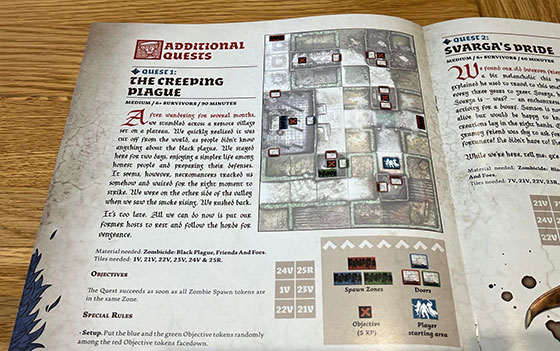
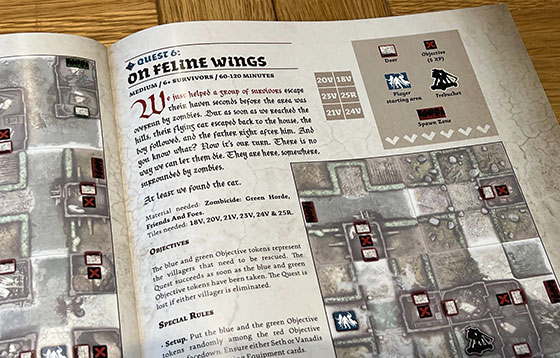
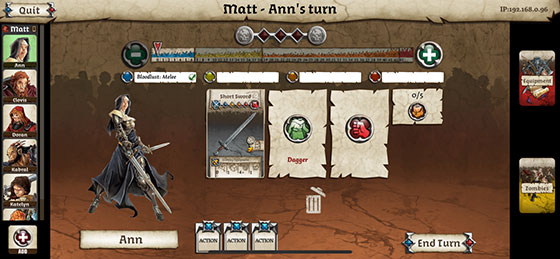
In almost every Zombicide scenario, you’ll need to play with a full compliment of six heroes. Whether those heroes are played by one or six humans (or any number in between) is up to you – the game accommodates a wide range of player counts within minimal changes thanks to the fact that enemy behaviour is automated. There is no need for a dungeon master here. Actually getting the enemies onto the board is handled via a card deck that can spawn zombies in relatively small numbers or it can form hordes or unleash tough, special enemies. These include both necromancers and abominations, as well as specific mechanics such as “The Horde” which can be unique to one core box or the other.
Dispatching orcs in Zombicide is mechanically simple, although I’ll admit to the fact that both core experiences are tougher games than I was expecting them to be. Combat is largely driven by what weapons a character is holding or which spells they wish to unleash, but it boils down to a fairly classic combination of how many dice can I roll, what score do they hit on and how much damage they do? Both core boxes include a mix of fast, high damage enemies (such as runners and necromancers) as well as slower, more powerful enemies such as the orc fatties and the nigh-on undefeatable abominations.
Gameplay in each box varies considerably from one scenario to the next, which is one of the most attractive things about the Zombicide games. In one scenario you might be driving the zombies towards a specific location to trap them. In another, you might need to seek out a specific enemy, defeat them and then make your escape. In one, memorable quest, you’ll fight desperately from street to street with no hope of overpowering the enemy and with only a slim chance of surviving if you can reach a certain location within a turn limit. Another favourite of mine takes the fight directly to the horde and makes it easier for the players to survive in close quarters, which I also enjoyed.
In any scenario, Zombicide is a game about killing zombies and moving your team around the map in an efficient way to meet the objective. I can kind of see how this does appeal to some people and not to others. I enjoy games of all kinds whether they are based on abstract tile placement or all out war and of all the miniatures combat based games I’ve played, I’m happy to admit that the Zombicide melee system is among the very best. There is practically limitless variation in how enemies can be deployed (and unleashing a horde is terrifying) and there are tons of item and monster cards to work through in order to keep things interesting.
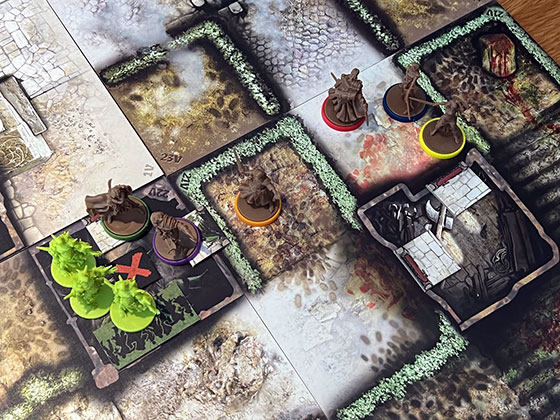
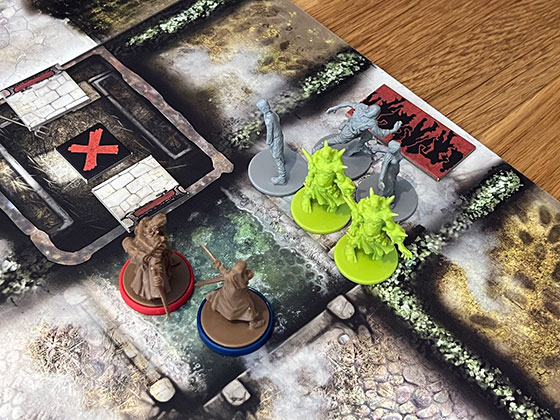
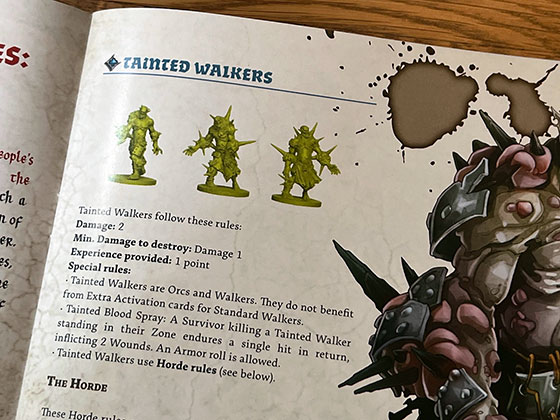
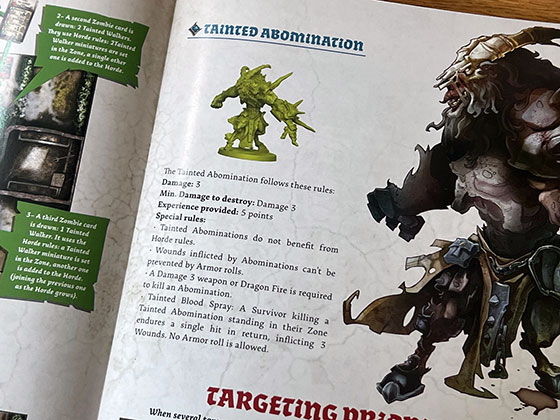
I may also have given the impression that Zombicide is quite simplistic, but that’s not the case. Sure, you’ll run around killing zombies most of the time, but the game doesn’t lack for sophistication. Each player receives a plastic board with pegs on it that track their experience level, skills, spells and items. Defeating enemies makes the players stronger, but it also affects the number and type of enemies that spawn. In the game world, noise is a key factor and whilst some activities make noise regardless, on other occasions you’ll want to use it intentionally to drive the zombies to one place or another. Searching is a huge part of Zombicide gameplay, with players needing to improve upon their starting items very quickly – whilst also balancing the use of actions to move their objectives forwards.
But what if you’ve already invested in Zombicide melee, and now you want to expand it? Perhaps you should try one of these expansions:
Zombicide: Green Horde – Friends and Foes
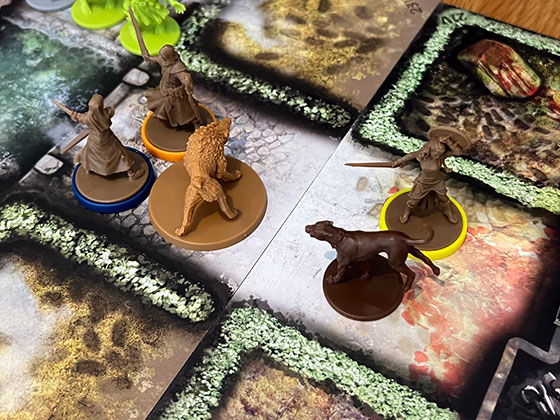
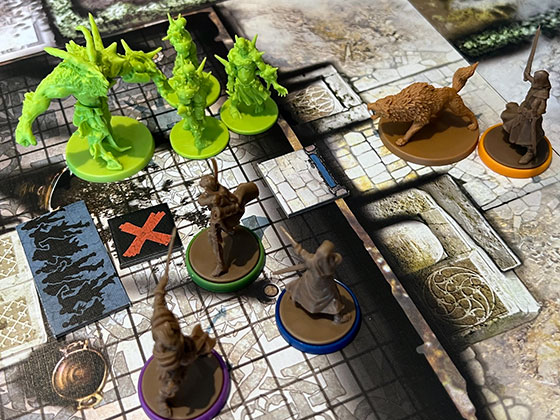
In Zombicide: Green Horde – Friends and Foes, players can expand the content of either of the core boxes by adding four new playable characters and six new “Familiars” who can either be found during searches via the item deck, or who can be added to any mission during setup to make things a little easier. There are also Tainted Walkers (who deal two damage rather than one, and splash the survivors with their tainted blood when killed, and a Tainted Abomination who is similar… But much harder to kill.
The most interesting new addition in this set is without doubt the Familiars, who are a great answer to the increasingly sharp difficulty curve that comes in Zombicide: Green Horde in particular. These guys take up a slot in a characters inventory and are then bound to them. With their own mini (dogs, wolves and cat creatures are represented), a Familiar can be sent around the board on their own and can move, search and attack independently. Meanwhile, the addition of Tainted Walkers really swings the dial the other way – and whilst dealing two damage might not sound like much, it really is, especially when these guys end up in the same space as other tough enemies such as orc fatties.
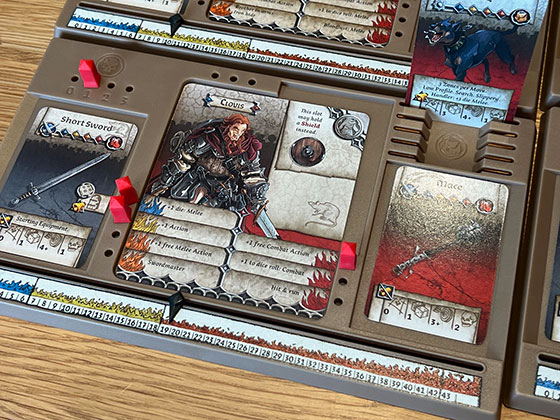
Zombicide: Black Plague – Wulfsburg
Coming soon!
Zombicide: Black Plague – No Rest for the Wicked
Coming soon!
When I first began playing Zombicide melee, I wasn’t expecting a game that was either challenging or smart, but the Zombicide engine allows for both. The combat is simple to resolve and doesn’t have a ton of different rolls that all link back to the original roll, which I think is because the enemy is AI controlled and so plentiful. The game relies on players achieving a high body count among the enemies in order to level up, make progress and ultimately, to survive. The game also players well no matter what the count is, whether one or six players are involved. The only slightly weird situations are those where one player controls more heroes than the others.
Frankly, if you like miniatures combat or dungeon crawling type experiences, then I think Zombicide is well worth your time. Given the number of features – noise, levelling up, the horde and so on, then I’d say the saving grace here is the relatively straightforward way in which it’s all delivered and presented to the players. It’s a quick, fluid experience that gets players directly into the fight as quickly as possible and sustains the action from start to finish. As such, no matter which Zombicide you choose to play, it’s well worth looking into – especially considering how impressive the package inside the box is, and how much scope there is for expansion.