
‘Star Wars: The Deckbuilding Game’ Review
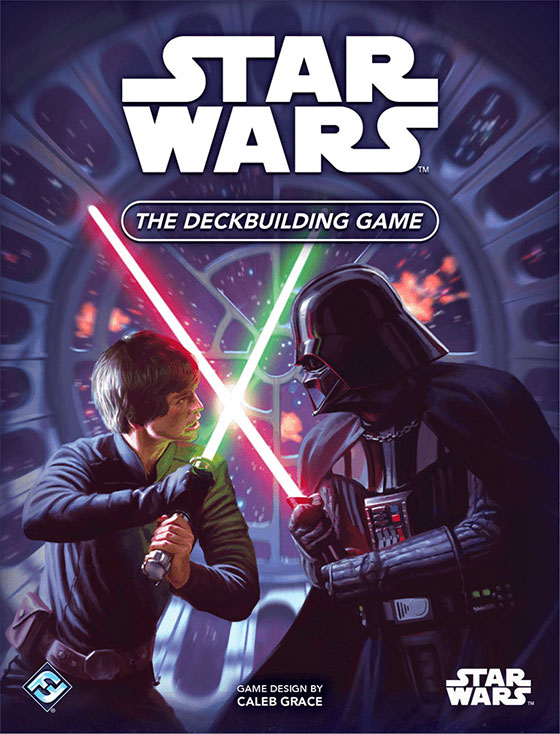
There are already many games based on the Star Wars universe – featuring everything from galactic-scale strategic simulations like Star Wars: Rebellion down to filler games like Love Letter: Jabba’s Palace. There are certainly a few card games based on George Lucas’ epic out there – but I can’t think of one that is quite as punchy and focused as Star Wars: The Deckbuilding Game.
Presented in a small, unassuming box that feels very efficient for a big-license product such as this, Star Wars: The Deckbuilding Game is a game for exactly two players who will choose to represent either the Empire or the Rebel Alliance. The box contains mechanically identical ten card starter decks for each side, as well as a small stack of base cards that act as health.
There is also a deck of ninety cards that will be added to the player decks via means of the galaxy row – a market of six cards that sits across the middle of the table. Thirty of these cards below to each side, whilst another thirty are neutral cards that can be recruited by either side. I’ll explain more about how cards are recruited (or not) later on.
Star Wars: The Deckbuilding Game also uses a unique Force Track which is laid out somewhere to the side. Starting will full alignment to the Rebel player, the force track modifies certain cards with benefits if “the force is with you” whilst also conferring an additional resource to be spent by either player if they have full alignment at the start of their turn.
Turns in Star Wars: The Deckbuilding Game are generally quite straightforward. The player will draw up five cards at the end of their turn (important just in case their opponent uses a discard card effect) and use them on their turn. Cards feature three symbols – resources, attack power and force, as well as any specific text effects that might trigger when the card is purchased, played, discarded or similar.
As an example, if a player were to play all five cards in their starting hand, chances are that they would have a card that simply generates one resource (like Imperial Shuttle), a card that generates two damage (Stormtrooper) and a card that allows the player to choose one of the above (Inquisitor) or to take one movement step in their direction on the Force Track.
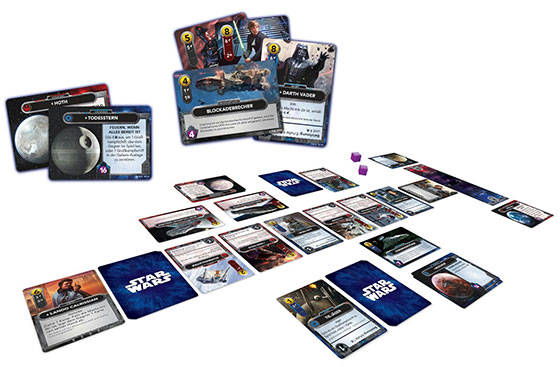
Resources generated in this way are used to purchase cards from the galactic market that I mentioned earlier. What makes Star Wars: The Deckbuilding Game really interesting is how it plays with the cards from different factions. Specifically, cards from your faction will be placed to face you, and only you can recruit them – after all, it wouldn’t make much sense if Han Solo were recruited by The Empire… Or would it? Neutral cards are placed sideways so that both players can see their cost and any effects clearly.
The really interesting bit is that each faction card also has its own combat value which will face toward the opposing player. If that player chooses to spend combat power to meet that value, that card will be discarded from the galaxy row before it can be recruited – thus denying your opponent a powerful option. Also, when you defeat a card this way, you’ll also get a benefit – sometimes resources, sometimes a movement on the force track, and sometimes both.
This means that on a typical turn, you’ll probably end up generating a mixture of resources and combat power, and then you’ll decide what you want to do. You might already have enough resources to buy one or more cards from the row (which you’ll then add to your discard pile to shuffle in later) but if you generate combat power, you’ll need to decide between attacking your opponent directly (damaging their base and moving closer to winning the game) or taking out something in the galaxy row – which may, in turn, give you resources to expand your own deck.
I mentioned earlier that the Force Track begins aligned to the Rebel Alliance – and this does confer a definite benefit. To ensure the game is balanced, the Empire player seems to have access to more varied and powerful capital ships. When played, these large ships (such as Star Destroyers) are placed in front of your base where they will remain from turn to turn – often generating resources and/or firepower every turn. More importantly, they also soak up damage before your base does, which makes a huge difference.
Whilst early turns are as simple as generating resources and spending them, or assigning combat damage to targets in a relatively simple way, more powerful cards come with more interesting rules. Skywalker, for example, destroys an enemy capital ship when he enters play, whilst the Millenium Falcon allows a player to dredge a unique (hero) card from the Rebel discard pile and add it to their hand. These two cards together are powerful, and it behooves the Empire player to prevent such combos from happening.
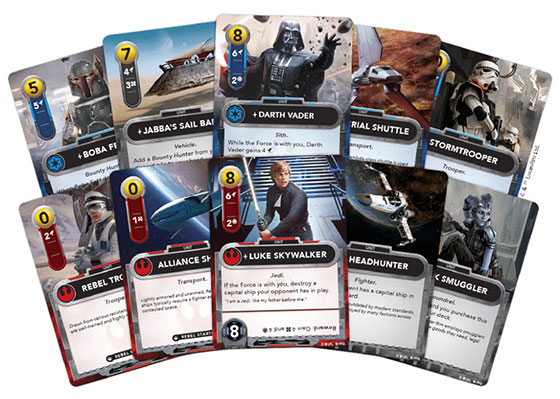
Whilst I am sure that Star Wars: The Deckbuilding Game will be expanded in the future, I also feel that there’s quite a lot happening in the box from the outset. Heroes like Skywalker, Han Solo and Chewbacca all appear for the Rebels, whilst Vader, General Veers and Grand Moff Tarkin appear for the Empire side. In a universe where the ships are also as iconic as the heroes, it’s also fantastic to see the Millenium Falcon and several Star Destroyers, with lots of potential for expansion content yet to be tapped into.
Star Wars: The Deckbuilding Game has fairly rapidly become one of my favourite deckbuilding games for several reasons. Firstly, the Star Wars theme is easy to position with just about anyone, and the Rebel vs Empire setting helps make the rules about how recruitment works very easy to articulate. The two factions also feel different, and the rebel alignment to the force and need to finish before the Empire becomes too powerful feel like thematic elements that come through in the gemeplay.
Star Wars: The Deckbuilding Game Is a fantastic addition to any collection thanks to the strong license, small box and relatively low cost, but also because the mechanics it introduces to the genre are excellent. I love the use of the force to adjust the game balance, and the ability to attack cards before they are bought is really clever – and something I have not seen before. This is a game that more or less anyone should consider trying, and for Star Wars or deckbuilding game fans, there’s no risk in going straight to purchasing it.