
‘Familiar Tales’ Board Game Review

Just over two years ago, I remember reviewing Jerry Hawthorne’s Aftermath and wondering how storybook games could get any better. In Aftermath, the players had access to four diverse anamorphic characters, a narrative-driven campaign and a method for saving both characters and the finer details of the enclave that the players were looking to defend and expand in a post-apocalyptic setting. In Familiar Tales – Hawthorne’s latest in an ever-expanding series of storybook games – the focus is on deck-building, and rather than a gritty, alternate reality, the setting is high fantasy.
The benefit of Familiar Tales being the sixth game in this series (if I include Mice & Mystics which is not strictly a storybook game, but it did inspire them) is that publisher Plaid Hat Games has learned what does and does not work. That means we get the storybook-based map that first debuted in Stuffed Fables, the deck-box save system seen in Aftermath and the campaign tracker used by Forgotten Waters. Familiar Tales introduces new miniatures, more cards than usual (thanks to the focus on deck-building) and fewer dice (just one) along with a handful of supporting tokens and standees. Perhaps the nicest addition (albeit completely unnecessary) is a storage display for the various resource tokens – which the box tells us is “limited” to the first printing, so get in there quickly if you want one.
All of the artwork in Familiar Tales is very appealing to me. This game tells the tale of four familiars who are tasked early in the game with protecting a baby – who just so happens to be the Princess of the realm. As we soon learn, an evil advisor to the royal family is staging a coup of sorts, and the Princess is in grave danger. This is all revealed to us via a fully-voiced and generally excellent app which runs directly in your iOS or Android browser, or which can be installed on Windows PC’s. The inclusion of such a quality app, complete with a decent tutorial is a nice feature – and in my household, it really brought the game to life for my two eldest kids, who also found the story itself (princesses and magical creatures) particularly enchanting.


For me, there were a few problems early on. Firstly, when setting up Familiar Tales, the game insists that all four playable characters are present – which is not uncommon. At four players this is fine and setup is “normal” but at three, two or one players, each player will take certain cards out of each of the starter decks that represent each character. This means that they will use one single deck of cards to control two, three or even four characters – including a single hand of five cards. In a four-player game by comparison, there would be four hands of cards around the table (one for each player.) This matters because cards are fundamental to Familiar Tales‘ gameplay, and can be used to attack, defend or support attacks.
Strictly speaking then, access to more cards is outright better, but what about card quality? Does this system mean that only filler cards are removed? Not really. Unfortunately, each character deck is built to allow some element of combination play – with effects shown in the top left of a card or in the card text triggering under certain conditions. If you’re about to take a turn as a melee character, it makes little sense to have a hand of cards focussed on dexterity, when you know full well that having your own hand would give you a more suitable set of cards. That said, solo play can still be fun because of features like fatigue cards – which can be taken to add extra actions at the cost of having a temporarily weakened deck.
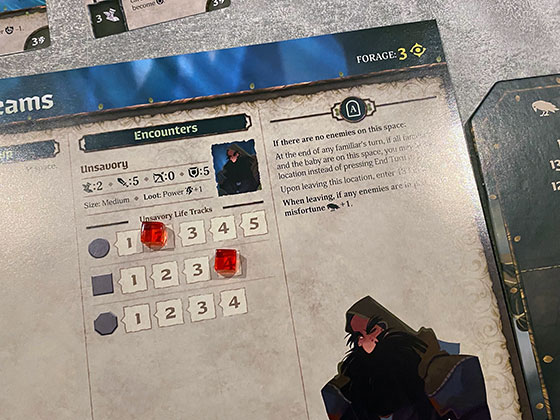
Whatever player count you choose, the four familiars will work their way across pages of the beautifully drawn storybook that underpins the action one space at a time. Pleasingly, spaces are not laid out in a uniform way and thick lines (which are hard to pass and block line of sight) are usually visible for what they are – hedges, walls or similar – whilst dotted lines (passable) are more like small hills or low walls. There’s real texture to these small play spaces, and the range of enemies and encounters is as varied as it was in Aftermath and the other games of this kind that I have played, if not more so. There are traditional dungeon-crawling and puzzle scenes, and even those that feel more like tower defence or similar.


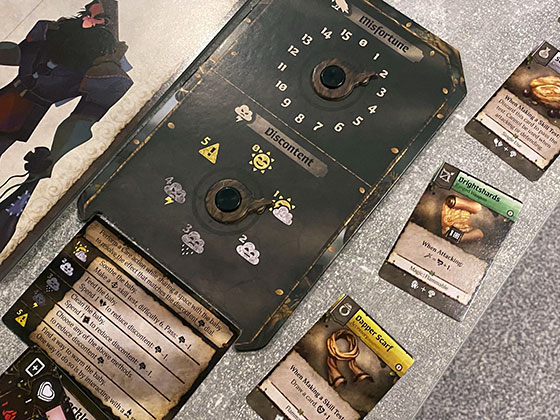
One of the most fun things about Familiar Tales is the inclusion of the baby. Where in Aftermath we had to ensure the long term survival of our survivor enclave, in Familiar Tales we need to ensure the safety and wellbeing of the Princess. In the first Era of the game she is a baby and must be carried – or if she is put down she can be kidnapped in a heartbeat. Just keeping her with you is not enough though, and various game effects will cause her to become less and less happy – which comes with negative effects as the situation worsens. Fortunately, along with moving, attacking, solving tests and other situation actions, giving care to the baby is an action that players can take at any time – something my kids loved to feel responsible for.
As always with one of Plaid Hat Games primary lines, Familiar Tales is produced to an exceptional standard. Not only is the quality of the application really high (with full voice acting and narration) but so too is the content in the box. The ringbound storybook map looks fantastic and feels thick and of a high quality, whilst the miniatures are plentiful and well made. Each card has gorgeous, rich artwork on it and where appropriate, it depicts the character it belongs to in detail, which really helps to bring the world-building to life. The token store that I mentioned earlier is honestly quite pointless, but it looks really nice and compliments the overall quality feel of the game.
In summary, Familiar Tales is a really good addition to the storybook game genre. I will admit that I found the need to merge decks to play at one or two players (where the impact is felt the most) was a bit jarring, but at three or four players it worked well. Players who want to play solo do obviously have the choice to play separate hands for each character, but having tried this myself I can tell you how laborious it is. The one saving grace here is that levelling up your characters (by purchasing and adding cards) isn’t quite as fast in multiplayer, and I found my “single” deck of cards as a solo player got more powerful cards in it more quickly, and I was able to draw around to them more often.

For three to four players, especially if your audience is likely to enjoy the theme, Familiar Tales is a success. The quality of the application and the overall components is very high and really adds to the wow factor, whilst the writing itself is actually very decent. Gameplay is a simplified take on deck-building and hand management that supports the narrative play, and I really liked some of the things that emerge in the second and third Era’s of the game (which I will not spoil here.) Overall, Familiar Tales is a game well worth your time, if the idea of narrative gameplay appeals to you, and it’s especially fun with a willing cast of children in the sort of eight to twelve kind of age range.
**** 4/5
Familiar Tales is available online at 365Games.co.uk, or at your local games store. Don’t know where yours is? Try this handy games store locator