
‘Star Realms’ Board Game Review

Cards are perhaps the single most amazing and important component in board games. Yes, chess and checkers pieces have played their part, as do modern miniatures – but cards offer so much flexibility. A card can have an objective, a power, a monster or a treasure on it – it can have two or three separate uses. It might be public or secret information, and in some cases it’s all of the above. Star Realms makes the case for the power of cards better than almost any other game, and it is one of the best deckbuilding and card-battling games I’ve played.
Most commonly seen as a two-player game presented in a relatively small blister pack, Star Realms is inexpensive to get into, but benefits from numerous expansions which are already available should you want to expand your collection. The version that we received to review is the more expensive 2021 “Box Set” edition which includes a larger box (with a decent insert), starter decks for up to four players, the Gambits mini-expansion and a board that organises the playing area properly. There are also two boss cards enclosed and rules for solo or cooperative play that go with these. At around £35, I think this is a good way to get into the hobby if you are reasonably sure that you’ll expand on it.
What differentiates Star Realms from many other deckbuilding games is just how staggeringly simple it is to get into. Players begin the game with ten cards – eight scouts and two vipers. The decks are shuffled and each player draws their hand – player one draws three cards and any opponents draw five. The first player may then play any – and usually all – of their cards onto the table. In short, each scout adds one “coin” symbol to their pool, whilst each viper adds one combat. Coins are used to buy cards from the market of five face-up cards in the centre of the table (which are added to the player discard pile) whilst combat allows that player to damage an opponent (and everyone starts with 50 health, aka Authority.)
For the three to five coins that players will have during their first few turns, the game offers a surprisingly powerful range of choices. The five cards in the market will usually cost between one and seven coins, with relatively few at the one or seven ends of the scale. This leaves players with a real choice. It’s not usually a case of “what’s the best I can afford” and more one of “how do I want to develop my deck?” Aside from just considering the cost of the cards, there are also four factions represented, each of which synergises with other cards of the same group. Each faction is very different, and you may choose to lean hard into one or to diversify across a couple of factions to take advantage of particular cards.


Whilst coins and combat symbols are the first you’ll encounter in Star Realms, there are a few others that appear on cards. Authority (which I referred to earlier as health) is one of them, whilst others (mostly known as Stations) include a shield – but I’ll explain those later. Many cards have text on them such as those that allow the player to draw extra cards or force an opponent to discard cards. There are even some that allow a player to choose from one benefit or another, or to scrap another card (sometimes including themselves) in order to achieve some other benefit.
And so the flow continues. Each turn a player basically drops their hand (sometimes in a specific order) until they have no more cards to play, then they spend the coins they earned on new cards, increase their health by any authority points played, and then deal damage based on their combat value. Sometimes, a player will play a station card. These are distinct from other cards by their landscape artwork, and they are the only cards in the game that persist from one turn to the next. That is, of course, until someone destroys them by dealing combat damage equal to or greater than the shield value on the station. Some stations add coins, combat value or authority to their controllers pool each turn, which makes them too powerful to leave on the board for long.
In this way the players each increase the strength of their deck, dealing damage to each other as they do. As the game reaches its middle to late game, the players who have successfully built a deck of good, synergistic cards whilst carefully scrapping their weaker options will likely be taking the lead. There’s no single good way to win Star Realms and no faction that is simply better than the others – they all have strengths and weaknesses, and it’s unlikely that the market will allow you to focus on a single strategy. In this regard, Star Realms rewards players who are ready to be flexible, whilst also considering the wider strength of their overall deck.

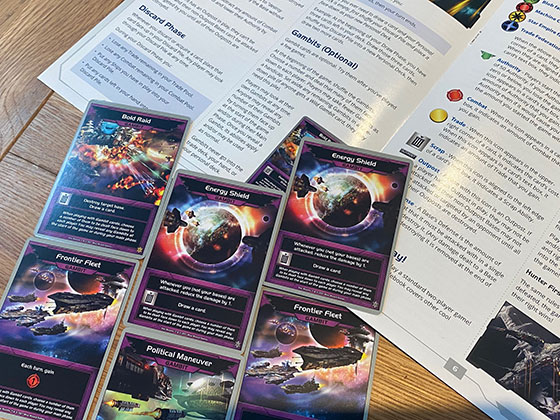

In this particular box set, the Gambits mini-expansion is included. This includes a set of sixteen cards that can simply be handed out during setup – with the rules suggesting that more be given to inexperienced players. In short, Gambits offer powerful, one time benefits that can be played almost any time. For example, destroying an enemy station, or adding two coins to your total for one round only. This is a cool addition, but it’s not necessarily part of the core experience so if you can’t get the bigger box, I wouldn’t worry about missing out on Gambits too much.
Star Realms is a really clean, simple deckbuilder with a great, universally appealing sci-fi theme. It may not be based on any particular IP, but it creates a compelling narrative as the decks expand and the different factions take shape. Whether you look at the base two-player game or this bigger box set, it’s also relatively inexpensive. I’d recommend Star Realms wholeheartedly as a champion of the deckbuilding genre, and if you have any doubts, there’s already an IOS version that you can download and try for an even lower cost of entry.
****½ 4.5/5
Star Realms is available online at 365Games.co.uk, or at your local games store. Don’t know where yours is? Try this handy games store locator