
‘Red Flag Over Paris’ Board Game Review
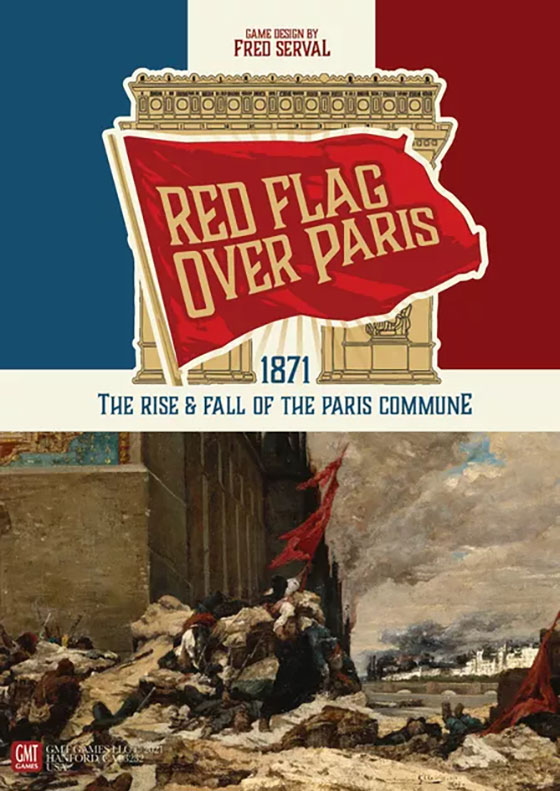
Some three and a half years ago I had the pleasure of reviewing Mark Herman’s Fort Sumter. A two-player wargame simulating the onset of the American Civil War, Fort Sumter was a delight thanks to its light mechanics and deep, head-to-head gameplay. Even though my wife and I enjoyed it (and I rated it four out of five), it was always difficult to sell the idea of Fort Sumter to other people – mainly because the American Civil War is considered less interesting to those of us on the other side of the pond. The Paris Commune, on the other hand, is much closer to home – up step Frederic Serval’s adaptation of Mark Herman’s design, and with it, GMT Games latest offering; Red Flag Over Paris.
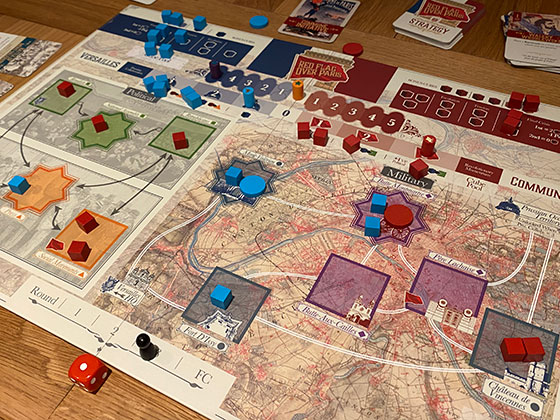
Rather than comparing the two, I think it makes more sense to look at Red Flag Over Paris as a completely standalone game. After all, the only thing that links the two games is the fact that both games centre on a form of area control in which the two players try to wrestle control of key parts of the conflict – whether military, social, or political – and both are driven by cards played in turn. In Red Flag Over Paris, the board is split into two halves – one political (containing three areas representing Politics and three for popular opinion) and one military (representing control of Paris and control of the outlying forts.)
Each game of Red Flag Over Paris lasts for just four rounds – three “normal” rounds and one “Final Crisis.” The blue player represents Versailles and will seek a military victory by holding the military locations. The red pieces are the Commune, and their focus is political legitimacy. A shared scoreboard tracks both military and political victory points, and at the end of the Final Crisis, the winner will be the player who has the most victory points of the kind they need, adjusted by the points scored by their opponent. To illustrate this, if the Versailles player has five military victory points and the Commune has four political victory points, the Versailles player wins by one point.
Besides having very different objectives, the two sides play very differently. Even during setup, the way that influence cubes are placed on the board hints at this. Both the Commune and Versailles draw influence cubes from a Crisis Track which simulates – and this takes a bit of imagination – the escalation of the crisis. The more cubes drawn from either side, the closer that player comes to breaching their last set of cubes (and losing a victory point as a result.) This, I imagine, symbolises the total chaos that Paris finds itself in – which can’t be good for whichever side caused the breach.


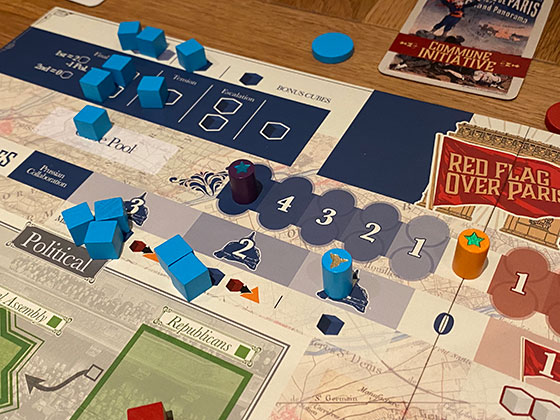
These cubes will be placed onto the board based on Operations actions (removing an opposing cube or placing one of your own) or through events. When a Versailles player loses cubes, they return to a pool that basically allows them to be redeployed, but for the Commune, if a cube is removed, it will often leave the game entirely. That is, unless, the Commune player has invested in moving their Momentum track, which builds them a pool for cubes to return to in line with how much Momentum their movement has. Conversely, when the Versailles player increases their equivalent of Momentum, they actually gain support from Prussia – in the direct form of more cubes.
Whilst I appreciate that these nuances might not leap of the page of this review, I can tell you that in practice they feel thematic and highly asymmetrical. There’s a sense that the Commune player is at the start of something and needs to build up to it fast, whilst the Versailles player has to be aware of powerful Commune events that can appear anywhere, and where possible try to quash Commune resistance quickly when it appears, thus removing the cubes from the game early before the Commune has momentum. Despite this difference in starting conditions and focus, Red Flag Over Paris remains balanced throughout which is incredibly important in two-player only game intended for repeat plays.
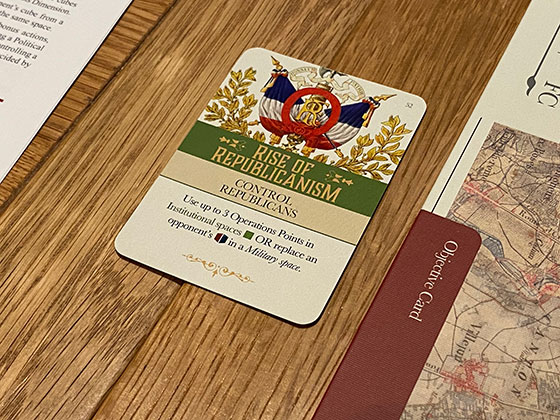
In terms of the card play that I’ve mentioned, Red Flag Over Paris does a great job of being both simple and powerful – offering players lots of choice, without a huge rules overhead. A hand of four cards is drawn at the start of each round, and the players take turns to use their hand one by one until three cards have been played. The final card is placed to the side where it will be used in the Final Crisis round. When playing a card, a player can use either the Operations value (a number in the top left hand corner), the Event (if the card is in their colour, or neutral), or they can discard the card to either increase their Momentum/Prussian Support or to play the Event on a card that was previously placed on the discard pile.

Operations points simply allow a player to remove opposing cubes or add their own to spaces on the board. In the political area, this is simple as it sounds – one Operations point means removal of an opponent’s influence, or the addition of your own. On the military side, things are a bit more complex since the game describes how disorganised the Commune is and how demotivated the Versailles troops are. This means that a player can only remove opposing cubes if they have a certain amount of presence/adjacency, or if they spend additional Operations points to organise themselves. In a way this is how the Commune side remains balanced against the Versailles side despite things being stacked against – because both mechanically and thematically, once the Commune is dug in on the military side, it’s harder to remove them.
Overall, Red Flag Over Paris looks bright and appealing, and it captures the feeling of the turmoil associated with the Paris Commune and the 1871 rebellion really, really well. Neither side has a clear advantage over the other in pure mechanical terms, yet at times during each game, the player on either side might feel hopelessly outmatched until they draw their next set of cards. Each play after the initial learning game (or two) will be done and dusted in something like 30-45 minutes, and Red Flag Over Paris is a really good game for two people who player regularly to play against each other swapping sides each time – like the classic game of Chess. For me, Red Flag Over Paris is a thematic improvement over its sibling title, but both Red Flag Over Paris and Fort Sumter are equally tight and well made, so this will also be a four out of five for me – you now simply need to choose which theme suits you best.
**** 4/5
Red Flag Over Paris is out now from GMT Games. A copy was supplied by them for review.