
‘Leo Cronin’s The Mummy’ Review
Stars: Jack Reynor, Laia Costa, May Calamawy, Natalie Grace, Shylo Molina, Billie Roy, Hayat Kamille, Verónica Falcón, Emily Mitchell, May Elghety, Lily Sullivan | Written and Directed by Lee Cronin
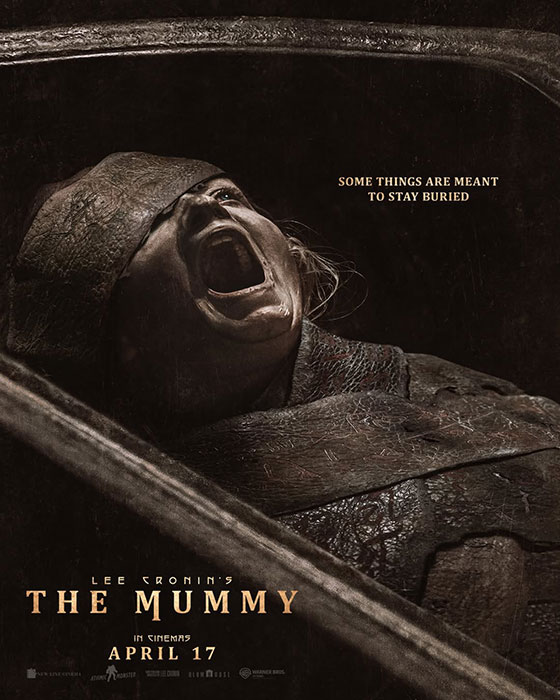
Writer-director Lee Cronin scores an authorial title credit with only his third horror feature, following The Hole in the Ground (2019) and Evil Dead Rise (2023). However, the name recognition factor isn’t the only problem with the title, because Leo Cronin’s The Mummy isn’t really a Mummy movie, or at least not in the sense of the classic Boris Karloff film or the beloved Brendan Fraser / Rachel Weisz blockbuster from the ‘90s.
The story starts with a prologue in which an Egyptian family – headed by a chilling mother figure (Hayat Kamille) – unearths an ancient sarcophagus and reveals a mummified figure inside. We then join the Cairo-based Cannon family – US TV journalist Charlie (Jack Reynor), his wife Larissa (Laia Costa) and their two children, whose lives are suddenly upended when their adorable young daughter Katie (Emily Mitchell) goes missing, after accepting candy from the Egyptian mother we saw earlier.
Eight years later, a plane crashes, and authorities find an unharmed sarcophagus in the wreckage. When it’s opened up, Katie (now played by Natalie Grace) is discovered to be inside, still alive, but severely traumatised and unable to speak. However, when the Cannon family take her in, to try and aid her recovery, spooky stuff starts happening, and they eventually realise something is very, very wrong with Katie.
Despite the fact that Katie technically is a mummy, this is effectively a demonic possession movie, although the mummification scene (revealed relatively late in the film) is certainly one of the film’s scariest sequences. That said, the peril faced by the Cannon family is much more in line with possession movies, which only makes it weirder that no one, at any point, suggests calling in an exorcist.
Overall, Leo Cronin’s The Mummy is something of a mixed bag. The first act is excellent, establishing strong characters, setting up a creepy atmosphere and presenting a compelling mystery – a significant part of the film involves an obsessed Charlie teaming up with an Egyptian police detective (May Calamawy), to try and find out what happened to Katie.
However, the second act is all over the place, pinging between multiple characters and throwing an overwhelming amount of suitably nasty, gory stuff at the audience, but at the same time, creating multiple plot holes in the process, mostly characters witnessing something supernatural or evil and then either just shrugging it off or somehow not bothering to tell anyone else about it.
In fairness, Cronin pulls everything together for a satisfying and gore-soaked final act, but the film can’t sustain its 133-minute running time, and some of the middle section should definitely have been trimmed. For one thing, the demonic possession stuff is both repetitive and derivative, even if the high gore factor makes it stand out.
On the plus side, the performances are excellent – Reynor and Costa are both very solid, and there’s strong support from Calamawy, while Kamille makes the Egyptian mother deeply creepy (especially in the abduction scene) and Grace does some impressive physical and vocal work as possessed Katie.
Similarly, despite its flaws elsewhere, there’s a lot here for gorehounds to enjoy, including a couple of stand-out gross-out sequences involving a buffet. In addition, there’s occasionally a bit of jet-black humour amid the gore that elicits simultaneous laughs and winces.
In short, Leo Cronin’s The Mummy is overlong, riddled with plot holes and occasionally too chaotic for its own good, but it’s also well-acted, fast-paced, and it keeps up a steady flow of gore, jump scares and tension. And even though it isn’t really a Mummy movie, Cronin has effectively reinvented the concept and given it significant franchise potential, so expect to see more Mummies in the not-too-distant future.
*** 3/5
Leo Cronin’s The Mummy is in cinemas now.