‘Undertone’ Review
Stars: Nina Kiri, Adam DiMarco, Michelle Duquet | Written and Directed by Ian Tuason
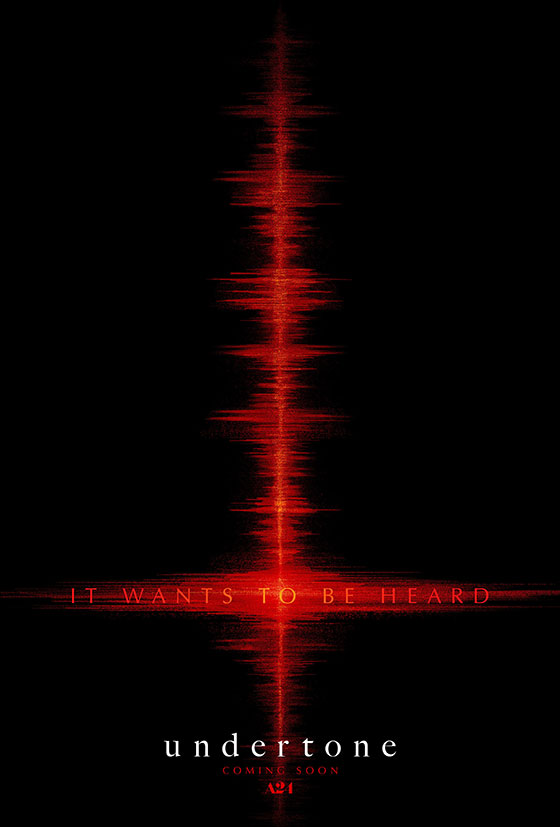
Taking time out from caring for her dying mother, Evy (Nina Kiri) settles down for the night to host her titular paranormal podcast with partner Justin (Adam DiMarco). This week’s episode of Undertone features a series of mysterious sound files sent from an anonymous e-mail address. Hitting the play button, the pair get more than they bargained for when they inadvertently open a door to a malevolent force with a thing for pregnant mums. Spectacularly bad timing, given Evy’s own unexpected baby news.
Written and directed by Ian Tuason, Undertone is Pontypool, Skinamarink and Sinister for an age of podcasts, ASMR and Creepypasta. With the film’s events unfolding entirely in Evy’s home, it utilises Kiri as the sole face on screen – save for that of her comatose, bed-shitting mother (Michelle Duquet).
Tuason ramps up the tension early, opening with a podcasting session in which Justin and Evy delve into the first of ten mysterious sound files. Much of Undertone feels like listening to an audio feed of Paranormal Activity, but those who share a bed with a sleep-talking partner (particularly a pregnant one) should find something to be spooked by in its setup.
Less compelling is Evy’s realisation that many children’s nursery rhymes have sinister real-life origins (!) As these grown adults discover metaphors for the first time, Undertone makes its first digression, and the duo take one of several two-day-long recording breaks. Cue a collective sigh of relief that the whole film isn’t going to be set entirely around Evy’s kitchen table, at least.
Those who opt for the big screen might be hearing a lot more sighing, as well as just about everything else in the vicinity. For a film about sound, most of Undertone’s power lies in its moments of silence, where there’s a palpable sense of an ominous presence watching, lurking and quietly influencing. There’s a throughline there to the visuals, which utilises the negative space in Evy’s home to keep the audience constantly on edge, waiting for a jump scare which never comes.
As such, Undertone is neither here nor there. It’s a film which builds in room for jump scares, only to withhold them every time. It’s a story about sound, although the visuals are stronger (if you like religious imagery and angles so Dutch they’re practically wearing clogs). It’s a tale of haunted audio files… but also about hidden messages in nursery rhymes… and an anti-abortion allegory (intentional or otherwise) too. For a film with such a simple setup, it doesn’t always do its ideas justice.
Not least the ludicrous conceit that Evy and Justin should build two episodes of their podcast around ten audio files that neither has screened first (and how one would have loved the tenth file to have just been a clip of Rick Astley bursting into song). The film soon settles into a rhythm of the pair listening to two or three files, then taking a two-day break during which an increasingly nervy Evy experiences things going bump in the night, before the cycle begins again.
Kiri carries this one-woman show on her shoulders, even when the writing doesn’t always have her back. It’s down to the Mulder to her Scully – DiMarco’s faintly insufferable Justin – to deliver the bulk of the exposition, as Evy panics while googling the lyrics to Baa Baa Black Sheep. By the time Justin starts researching “people who say the phrase ‘come here Abzyu backwards’,” there’s a definite sense that it’s only Kiri and the sound design holding the whole thing together.
After seventy minutes of going around the houses, Undertone does perk up for its boisterous finale. Ignore the fact that Evy could just take her headphones off at any time, and there are some legitimate chills in its payoff. Is it scary? Not really, but it is loud. But by then it’s too late anyway, and Tuason will have long since shed his less patient viewers, many of whom will catch the thing later in a series of TikTok clips or YouTube recap.
** 2/5
Undertone isn’t entirely without merit, but its better notions are drowned out by a cacophony of clumsily articulated ideas and underwhelming key-rattling.