‘Innovation: Ultimate’ Board Game Review
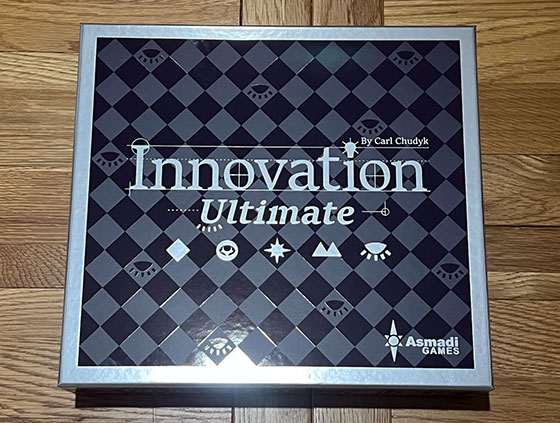
There’s something inherently audacious about Innovation: Ultimate. It’s not just a greatest hits compilation – it’s the full boxed set, the remastered edition, the director’s cut where every radical design decision Carl Chudyk ever cooked up finally gets its moment in the spotlight. And it doesn’t apologise for the chaos. If anything, it revels in it.
Designed by Chudyk and published by Asmadi Games, Innovation: Ultimate crams over a decade of asymmetric, icon-drenched, combo-laced gameplay into one rather unassuming box. But that box is practically bursting at the seams with potential mayhem: the original base game, all six expansions, a fresh Age 11 for future-tech mayhem, and a new twist in the form of the “Unseen” expansion.
For those unfamiliar with the Innovation experience, here’s the elevator pitch: players start in the Stone Age with a single card and use “innovations” to build a tableau of ideas, technologies, and social advancements across eleven ages. Each innovation is unique and often strange. You might discover “Calendar” and “Gunpowder” early on, but soon you’re leaping headlong into “Rocketry,” “The Internet,” or “Globalisation.”
Each card has icons – little glyphs that represent your civilisation’s knowledge and prowess – and effects that can alter the state of the game in wild, often disruptive ways. At the heart of this design is the Dogma action: activate a card’s ability, sometimes dragging your opponents along with you if they have enough of a matching icon. It’s both clever and cutthroat. Helping your rivals is a risk, but sometimes you don’t have a choice. Other times, you use Dogma to steamroll your way into the future and leave everyone else neck-deep in feudalism.
What makes Innovation: Ultimate particularly fascinating is its scope. This is not just a compilation; it’s a recontextualization of the system. The cards from different expansions are balanced and laid out in a way that makes mixing and matching not only possible, but encouraged. Cards from “Echoes,” “Cities,” “Artefacts,” and “Figures in the Sand” are now more smoothly integrated thanks to updated iconography and a more consistent layout.
Those who’ve played the older editions will notice small but meaningful improvements. Icons are cleaner, splaying directions are more intuitive, and the new card backs help distinguish each expansion. These may seem cosmetic, but for a game where visual clarity is key to parsing potential chaos, they’re vital refinements. The addition of Age 11 – a speculative set of ideas like “Singularity” and “Decentralisation” – gives Innovation a new ceiling. It allows games to spiral a little further before ending, while offering powerful, almost game-breaking effects that still manage to feel earned. It’s like Chudyk asking, “What if the end of civilisation was just the next innovation?”
And then there’s “The Unseen.” This mini-expansion adds hidden cards to each player’s hand and injects uncertainty into a game that was already comfortably unpredictable. You might think you’re in control, with a top-splayed “Democracy” giving you military dominance – but then someone reveals “Espionage” and siphons away your entire strategy. Delicious. Maddening. Pure Innovation.
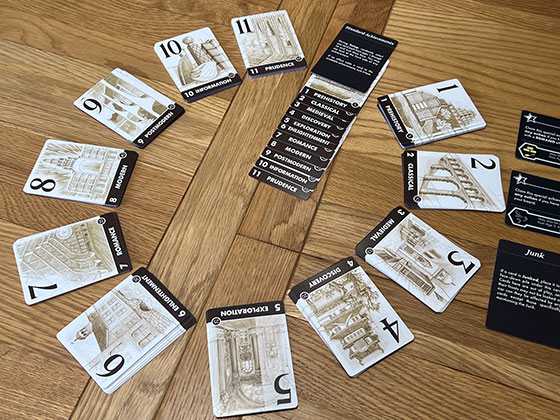
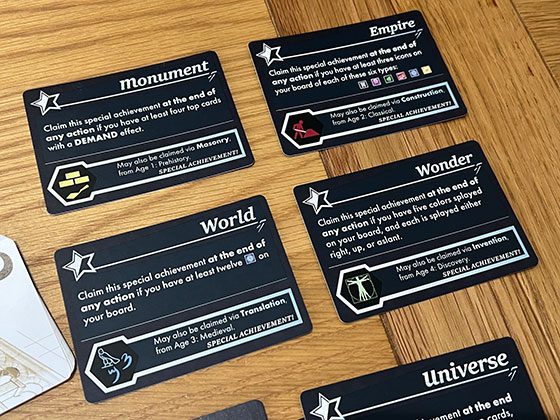
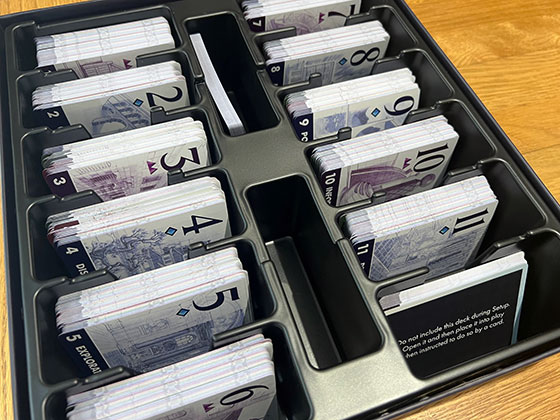
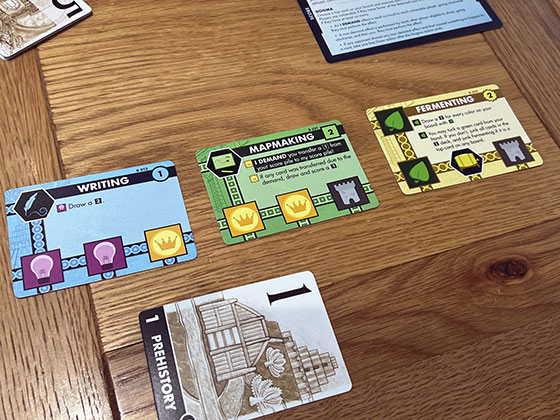
Yet even with all this content, the game remains surprisingly tight. That’s a testament to the underlying engine, which still revolves around four simple actions: Draw, Meld, Achieve, and Dogma. These verbs drive everything. The complexity emerges not from a bloated ruleset, but from the ever-changing relationships between cards, icons, and tableaus. This keeps the game both reactive and tactical. Long-term planning is possible, but brittle. More often, success favours players who can shift gears quickly. Did your opponent just reveal a card that benefits them if they have more Leaf icons? Cool – let’s pivot, try to cover our icons, and maybe throw down a “War” card to knock them back to the Neolithic.
Innovation is, at times, a knife fight in a science museum. Of course, not everyone will love that energy. For every player who delights in chaining four Dogma effects into an accidental victory, there’s one who will lament the lack of control. And yes, games can occasionally hinge on a single card draw. But for those willing to surf the edge between chaos and genius, the experience is one-of-a-kind.
While the game sings at two players (where tactical feints and counterplays shine) it becomes an entirely different animal at three or four. Turn order matters -more, alliances form and break in real time, and someone inevitably ends up staring at a splayed mess of iconography wondering how they got left behind in the Renaissance. That someone may very well be you. But that’s part of the charm. Innovation: Ultimate doesn’t promise fairness or predictability. It offers narrative arcs stitched together from unexpected moments. A run of tech cards might elevate one player to orbital supremacy, only for another to use “Iconoclasm” and knock everyone down to iron tools and shame.
In terms of presentation, this edition is a noticeable upgrade. The art has been modernised without losing its functional clarity. Ages now have thematic backs, and the consistent layout makes it easier to parse complicated cards at a glance. The rulebook is dense but better indexed, with examples that walk players through tricky scenarios involving splaying, achievements, and shared effects.
The box also includes handy dividers, colour-coded for each expansion and age, which is crucial when you want to customise the experience. Want a tighter, more strategic game? Use just the base and “Echoes.” Prefer all-out mayhem? Toss in everything, shuffle it together, and embrace the entropy.
Let’s not overlook what this edition does for the hardcore fans. With Innovation: Ultimate, veteran players now have access to tournament-friendly modes and preset decks that enable more structured play. These “core sets” are prebuilt combinations that emphasise different aspects of the system: one might focus on icon denial and control, another on explosive combos. It’s a nod to a competitive scene that’s grown up around a game many once dismissed as too wild to master.
And if all that sounds overwhelming, that’s because it is – at first. But that’s the other magic trick here: Innovation layers itself over time. New players will latch onto familiar ideas – Agriculture, Tools, Mathematics – and slowly discover just how strange the system can become. Veterans, meanwhile, will find depth in every draw, always chasing that perfect synergy that lets you splay your way to intellectual supremacy.
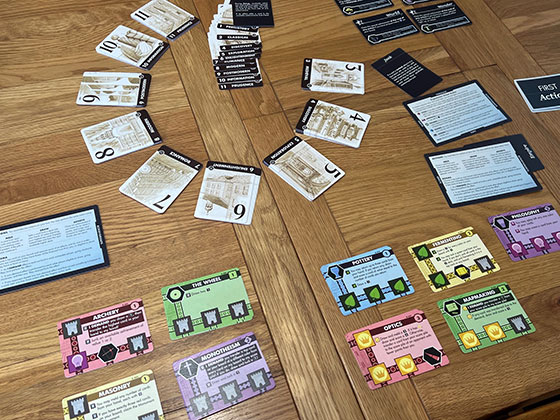
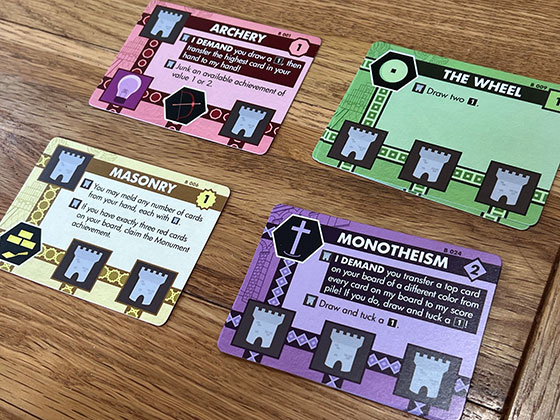
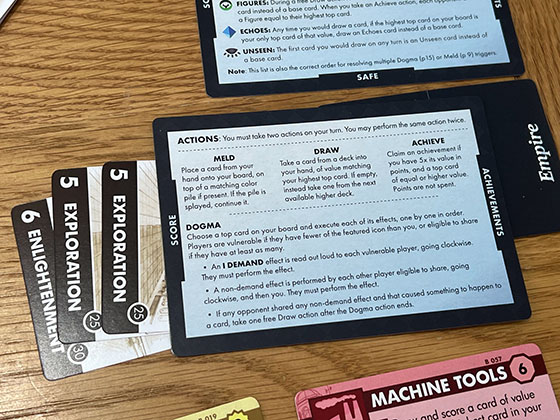

If there’s a criticism to be levelled (and it’s a gentle one), it’s that even with the updated rulebook and streamlined components, Innovation: Ultimate still has a learning curve. The iconography, while improved, can be daunting. Understanding when to pursue achievements versus pushing the tech tree upward isn’t always intuitive. And the more players at the table, the more likely it is that someone will need help deciphering what just happened.
But for the right group, those moments are golden. The table talk alone – “Wait, how did you leap from Code of Laws to Climate Engineering in one turn?” – is worth the price of admission. And then there’s the joy of a comeback. Innovation offers some of the most satisfying reversals in gaming. You may be behind for most of the game, stuck with outdated tech and a mismatched tableau. But then you draw that one card. The one that turns all your opponent’s icons into penalties. The one that unlocks Age 11 prematurely. The one that lets you steal an achievement and tip the whole thing in your favour.
It’s not balance in the traditional sense. It’s dynamism. Innovation isn’t about equal footing – it’s about adapting faster, thinking sideways, and embracing whatever your twisted little civilisation throws at you. For players who appreciate that kind of dynamic tension – the knife’s edge between control and catastrophe – Innovation: Ultimate is essential. It’s a triumph of systems design, a relic of an earlier board game era that still feels ahead of its time. And now, fully upgraded and all in one box, it might finally get the recognition it deserves.
If you’re new to the series, start small. Play the base game once or twice. Learn to read the splay, anticipate your opponent’s icons, and manage the Dogma dance. Then, slowly add the expansions. You’ll find that each one brings a new flavour – a new angle on progress, decay, and absurdity. And if you’re a returning player? You already know the drill. Strap in, shuffle up, and let the ideas fly. Innovation: Ultimate is less a game and more a machine – one you crank, poke, and occasionally kick when it breaks in the most glorious way possible. You don’t control it. You learn to live with it. And when the sparks fly and history bends to your will, you’ll smile and know: this is what innovation was always meant to be.