
‘Protos’ Review
Stars: Anja Akstin, Fred Thomas Jr., Ricky Herrera, Trista Robinson, Mike Ferguson, Justin Dray, Melinda DeKay | Written by Brian Avenet-Bradley, Simon Clark | Directed by Brian Avenet-Bradley, Laurence Avenet-Bradley
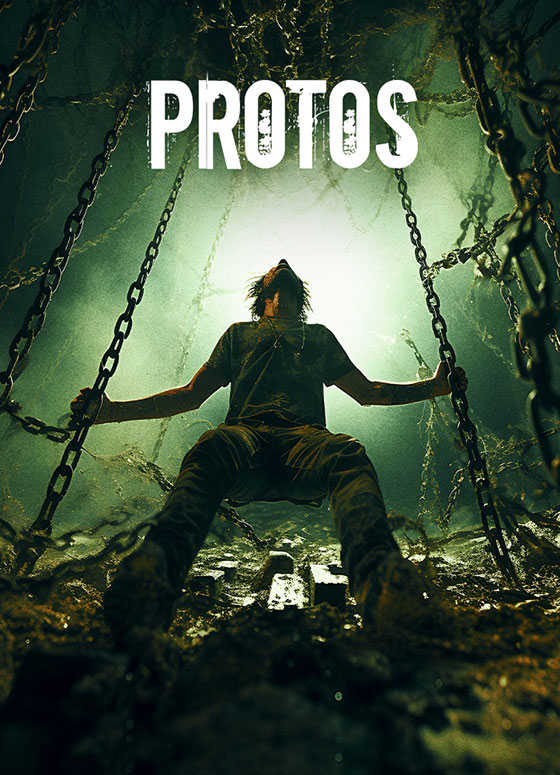
In a dystopian future, death row inmates are used like lab rats by a private company that uses memory implants to revolutionise the correctional system. Two prisoners who become subject to the experiment must escape or risk losing their minds forever.
Having grown up with a love of the dystopian sci-fi thrillers of the 1970’s (think Soylent Green, Omega Man and their contemporaries), the concept of Protos (or The Protos Experiment, dependent on which website, you’re perusing) leapt off the page, as modern homage, to some great childhood memories. Science-Fiction horror, from the pen of notable horror author, Simon Clark, and supported by a creative directing team, makes for a fun 91 minutes.
Opening, we find our protagonists groggily awaking in a mysterious cave/silo, trapped, with little memory of who they are, and how they got there. Akin to horror legend, Jigsaw, some big bad has kidnapped our “heroes”, Kyra (Anja Akstin), John (Fred Thomas Jr), and Nev (Ricky Herrera), and is forcing them to play a nefarious game of life and death. As “The Purge” siren sounds, sadistic, WWE-esque, muscled killers emerge from the darkness, adorned with red-hued VR headsets, and set about tormenting our bewildered bunch. And so, the rampage begins…
As it turns out, the sadistic, muscle-bound sadists are being controlled by an outside force. When their headsets glow red, they are ordained to kill; when their headsets glow green, they retreat into the shadows.
And then the creepy horror child appears, with her robotic toy dog…
And then there’s the messages scrawled on the walls…
Is this a game? Is this an experiment? A test? Who’s directing traffic (lights!!)?
It’s a fun and intriguing set-up.
Protos boasts a high-quality look, on (presumably) a low budget. The darkness of the cavern allows effective usage of torches, strobe-lighting effects and illuminated mech-suits and headsets. It looks and feels like a theatrical production, and limitations on spending are hidden in the dark, through the use of economical character-lit illuminations. The “safe in the light” gimmick, employed by the script, is also used to create palpable tension – hats off to the directors and their lighting and photography crew.
A flash of light, and our characters’ minds are wiped clean. Someone is monitoring them from a control room. Kyra and co are continuously harangued by the red-light beasts, and spaces of light are getting smaller. Fragments of past lives are glitching, casting doubts over who these people are, and what they are doing in this place. Escape is the only option.
Like rats in cages…
The film briefly touches on themes of nature versus nurture, exploitation of the destitute and incarcerated, and government contract oversight – what is the cost, versus what is the result. All weighty ideas that point at what could have been a much smarter, intelligent think-piece.
Where Protos lets itself down is in not letting the audience care about the characters – there is plenty of exposition amongst our perilous ensemble, but come the final act, there’s little left outside of quickly forgotten dialogue, broad strokes of character traits and a pile of rotting corpses. Anja Akstin, as Kyra, stands out as our would-be protagonist, resourceful and resilient – the rest of the cast are given so little to do, as to become cyphers.
To say more would be to ruin the fun. Protos is a film that very much wears its influences on its sleeve. Visually impressive, exceptionally photographed and directed at pace, the film is never boring. A fun concept, full of tropes made familiar by many other genre films – Saw (2004, Dir. James Wan), The Running Man (1987, Dir, Paul Michael Glaser) and Total Recall (1990, Dir. Paul Verhoven) – all cut from the same cloth.
The final act, as it twists and turns, calls back to those nihilistic 70’s sci-fi thrillers – the world is not alright and the endings are not always particularly happy…