‘The Adventures of Conan + Expansions’ Board Game Review
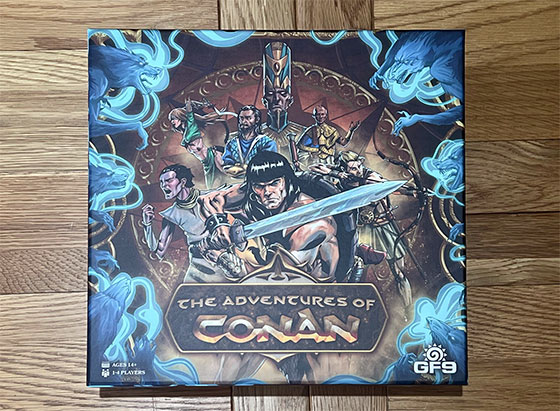
With some games, you know just what to expect as soon as you look at the cover art. The Adventures of Conan, designed by Jack Reda and published by Gale Force Nine, is one such game. It doesn’t try to be a sprawling sandbox or a deeply strategic Euro, nor does it focus on fighting like other games wearing the Conan moniker. Instead, it leans hard into its pulp roots, delivering a fast-paced, narrative-driven experience that captures the raw, muscular energy of Robert E. Howard’s iconic barbarian. It’s a game that’s as much about tone and texture as it is about mechanics – and in that regard, it succeeds with bloody flair.
Set in the grim and mystical Hyborian Age, The Adventures of Conan casts players as Conan himself, embarking on a series of loosely connected adventures that span the breadth of his mythos. From the decadent cities of Zamora to the haunted jungles of Kush, each scenario is a self-contained tale of swordplay, sorcery, and survival. The game is structured as a modular campaign, with each adventure offering a different objective, map layout, and set of challenges. This episodic format suits the source material perfectly, evoking the serialised nature of Howard’s original stories.
Mechanically, the game is a hybrid of action selection, dice-based combat, and light resource management. Players control Conan and a rotating cast of allies, each with their own unique abilities and stats. On each turn, players choose from a limited pool of actions – move, attack, rest, interact – and resolve them using custom dice. The dice system is elegant and intuitive, with symbols representing hits, blocks, and special effects. It’s not a super deep system, but then again, it doesn’t need to be. The focus is on momentum, on keeping the story moving, and on making players feel like they’re in the middle of a comic book adventure.
What’s particularly impressive is how the game balances narrative and mechanics. Each scenario is driven by a story card that sets the scene and outlines the objectives, but the game never feels bogged down by text or overly scripted. Instead, it uses a clever system of event triggers and branching outcomes to create a sense of dynamism. Fail to stop a cultist ritual in time, and you might find yourself facing a summoned demon. Rescue a prisoner early, and they might become a temporary ally. These moments feel organic, not forced, and they give the game a sense of consequence that’s often missing in lighter adventure games.
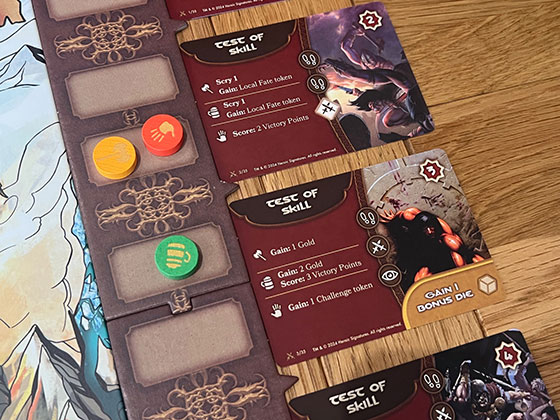
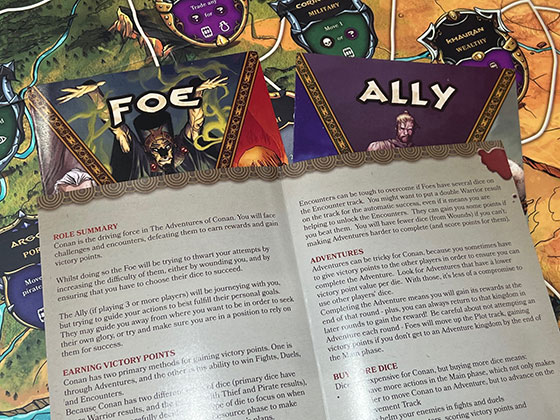
The production quality is, as one would expect from Gale Force Nine, solid across the board. The miniatures are detailed and evocative, capturing the brutish elegance of Conan and the grotesque menace of his foes. The artwork is bold and dramatic, leaning into the heavy shadows and lurid colours of classic sword-and-sorcery illustration. The modular map tiles are well-designed, with clear iconography and a good balance of visual interest and functional clarity. If there’s a criticism to be made, it’s that the card stock could be a touch thicker, and the rulebook, while serviceable, could benefit from a more structured layout and clearer examples.
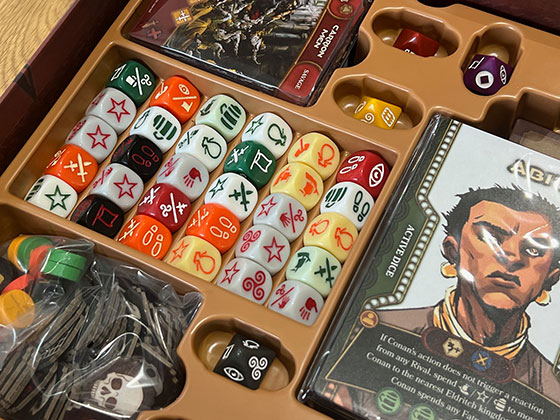
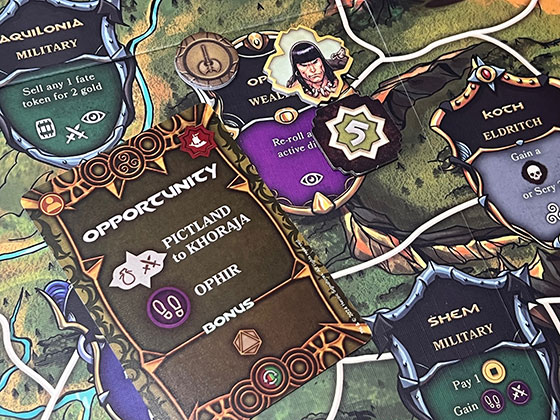
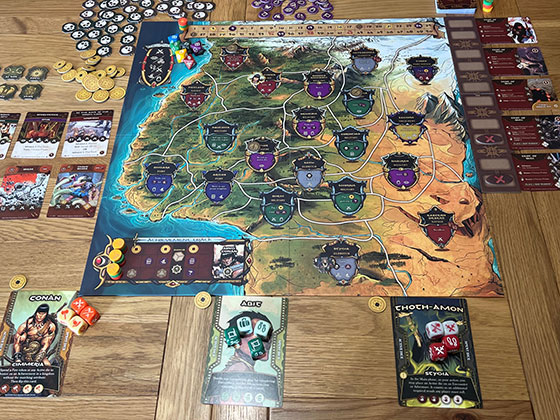
One of the game’s strongest features is its pacing. Scenarios typically run between 60 and 90 minutes, and the game does an excellent job of maintaining tension throughout. Enemies spawn regularly, objectives evolve, and the threat level escalates in a way that keeps players engaged. There’s a real sense of urgency, of being just one step ahead of disaster, and that fits the theme beautifully. Conan isn’t a planner – he’s a doer, a survivor, a force of nature – and the game captures that ethos with admirable fidelity.
Replayability is another area where The Adventures of Conan shines. With multiple scenarios, branching outcomes, and a variety of allies and enemies, no two playthroughs feel exactly the same. The game also includes a light progression system, allowing players to carry over certain items or traits between adventures. It’s not a full-blown campaign in the legacy sense, but it adds just enough continuity to make the experience feel cohesive. There’s also a solo mode, which, while not the game’s primary focus, works surprisingly well thanks to a streamlined AI system and scenario-specific objectives.
That said, the game isn’t without its limitations. The AI for enemies is functional but basic, relying on simple movement and attack priorities. This can lead to predictable behaviour, especially in later scenarios where the challenge comes more from numbers than from tactical complexity. Additionally, while the game supports up to four players, it’s arguably at its best with two—enough to allow for meaningful cooperation without bogging down the pace. With more players, downtime can become an issue, especially during combat-heavy turns.
Another point worth noting is that The Adventures of Conan is very much a game for fans of the source material. While it’s accessible enough for newcomers, those with a familiarity or fondness for Howard’s stories will get the most out of it. The game is steeped in lore, from the names of locations and characters to the flavour text on cards, and that immersion is a big part of its appeal. If you’re looking for a generic fantasy romp, this might not be the game for you. But if you want to feel like you’ve stepped into the pages of Weird Tales, this is as close as cardboard can get.
Now, turning to the two expansion packs, both of which build on the core experience in meaningful ways. The first, The Tower of the Elephant, is a direct adaptation of one of Conan’s most famous stories. It introduces a new multi-level map, a unique stealth mechanic, and a climactic encounter with the alien Yag-Kosha. What’s impressive here is how the expansion captures the tone of the original tale – less about brute force, more about cunning and exploration. The stealth rules are simple but effective, adding a new layer of tension and encouraging players to think differently about how they approach challenges. It’s a tighter, more focused experience than the base game scenarios, and it serves as a perfect palate cleanser between more combat-heavy adventures.
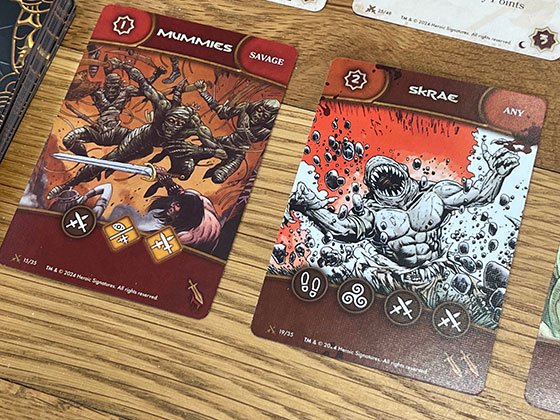
The second expansion, The Black Coast, shifts the action to a coastal setting and introduces naval elements, including ship-to-ship combat and sea monsters. It’s a more ambitious expansion, both thematically and mechanically, and while it doesn’t always hit the same highs as Tower of the Elephant, it adds a welcome sense of scale and variety. The new enemies are particularly memorable—hulking pirates, aquatic horrors, and a kraken-like boss that makes for a thrilling finale. The expansion also includes new allies and items, further expanding the game’s toolbox and increasing replayability. Both expansions are modular and can be slotted into the base game with minimal setup, making them easy to integrate and well worth the investment for fans.
In closing, The Adventures of Conan is a game that knows exactly what it wants to be – and delivers on that vision with confidence and style. It’s not the most mechanically complex or strategically deep game on the market, but it doesn’t need to be. What it offers is something rarer: a cohesive, immersive, and thoroughly enjoyable adventure that captures the spirit of its source material with genuine affection. With its fast-paced gameplay, evocative art, and strong narrative hooks, it’s a must-have for fans of Conan and a worthy addition to any adventure game collection. The expansions only deepen that experience, offering new stories, mechanics, and challenges that keep the game fresh and engaging. In a market crowded with fantasy games, The Adventures of Conan stands tall – not because it’s the biggest or the flashiest, but because it knows how to tell a damn good story.