
‘Bloat’ VOD Review
Stars: Ben McKenzie, Bojana Novakovic, Sawyer Jones, Kane Kosugi, Malcolm Fuller | Written and Directed by Pablo Absento
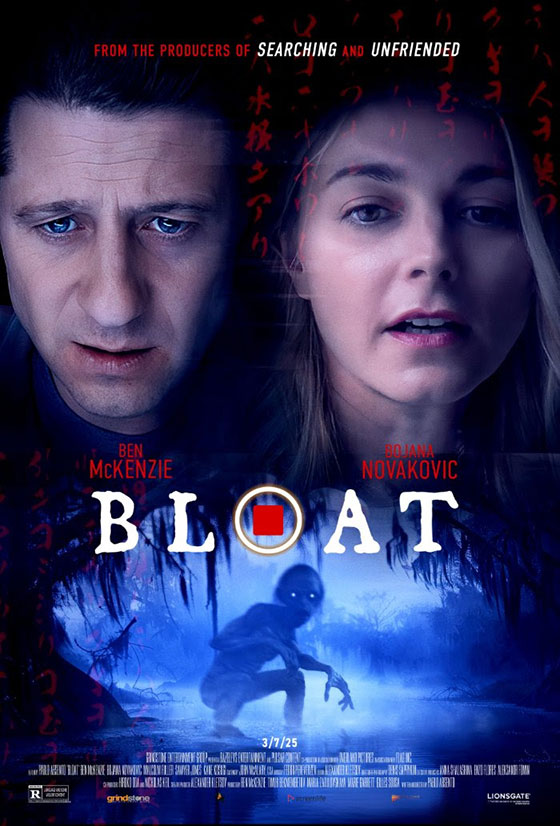
Bloat follows Jack (Ben McKenzie; Adventures in the Sin Bin, The O.C.), a soldier whose family is trying to move past a recent personal tragedy. To facilitate this healing process, Jack books a family vacation to Japan for his wife, Hannah (Bojana Novakovic; Beyond Skyline, Drag Me to Hell), and their children. However, before he can join them, a sudden escalation in tensions in the Middle East forces him to remain at his post, leaving him able to interact with his family only through digital means. Their trip takes a terrifying turn when Kyle (Sawyer Jones; Madagascar: A Little Wild, Antlers) their youngest child, has a near-fatal accident in a lake. Though he survives, the incident serves as an entry point for a supernatural entity – a kappa or river child, a water demon from Japanese folklore – to take possession of him.
While kappa are not necessarily the most malevolent of supernatural creatures, their actions in folklore range from mischievous pranks, such as looking up women’s kimonos when they near the water, to truly horrifying acts like drowning people, abducting children, assaulting women, and even consuming human flesh. Despite their at times menacing nature, kappa are also known to interact amicably with humans, making them a fascinating yet unpredictable choice for a possession horror narrative. As the demon’s hold on Kyle strengthens, Jack is left to watch helplessly from afar, trying to intervene through apps, video calls, and messages. In his desperation, he reaches out to an old friend, Ryan, played by Kane Kosugi; Ninja: Shadow of a Tear, Tekken: Kazuya’s Revenge), who just so happens to be the son of legendary screen ninja Sho Kosugi (Enter the Ninja, Pray For Death and, of course, Ninja III: The Domination)
The film’s plot follows a fairly standard trajectory for a possession horror movie. Kyle begins exhibiting unsettling changes in behaviour, displaying violent tendencies that culminate in him biting a chunk out of his brother Steve’s (Malcolm Fuller; City on a Hill, Puppy Place) arm. He also develops an insatiable craving for cucumbers, a nod to the kappa’s traditional fondness for the vegetable. What sets Bloat apart, at least in theory, is its screen life presentation. However, rather than immersing the viewer in the story, the film presents events in an even more detached manner. Instead of watching the events unfold directly on our screen, we are shown footage playing on someone else’s screen. This extra layer of removal makes the experience feel less engaging, diluting the immediacy and tension that the screen life format typically aims to achieve.
Unfortunately, the use of screen life in Bloat comes across as more of a gimmick than a necessary storytelling device. There is no inherent reason why the story couldn’t have been told with Jack physically present but at a loss for how to help his son. After all, he is a soldier, not an exorcist, and his lack of expertise would have still provided ample room for conflict and tension. Writer/director Pablo Absento (Call My Name, Slit) appears enamoured with the format, filling the film with footage playing on monitors and unnecessary picture-in-picture effects. While this might seem stylistically interesting at first, it quickly becomes a distraction, pulling focus away from the horror elements. Additionally, certain moments strain inevitability—such as footage capturing Hannah’s reaction to their daughter’s death. Who in their right mind would record such an intensely personal and painful moment, let alone save it for later viewing?
Cinematographer Denis Saprykin (UTRO. TNT, Anonimnaya Telega) leans heavily into the expected tropes of found footage horror, utilizing glitchy and pixelated visuals to indicate supernatural interference. This is a technique that, while effective in moderation, becomes repetitive over the course of the film. Jack’s investigation into his son’s condition—starting with Google searches before delving into the dark web and consulting Ryan—has its moments of intrigue, but the execution is clunky, hindered by weak dialogue and unconvincing performances.
That being said, Bloat does manage to deliver a few effective scares, albeit ones that feel overly familiar to genre veterans. Unfortunately, these moments of tension are not enough to compensate for an otherwise lacklustre experience. The film is riddled with plot holes, questionable character decisions, and a frustratingly abrupt conclusion that is likely to irritate anyone who invested their time in seeing the story through to the end.
Ultimately, Bloat is not a complete disaster, but it is far from a must-watch. While the concept of blending Japanese folklore with screen-life horror is intriguing, the execution leaves much to be desired. If the film had focused more on its story and characters rather than its stylistic gimmicks, it could have been a genuinely eerie and compelling addition to the subgenre. Instead, it feels like a missed opportunity. One can’t help but wish that Kane had called in his legendary ninja father to fight the demon, now that would have been a film worth watching.
*½ 1.5/5
Bloat is on digital platforms now, courtesy of Lionsgate.
______