
Sitges 2024: ‘1978’ Review
Stars: Agustín Pardella, Carlos Portaluppi, Mario Alarcón | Written by Luciano Onetti, Nicolás Onetti, Camilo Zaffora | Directed by Luciano Onetti, Nicolás Onetti
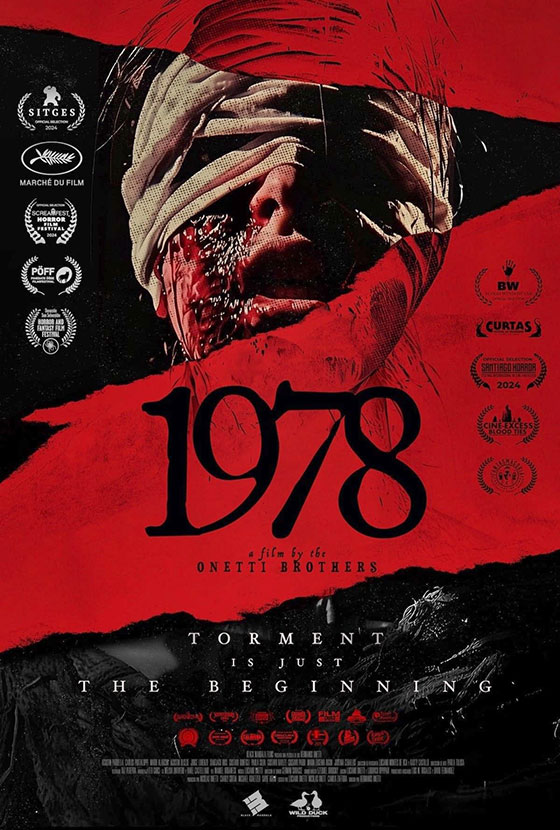
1978 is the new film from directing duo Luciano and Nicolas Ornetti, the Argentinian filmmakers (and brothers) behind Abrakadabra (2018) and What the Waters Left Behind (2017). Set during the titular year, it conjures up an intriguing clash between human and supernatural evil, but it never really adds up to the sum of its parts.
The film takes place in Buenos Aires, during the 1978 World Cup final between Argentina and Holland. With the country under brutal military dictatorship, the eyes of the world are focused on Argentina, but behind closed doors, government forces are continuing their routine activities of kidnapping, torturing and “disappearing” anyone they consider subversive.
Accordingly, 1978 opens on a group of torturers, including gruff, no-nonsense boss Moro (Mario Alarcón) and cheerful, overweight Carancho (Carlos Portaluppi), as they work over their latest victim. When he cracks and gives up an address rumoured to be the headquarters of a group of dissidents, the torturers organise a raid and round up a subversive group, but they get more than they bargained for when their prisoners also turn out to be part of a sinister cult.
The Ornetti brothers, who co-wrote the script with Camilo Zaffora, orchestrate an effective slow burn in the first half, with the torturers tightening the screws on their victim, unaware that in doing so, they are setting themselves up for a trap. To that end, the early stages are effective, with Alarcón and Portaluppi establishing interesting, if not exactly sympathetic characters.
Unfortunately, the same can’t quite be said for the members of the dissident group, who all seem rather bland and interchangeable. The result is that once the key shift happens – with the captives essentially turning on their captors – the audience is left with no-one to root for, since both sides seem to be equally evil, with no redeeming qualities.
On a similar note, once the story erupts into bloody, supernatural violence, it quickly becomes rather one-note, a relentless gore-fest with no real point to make. It doesn’t even conform to the expected rules for this sort of thing – you’re expecting the main torturer characters to meet particularly nasty ends, but that’s not quite what happens.
On top of that, there are various moments that end up raising questions that go unanswered, making for a frustrating finale. In addition, the football background and the specificity of the 1978 setting never really add up to anything, or at least, if there was a point to them, then it ends up getting lost amidst the mayhem.
Ultimately, 1978 also disappoints because it fails to really capitalise on its intriguing set-up, and the clash between violent, human evil and supernatural evil. If anything, the battle is rather one-sided, and if that was meant to test the audience’s sympathies, then the script needed a bit more work in that regard.
** 2/5
1978 screened as part of this year’s Sitges International Fantastic Film Festival.