‘House of Whipcord’ Blu-ray Review (88 Films)
Stars: Penny Irving, Robert Tayman, Barbara Markham, Patrick Barr, Ray Brooks, Sheila Keith, Dorothy Gordon, Ann Michelle, Ivor Salter | Written by Pete Walker, David McGillivray | Directed by Pete Walker
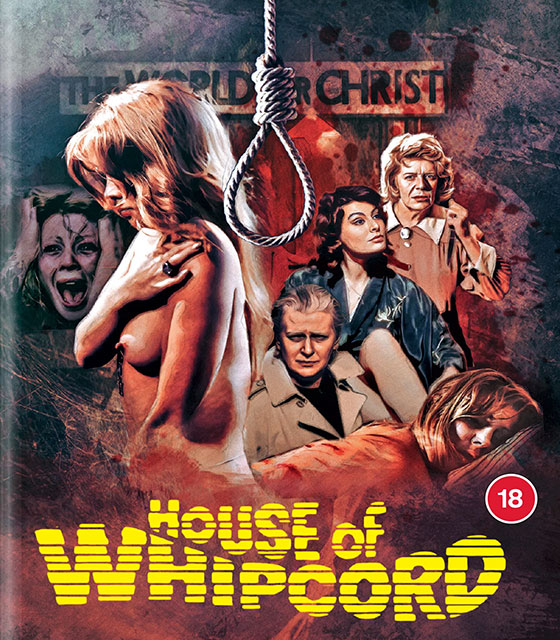
Directed by Pete Walker, House of Whipcord is an unsettling yet engaging example of British exploitation cinema, blending horror and social commentary into a dark and disturbing narrative. It’s a film that’s both of its time and oddly timeless, as it critiques moral authoritarianism through the lens of a sadistic prison system masquerading as a reformatory for wayward young women.
Plot Overview
The story centres around a young French model, Anne-Marie (Penny Irving), who, after a string of rebellious behavior, is lured into a twisted correctional institution by her seemingly charming new boyfriend, Mark E. Desade (played with eerie charm by Robert Tayman). The institution is run by Mark’s fanatical mother, Mrs. Wakehurst (Barbara Markham), and her sadistic staff, who enforce draconian punishments under the guise of moral reform. The women imprisoned there are subjected to brutal treatment, including floggings and solitary confinement, with the ultimate punishment being death if they “fail” to reform.
Speaking of Markham, she steals the show as the vicious and self-righteous Mrs. Wakehurst, her cold demeanor and authoritarian delivery making her one of the film’s most memorable characters. Penny Irving gives a sympathetic portrayal of Anne-Marie, conveying vulnerability and desperation as she slowly realizes the horror of her situation. Sheila Keith also delivers a chilling performance as the sadistic warden, Walker’s frequent collaborator adding layers of menace to the film.
Walker critiques Britain’s hypocritical moral conservatism, represented by Mrs. Wakehurst’s belief in discipline and punishment as tools of redemption. However, the film is never heavy-handed, allowing its allegorical elements to emerge naturally from the narrative. House of Whipcord exposes the inherent dangers of unchecked authority and blind adherence to “moral righteousness,” particularly when those in power justify cruelty as a necessary evil.
House of Whipcord taps into a fear of authoritarian control and the abuse of power under the guise of moral correction. The film’s central conceit—the punishment of women for perceived social transgressions—can be seen as a commentary on the misogyny and puritanical attitudes prevalent in British society at the time. The institution functions as a microcosm of broader societal pressures, where women are expected to conform to specific moral codes or face brutal consequences.
Pete Walker’s direction is restrained compared to some of his other exploitation films, allowing the grim atmosphere to speak for itself. The film’s visual style is bleak, mirroring the oppressive tone of the story. Walker uses stark, cold settings to evoke a sense of hopelessness, and the austere environment of the prison underscores the emotional and physical deprivation experienced by the women trapped inside. Walker’s film isn’t without its flaws, though. Some scenes feel repetitive, and the pacing can drag, particularly in the middle sections. However, these shortcomings don’t detract too much from the overall experience, as the film maintains a sense of creeping dread throughout.
House of Whipcord is a chilling exploitation film with a sharp social edge. Though it leans into the conventions of the genre with its provocative themes and shocking moments, it transcends mere sensationalism with its critique of authoritarianism and moral hypocrisy. It’s not a film for everyone – its grim atmosphere and depictions of cruelty may be off-putting to some – but for fans of British horror and exploitation cinema, it’s a powerful, thought-provoking watch.
In the context of Pete Walker’s filmography, House of Whipcord stands out as one of his more serious efforts, blending horror and social critique in a way that resonates long after the final frame.
Special Features:
- Brand-new artwork by Sean Longmore
- Reversible sleeve featuring original poster
- Audio Commentary with film critics Kim Newman, Barry Forshaw and writer David McGillivray
- Audio commentary with director / producer / co-writer Pete Walker, and director of photography Peter Jessop; moderated by biographer Professor Steven Chibnall (2006)
- Courting Controversy – An Insider’s View of the Films of Pete Walker
- House of Walker – Interview with director Pete Walker
- Return to the House of Whipcord
- Sheila Keith – A Nice Old Lady?
- Original Trailer
**** 4/5
After being released as part of the Pete Walker Collection, House of Whipcord is out now on standalone Blu-ray from 88 Films.