
‘Nova Roma’ Board Game Review
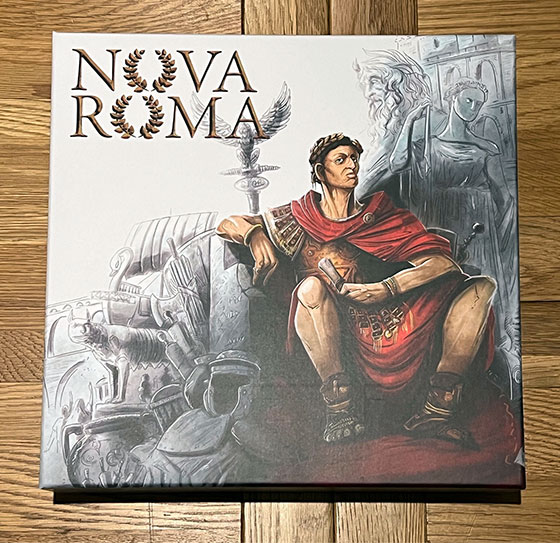
Of all the themes I might name for board games, Ancient Rome – alongside trains – might be the most popular. Not a month goes by where I don’t see a new game, whether it be a war game or a strategic eurogame that the idea of advancing the glory of Rome doesn’t come into the equation. To be honest, that’s OK by me since I am quite a fan of the theme – and the most recent game to grace my shelves along these lines is Stan Kordonskiy’s Nova Roma.
Kordonskiy is already a well-known designer, with credit for games like Rurik: Dawn of Kiev, Dice hospital and a couple of games in the Valeria series, so when I saw Nova Roma had launched I felt optimistic about what he would do with the theme. As it happens, Nova Roma just about lives up to my expectations – albeit with the caveat that I don’t think it does anything radically new or different.
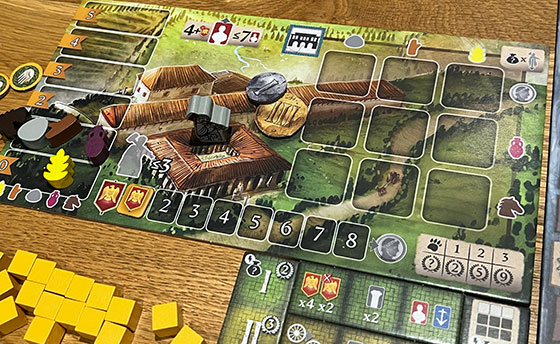
Nova Roma is a game in which the players act as powerful patricians under the rule of Emperor Constantine. The year is 324 and Constantine has founded the titular city of “New Rome” on the foundations of ancient Byzantium (later known as Constantinople and now, Istanbul.) Constantine needs powerful friends in order to establish the new city, and between the players, we will construct buildings, expand trade, gain influence and hire staff, among a whole host of other actions.
Essentially a point salad game, Nova Roma scores players for doing all of these things and more – with most of the points coming from things that the player does to advance the city, and then a smaller numbers of points (but not an insignificant amount) coming from personal achievements that link to those advancements, and which are unique to each player and selected either randomly or via a draft during the setup of the game.
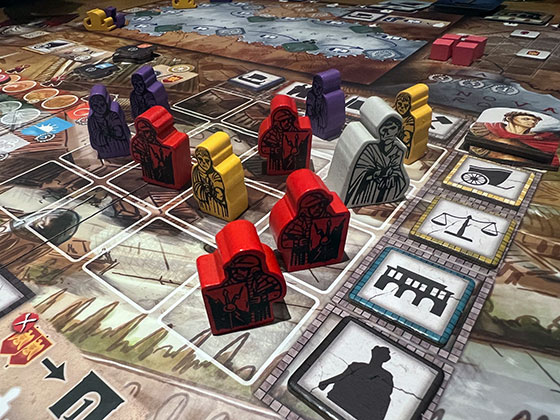
Whilst constructing buildings, farming your own lands, trading and recruiting are pretty standard fayre in this type of game, what Nova Roma does differently is the implementation of a central action selection board with a unique power mechanism. This basically offers a grid wherein each location corresponds to two of the in-game actions. When a player places their piece on one of these spaces, they will therefore trigger two actions – one on the X-axis and one on the Y-axis.
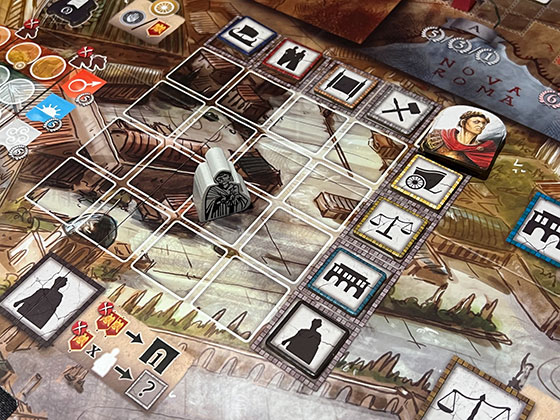
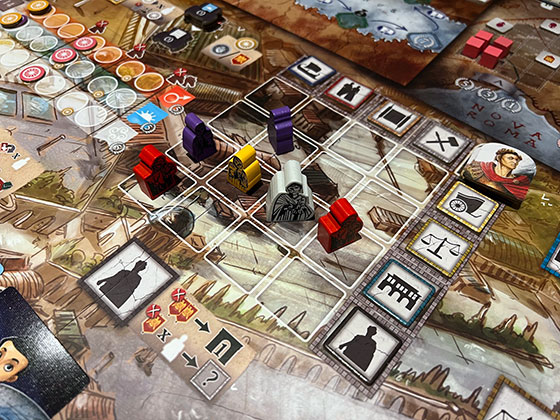
Each action is done at a power of between one and three – with the power level determined by who else is present on the row or column. In short, your played piece is worth one strength on its own, and then if either the Emperor Constantine or another figure of your own is on the same axis, then your power will gain plus one strength for each. This basically means that if you can place your piece onto a row or column where you have already placed another piece (or two) or if the Emperor is there, then each one will add plus one strength up to a maximum of three.
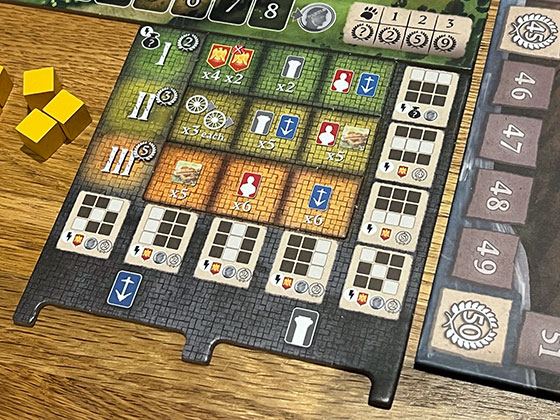
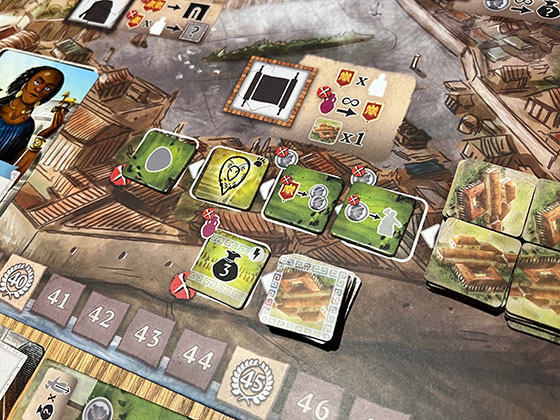
There are lots and lots of actions in Nova Roma and it would be laborious to list them all here, but they are all affected by the strength of the action you perform. To list a couple of examples, if you were to take a building contract then you would look at the four cards available and from left to right you would see one card at strength one, one at strength two and two at strength three. If you did a power one build action, then you would only be able to access the first card. Another example is recruitment – at strength three, you can recruit a follower card for free, at strength one or two, it will cost you one to two coins respectively.
I realise I have slightly contradicted myself already by describing how this power mechanic is unique, and because I said that Nova Roma does nothing particularly new, so let me qualify for a moment. The power mechanic is unique, clever and cool, but it feels very natural – almost to the point that it doesn’t feel new even though it is. I have seen similar mechanics such as the scoring in Terracotta Army, for example, but this system is pretty cool as used here. That said, the actions you take in Nova Roma – when taken separately to the action mechanic – are completely standard Eurogame fayre.
What impressed me about Nova Roma is how well it implements these actions, how they come together as a well-balanced whole and how naturally the action strength system integrates into the classic action selection so naturally, with very little complex rules overhead. The only issue we had with this was that I had to explain several times that pieces controlled by other players did not contribute to the action strength, which for some reason seemed to be a recurring question.
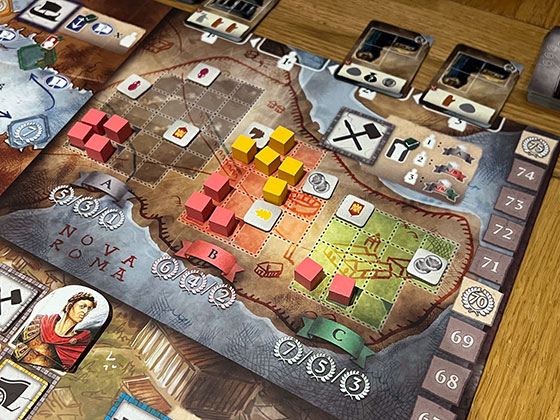
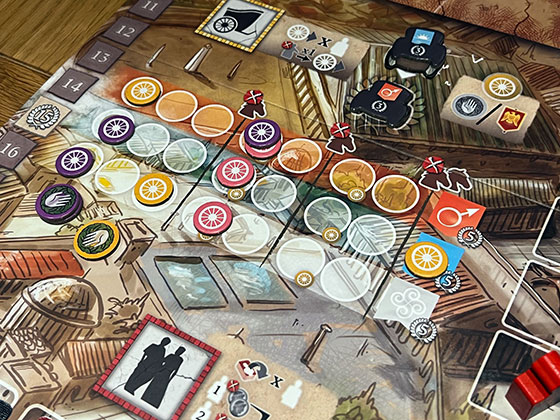
Aside from that, scoring in Nova Roma feels super, super clever. Nothing is scored until the end, so some players may be a bit anxious about not being able to work out there standing at any given time, but what really impressed me was how the different strategies (building, recruiting, focussing on trade and travel or even collecting animals and advancing your own estate) all come together at the end to result in very tight scoring. The only thing I would recommend – as I hinted earlier – is not to neglect focussing on your own achievement board, as this makes a real difference.
With art from “The Mico” and a very solid design from Kordonskiy, Nova Roma is a good-looking and very solid, but perhaps somewhat unremarkable game – but I say that with the greatest of respect. Sometimes it’s absolutely fine (and even better) to do something straightforward and familiar really, really well – and that’s what Nova Roma does. It is a “big” game to teach because there are so many actions, but each one in isolation is completely logical and easy to explain, whilst the action power mechanic adds a thoughtful twist that only ever enhances the experience.