‘The Mandalorian: Adventures’ Board Game Review

Whilst Unexpected Games is a relatively young publisher with only a few game credits to its name, the backing of legendary designer Corey Konieczka brings a lot of weight with it. The Mandalorian: Adventures is the first licensed game that Unexpected Games has published, but Konieczka himself has worked on countless big IP’s as well as many games that have significant lore in the board game community alone. Just some of his titles include Star Wars: Outer Rim, Forbidden Stars and the legendary Twilight Imperium IV. When Konieczka releases a new game with an IP as big as Disney’s Mandalorian – you can’t help but pay attention.
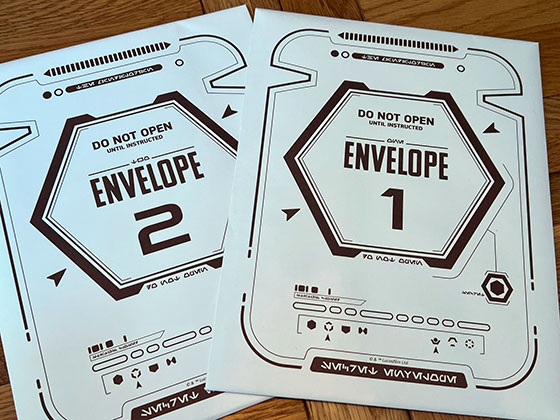
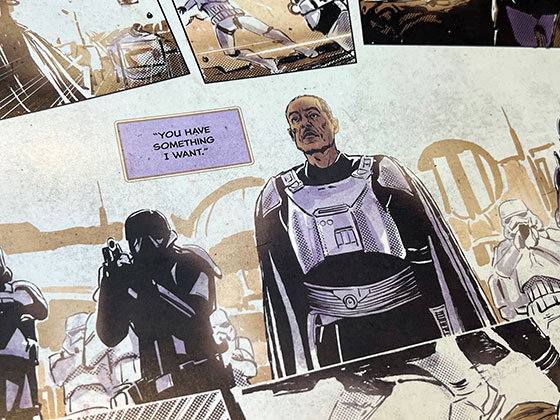
Putting that aside for a moment though – and it’s important to stay balanced. There are loads of licensed games, especially in the Star Wars universe, that simply don’t hit the mark. The Mandalorian: Adventures starts off with some good ideas, including two “secret” envelopes that I won’t spoil here, and a storybook-based map that borrows its concept from games like Stuffed Fables or Gloomhaven: Jaws of the Lion. I like less the fact that beyond these two things, most of the other components are cards and tokens – with just a few standees for the player characters. There are gameplay reasons for this which I’ll cover shortly, but I do find it hard to swing from some of the “super deluxe” games (which I find vulgar for the opposite reason) that we see nowadays to something that feels so flat and two-dimensional.
Having said that, the tokens in The Mandalorian: Adventures are such because of the semi-randomised manner in which most of the missions are set up. Each token has a number and a shape on it, and these numbers and shapes correspond to each of the maps, and specific spaces on those maps. This ensures that certain objective tokens, enemies and other features that might crop up only appear in the spaces where they are supposed to. Common tokens might be randomised over six or seven spaces (usually just basic enemies) whilst key mission elements like objectives or bosses might be randomised over just a couple of spaces, perhaps within a building or something like that.
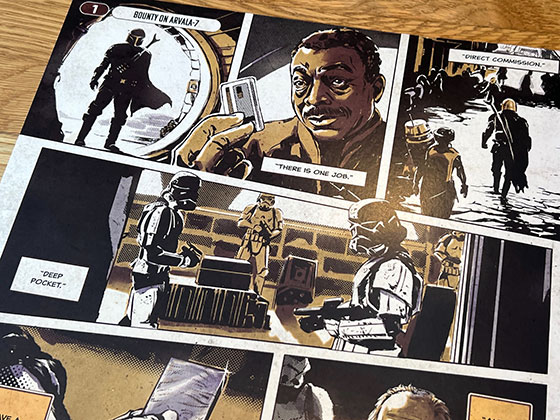
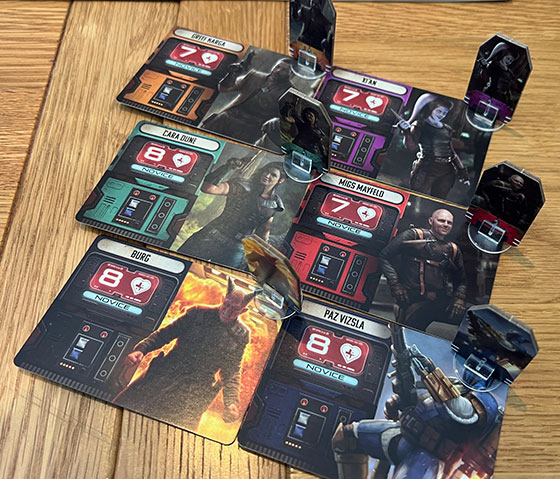
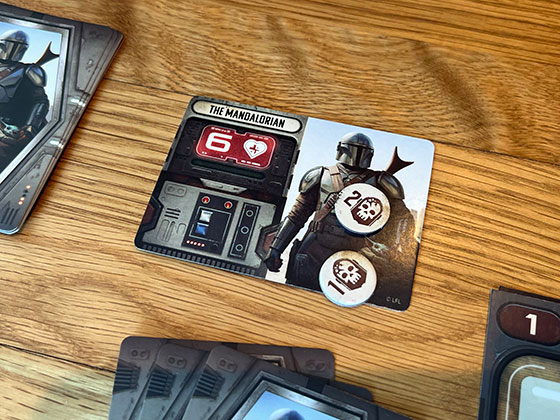
The objective of each mission – or adventure, if you’re going by the title – will vary, but they include themes from the TV series that will be familiar to anyone who has watched it. The first mission, for example, involves retrieval of a certain “asset.” Each adventure can be undertaken by one to four players and can include any of the available characters in the game, but each adventure does include a recommended character setup that reflects those who were present in that particular episode of the show. I’ll be honest, playing with more than two players often results in having to share characters, which is less than ideal. Let’s be honest, The Mandalorian: Adventures was always going to be as much about how Unexpected Games captured the theme of the show as much as anything.
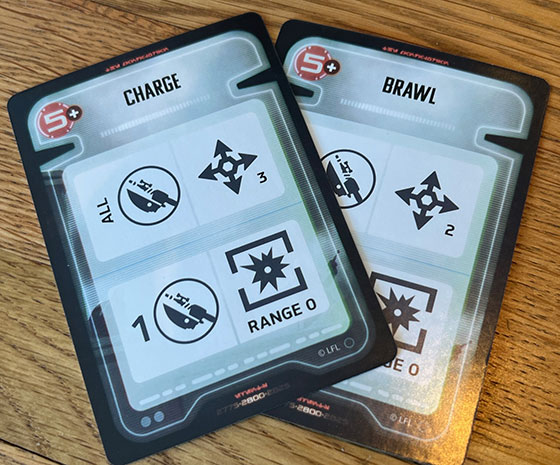
Perhaps the bit where having a fantastic designer comes into its own is the actual mechanism by which actions are taken in The Mandalorian: Adventures. Each character has a unique deck of twelve cards that offers thematic and relevant abilities that can be used by them alone. On their turn, a character will take exactly two actions – which they will do by playing one card (from a hand of four) into any of the four actions shown on the bottom of each adventure map. These actions are Move, Attack, Intel and Plan. The card you place on the action dictates the strength – with higher numbers leading to a more powerful action, and some cards have bonuses associated with certain actions (meaning that pairing them is a good idea).
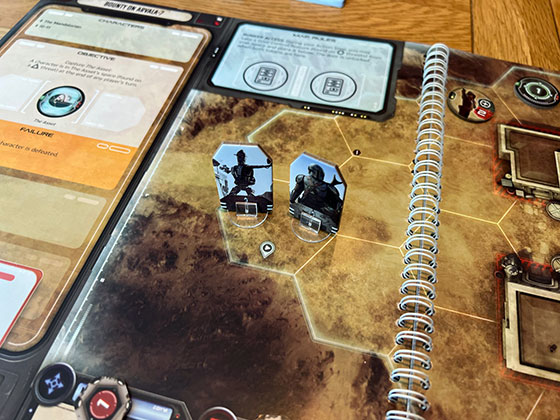
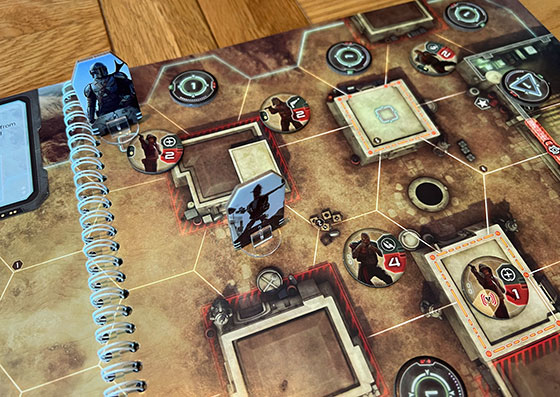
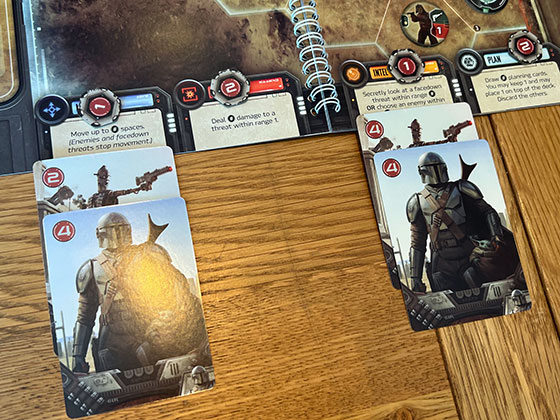
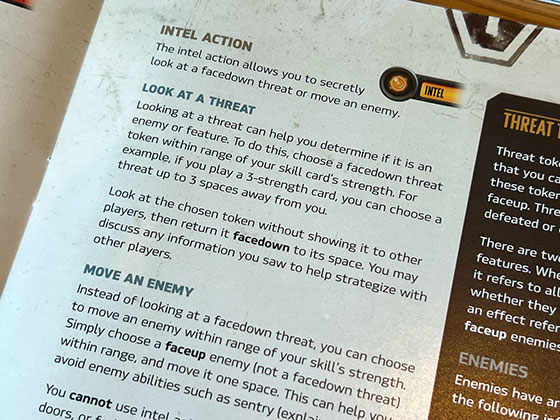
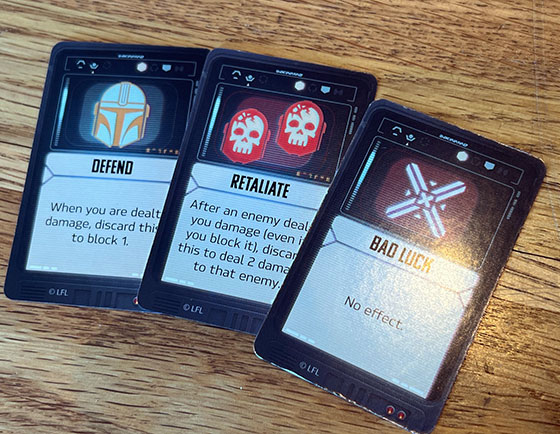
Move and attack do obvious things, whilst Intel allows the player to look at tokens within a certain range – thus determining the strength of a specific enemy, or the location of an objective token. The Plan action is quite interesting and pretty unique to The Mandalorian: Adventures – with the player drawing cards from a separate planning deck and choosing one to keep. Planning cards offer unique and often powerful bonuses – perhaps allowing the player to take out a threat immediately, or to block damage that otherwise might be taken. It’s also worth noting that when cards are placed on actions, they will stay there for a while – which has a specific purpose all of its own.
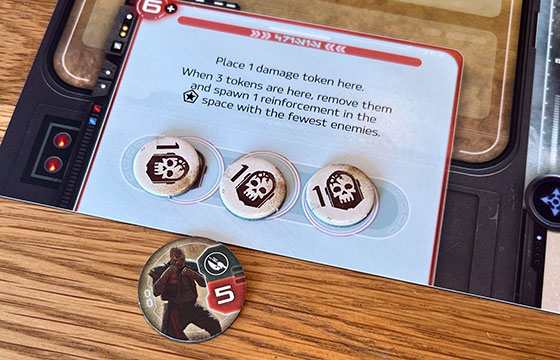
Whenever the total number of cards (and sometimes tokens, usually placed during setup) reaches either five or six, then an event or even a crisis will trigger. Events are drawn from a specific deck, and will affect the adventure in a wide variety of ways – but most commonly they will cause enemies to move, attack or spawn. When the crisis is triggered, the effect will always be unique to the specific adventure, but to use an example from the first adventure, each crisis trigger will place a single damage token on the crisis box, and when three damage tokens are placed there, they will be exchanged for an additional enemy spawn. This example isn’t too bad actually and isn’t any worse than most events (if not actually better for the players) but in most cases, players will want to avoid getting an action slot to six if they can.

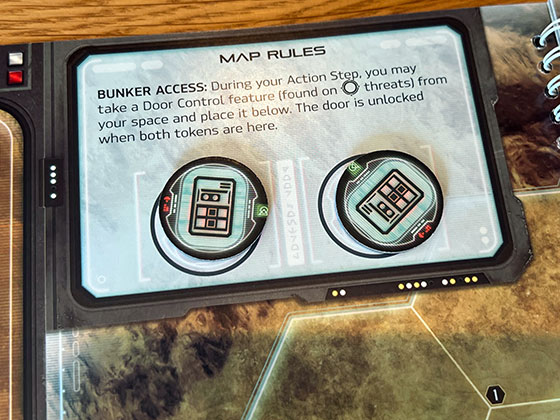
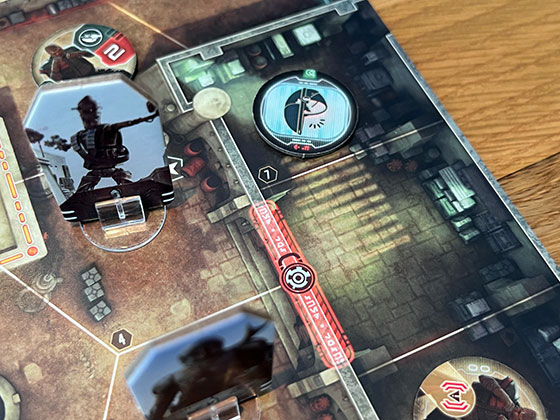
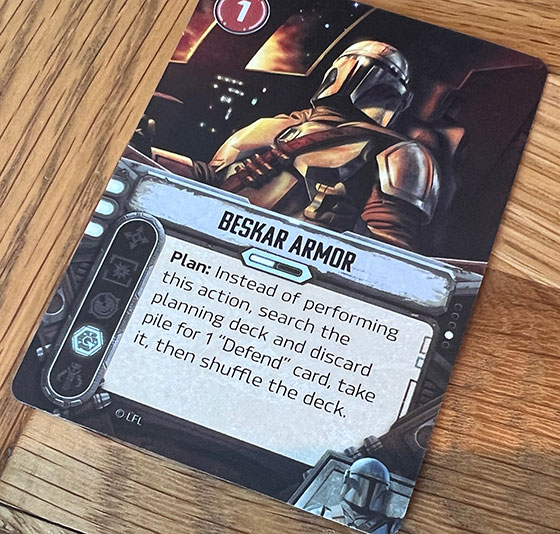
Whether an action space reaches either a five or a six, it will then be cleared down – with all cards placed onto it returned to their owner’s discard piles (for reshuffling if necessary.) I have to say, this system is, without doubt, the cleverest part of The Mandalorian: Adventures, leading to some very cool decisions. You’ll often want to take an action using a powerful card, but in doing so you may trigger an event or a crisis – depending on the current state of the adventure, the difficulty level and what health you have (among other things) this may cause you to reconsider. Equally, the introduction of the planning card concept is a cool one, giving cautious players a way to build up some resources in-mission in a way that actually makes sense to the theme.
All that being said, I did find The Mandalorian: Adventures fairly easy, at least during the first three adventures. Any experienced gamer is going to want to use the veteran rules fairly quickly, and I was also a little disappointed to realise that there are very few maps here – with some reused to extend the game further. These days, I expect at least ten or so unique experiences as a minimum from adventure games like this, and let’s be honest, Gloomhaven: Jaws of the Lion delivered about 30 for a price point that was actually lower (admittedly without a costly license.) I like the system here a lot, but just as soon as you’re used to it, the game is over – even including the content that the two secret envelopes include.
On that note, I am really keen to spoil some of the new mechanics and features that are introduced through these envelopes, but I really don’t think I should. One thing I will say is that there is a secret traitor mechanic which fits perfectly with the theme, but I’m only mentioning this because it is actually spoiled in the official description of the game. Let me just say then that the secret content adds a few more mechanics and rules which I universally enjoyed, and it does add replay value to the content you’ll find in the “out of the box” experience.
Overall, The Mandalorian: Adventures is a really fun game that is underpinned by a very clever design which I hope to see reused in a larger, more expansive experience. The limited replay value and general size of the game is a slight drawback for me, but I would also say that for a casual gamer who doesn’t play board games most evenings, there may well be more than enough here to satisfy. Fans of the Disney series will also love the authentic characters, settings and adventures, which for the most part capture the feel of the applicable episodes very well. I enjoyed both the theme and the mechanics, and as I always say, when these things come together well – you know you have a great game on your hands.