
‘Shipwrights of the North Sea: Redux’ Board Game Review
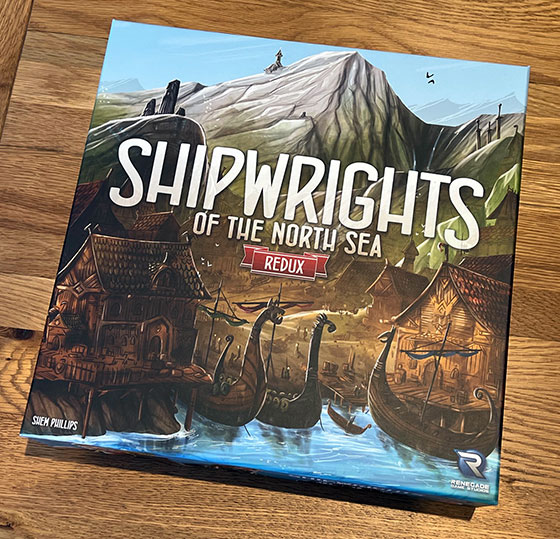
When I first played Shipwrights of the North Sea a few years ago, I really didn’t enjoy it. I can’t recall the specific issues, but I do recall there being a huge amount of negative interaction between players, with cards that take resources away from you just as you are about to use them, and a general sense that randomness would win the day over strategy as often as not. As unusual as it is, Garphill Games seem to have taken this feedback on board (not just from me, but from the community) to release Shipwrights of the North Sea: Redux, which is basically a completely new game that uses the same theme and concepts, but with many different mechanics.
Just as the original Shipwrights of the North Sea appealed to me, so too does Shipwrights of the North Sea: Redux – thanks mainly to the Viking theme, the excellent artwork (from Mihajlo Dimitrievski) and the generally high standard of Garphill Games products overall. Garphill Games cautiously advises that Shipwrights of the North Sea: Redux is an entirely new game – sharing only the theme. I have to admit, my first impressions quickly confirmed this, and the new Shipwrights of the North Sea seems to have removed all signs of player interaction altogether, favouring a game that feels very much like multiplayer-solo play, albeit with a drafting element.
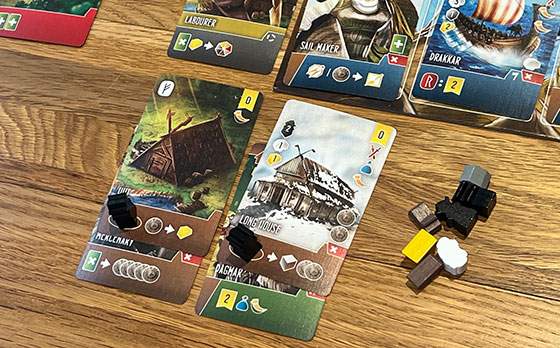
However, Shipwrights of the North Sea: Redux does offer quite a fun experience – and it’s one that I enjoyed a lot more than the original game. Players effectively operate a Viking village as it grows through the drafting of cards from a town deck. Within this deck you’ll find craftspeople, jarls, normal townsfolk such as traders or raiders, ships and buildings – and you’ll need to balance the recruitment of these into your personal tableau. At the centre of each player tableau is a board onto which up to five ships or craftspeople can be played, whilst buildings are placed directly below the board, and ships (only when complete) are placed above it.
In terms of drafting, the rules vary somewhat by player count, with specific rules for one, two and three or more players all explained. Regardless of which variant you play, you’ll always end up with six cards per round and then you’ll use all of them. Any card can be discarded to take a resource (as shown on the bottom left of the card.) Other cards work in various different ways, with craftspeople being played either under a building card (where they take up residence) which costs one gold, but lasts for the rest of the game, or onto one of the five town board spaces – which is free, but means that once they are used, they will leave.
Ships must also go onto the town board to indicate to others that you intend to build it later, but buildings can be built straight from hand. Jarls are simply placed into (under) a building for endgame points and progression on one of the three central tracks (more on that later) or discarded for gold – and no other card provides gold when discarded. There are several other card play connotations that need to be considered and this does add complexity to Shipwrights of the North Sea: Redux, but it’s not too bad – and the flexibility of multi-use cards is always welcome in a game like this.
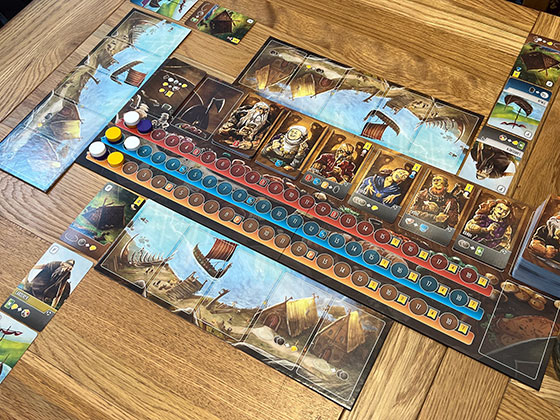
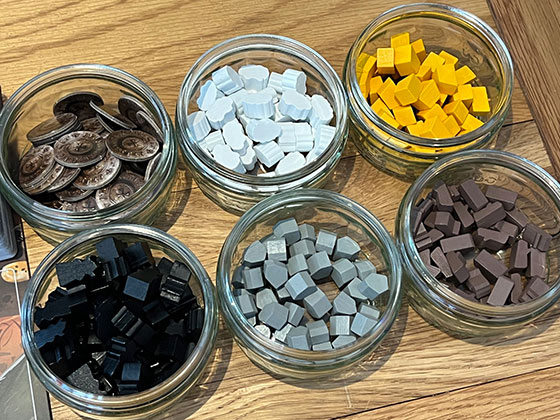
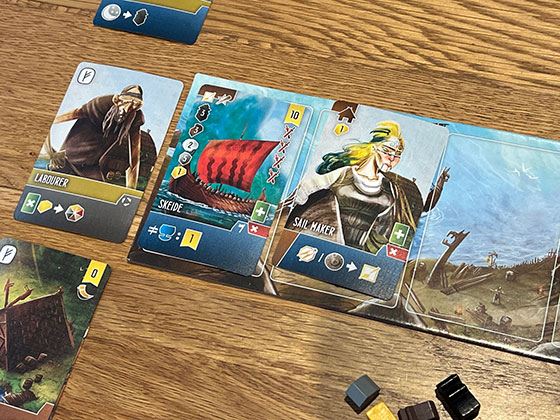
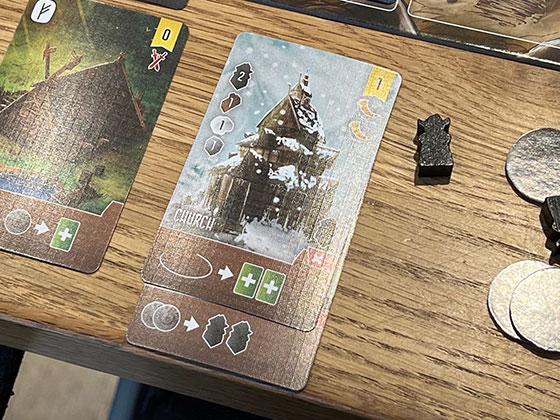
Other actions include using the workers that a player has collected to activate buildings. Almost all buildings have a worker placement space which can be used once per round, with whatever the building depicts being the benefit. This is usually gaining resources or silver, but can sometimes involve doing a favorable exchange of resources (where a standard trade action is always pretty bad value for money.) If a building has a craft or townperson in it (not a jarl) then it will almost always provide an additional benefit – with most craftspeople offering symbols that are used in shipbuilding, and townspeople offering more resources or trade options.
The object of all this, apart from the small amount of points gained from buildings, is to amass enough resources and crafting symbols to build ships – which are worth lots of points. With a ship on your town board and enough resources and symbols, a ship can be built, adding not only points, but also progression again on one of the central tracks and potentially the opportunity to gain income in future turns. If it wasn’t obvious already then, Shipwrights of the North Sea: Redux is partly a drafting and hand management game, and partly an engine-building game – with the latter coming from the income that steadily increases during the game, as well as a few other things which I’ll mention now.
I’ve talked about three progression tracks, and these broadly represent military might, trade power and renown or fame. As players progress along these tracks, they will gain access to additional cards and benefits – with the military track leading to bonus “raid” cards that can be plundered each subsequent round, the trade track offering trade cards that have a similar outcome and then the renown track offering the chance to upgrade the basic ship, labourer and hut card that each player starts with onto its more powerful side. At the end of each round, any player who is leading on a track will also gain the associated hero card for the next round, and again heroes provide important symbols and benefits that can add to your engine.
Now this is all very clever and I quite enjoy the flow of the game, but having already mentioned that Shipwrights of the North Sea: Redux is quite a solitary experience, let me just double down on that so you can decide if this is for you. Let’s say you play a three-player game – you’ll draw six cards, choose one and then hand the remainder to your neighbour. Then, you’ll receive five cards from your other neighbour and take one, passing the remaining four. You’ll do this until you have six cards. Then, in the action phase, you will resolve all six of those cards plus any other additional actions (such as placing works on your own cards, or building ships) until you can do no more. Everyone else will do this for their own village at exactly the same time.
After actions, you’ll all then look at where you’ve ended up on the three progression tracks, and you’ll sort out which hero belongs to who from there – this might include assigning previously unassigned heroes to whoever is furthest on any one track, or it might mean taking a hero off someone else if you passed them on the relevant track. Either way, it’s not something that I would consider to be interaction, and the exchange is very transactional – and at this stage in the round, it simply happens and cannot be undone by any hidden information, trickery or otherwise (because there is none).
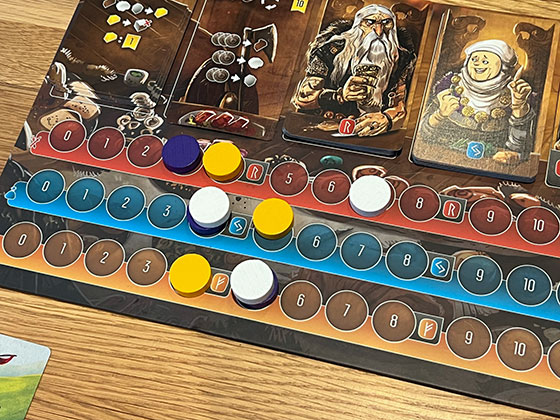
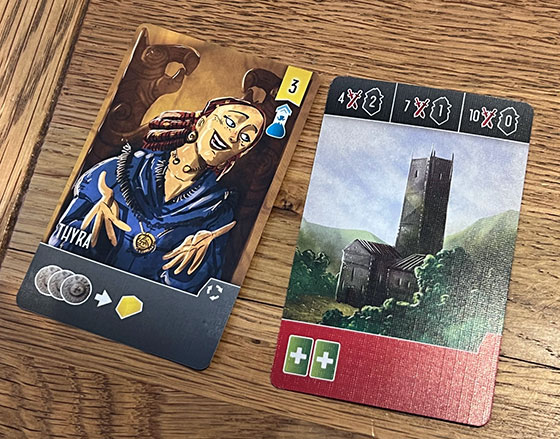
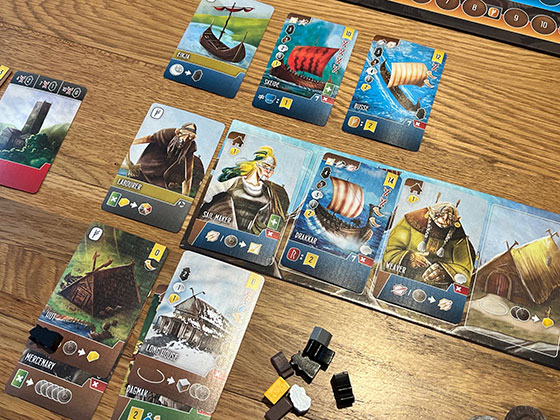
In some ways, this means that the design space for Shipwrights of the North Sea: Redux has gone to the complete opposite end of the spectrum to where Shipwrights of the North Sea was, which as I mentioned earlier could be far too mean and often very random. In Shipwrights of the North Sea: Redux you see twice as many cards per round and the randomness is therefore much reduced, but the player interaction has gone from “too much” to “absolutely none at all.” I’d go so far as to say that Shipwrights of the North Sea: Redux is a solo game that you can all play at the same time, with the only real way to influence what other people see or do coming in the form of the draft.
However, that doesn’t make it a bad game – and in fairness there’s a lot to like about Shipwrights of the North Sea: Redux, especially when compared to the original version. This is a rewarding feeling game that constantly gives you stuff. All six of your cards are going to become buildings, ships, members of your community or resources, and the decisions come in the draft about what you need most at any given time, and then in the moment when you get the six cards you end up with and potentially have to pivot away from your initial idea. Yes, it’s a shame that there isn’t some interaction (even if limited to the central board), but there’s definitely a place for Shipwrights of the North Sea: Redux in my collection and I have to say that it’s a fun, clever design that definitely feels more like the rest of the Garphill Games range.