
‘Word Traveler’ Board Game Review
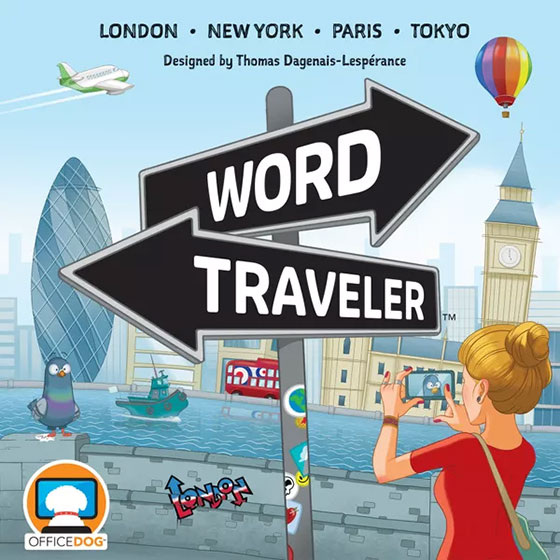
In Word Traveler, a group of players represents friends who are on a trip together. Each player carries with them a map of places which they’d like to visit (represented by a small card that is kept secret) and must work with the other players to visit as many of their desired locations as possible. Each location scores either one or two points (as shown on the secret card) and at the end of two rounds of exploration, the players will score jointly to see how well they’ve done. There is no competitive mode in Word Traveler, and therefore this is quite a relaxed experience that works well for family game nights.
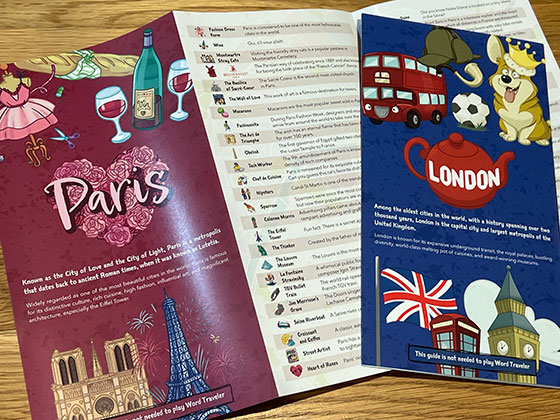
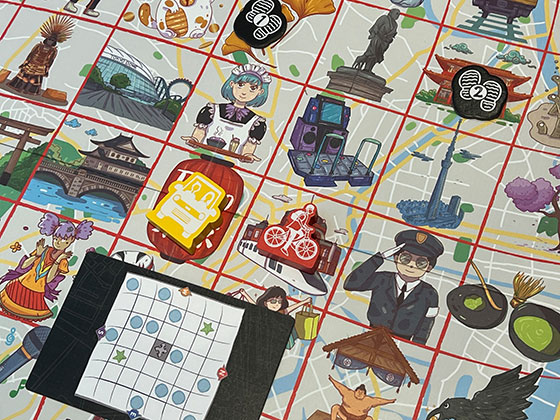
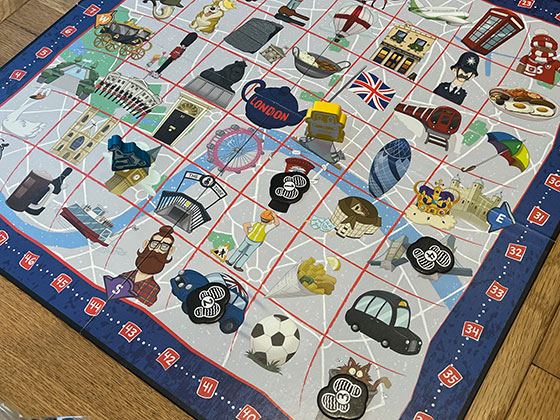
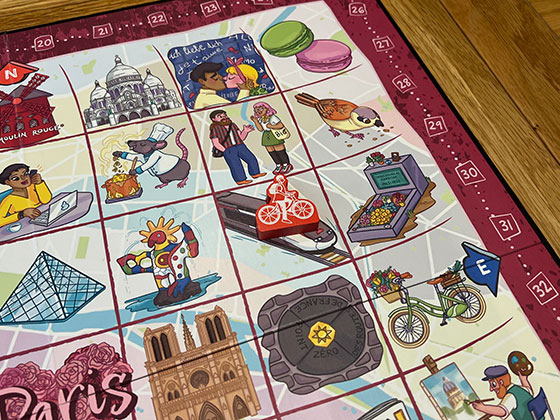
Included in Word Traveler are four maps across two boards (both of which are double-sided) depicting four cities – Paris, New York, Tokyo and London – and it’s nice to see a little “Tour Guide” booklet for these cities included, which again increases the interest for families. Even though the boards are quite abstract (because they need to be for gameplay), the theme in Word Traveler just about comes through. Examples of the symbols on each map include the likes of hot dogs, the Statue of Liberty, the Arc de Triomphe etc, so for young players there’s an opportunity to explore the guidebook or ask their parents what some of the more iconic elements are about.
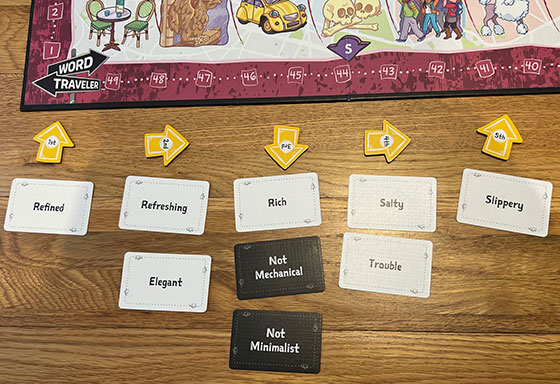
With a board chosen and a secret map handed to each player, the first planning phase begins. During this phase, each player will use three arrow tokens to point in a direction (relative to their starting position) and place word cards below them to indicate a clue. For example, if the Status of Liberty space is three spaces above you, then you might place an arrow facing upwards and then use a card (or cards) with words like “Majestic” or “Justice” on them, depending on what you think your friends will be able to guess. With one or more cards under each arrow and all players ready, the next phase begins.
In this phase, players take turns to assess the combinations of arrows and words in turn. If there are three players, then Players A and B will assess Player C’s clues and then move them accordingly… If we continue the example above and assume that Player C has placed the clue to the Statue of Liberty, then Players A and B will look upwards from Player C’s starting location, and whilst they won’t know how many spaces the player has indicated, they will see the clue (Majestic) and be faced with choices such as the hot dog we mentioned earlier, maybe someone walking a dog (not very majestic) or a perhaps a newspaper – plus of course the statue herself. In this example, it should be no problem to choose the Statue of Liberty and move Player C’s piece there, in which case Player C would inform them that they had scored one or two points (as shown on Player C’s secret map.)

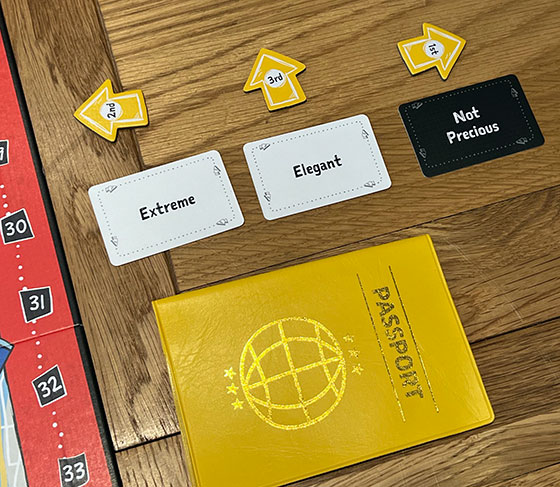
The tricky bit for younger players during planning can be the next bit – which is that the player must plan their second and third moves (and fourth and fifth in the second planning phase) from where they THINK the players will now have put them. This can be quite an exercise in visualisation for young children, who are both struggling to link clue cards and arrows to locations and at the same time, keep in mind where they believe that set of clues will start from. The other challenge, of course, is the limited pool of clue cards – with some locations being a real struggle to match to words. On the plus side, any word can be flipped to its “negative” side, so for example with the “Majestic” card, on the rear it says “Not Majestic” which at a pinch could be used to describe a trash can, or maybe the hot dog I keep coming back to.
The good news is that Word Traveler isn’t too punishing even when things go wrong. The secret maps all have lots of scoring locations on them, so even if you end up guiding your friend wrong, you can still score a couple of points. The worst thing that I have found is when the first clue goes wrong and takes a player badly off course, as this can make all the following clues a bit irrelevant. To mitigate this, players can discuss the second, third or later clues before committing to an earlier move, so if a first move makes a lot of sense but then the second and third don’t… You probably need to look at that first move again.
Our experience with Word Traveler was generally good, especially with our eldest child who is nearly ten now with good literacy skills and a decent understanding of the world through films and popular culture. Anyone younger than about this age (including one of our younger children) really could struggle with the set up of clues during the planning phase, and perhaps to a lesser extent, the guessing of clues by matching occasionally complex and almost always abstract words against generally abstract images. Word Traveler is officially aimed at children of ten plus, so this isn’t really a surprise, but it’s a shame that I couldn’t make it work in the way that I often am able to for our younger children.
Regardless of some of our unique challenges, if you have an audience of the right age an interest level – perhaps the peak being casual adult gamers with an interest in travel – Word Traveler is pretty good fun. The components are nice quality and feel quite generous with a surprising amount of extra stuff in the box to make the experience a good one, and the number of maps, secret cards and words keeping things fresh. The planning phase is a fun but taxing, and the travel phase can cause some really interesting debate and discussion – particularly as the number of players increases the variety of opinions expands. Overall, Word Traveler is a fun addition to any casual game shelf, and it’s not at all bad to ignite interest in travel among your pre-teen kids either!
***½ 3.5/5
A copy of Word Traveler was supplied by Office Dog for review.