‘Star Wars Unlimited: Spark of Rebellion Starter Set’ Review
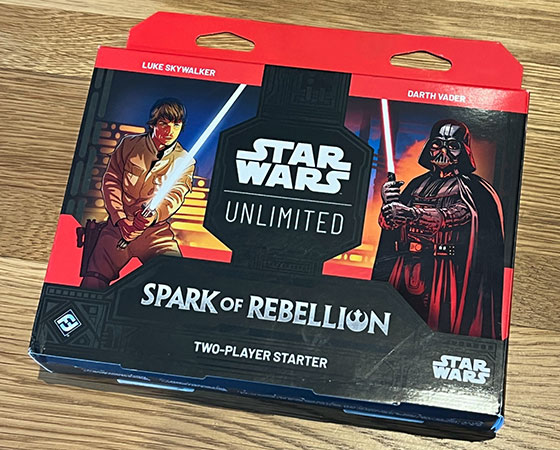
It seems barely days ago when we first received a few images of cards from the upcoming Star Wars: Unlimited Trading Card Game (TCG) set, but here we are with a copy in hand and an official release date of 8th March. We’re lucky enough to have been sent the Spark of Rebellion Starter Set to review, and in this set we receive two complete 50 card decks, complete with a leader, a base and three tokens each. Being a massive fan of TCG’s in general and of Star Wars, I can hardly wait to tell you about Star Wars: Unlimited, so I’m just going to dive straight in.
Star Wars: Unlimited is a true TCG – rather than a Limited Card Game (LCG) such as Star Wars: The Card Game. TCG’s are usually available with weak to mid-level starter decks (such as those we’ve received) and as booster packs or pre-release sets that enable either organised drafting or deckbuilding events, or organised play based on a specific set of living rules. Star Wars: Unlimited is certainly available in all these formats, so whilst I suggest the starter decks as a cost-effective and simple way to start the game, more experienced TCG players could start with a pre-release draft or just a box of boosters.
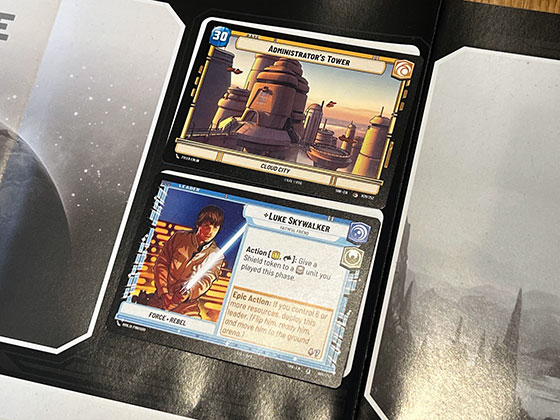
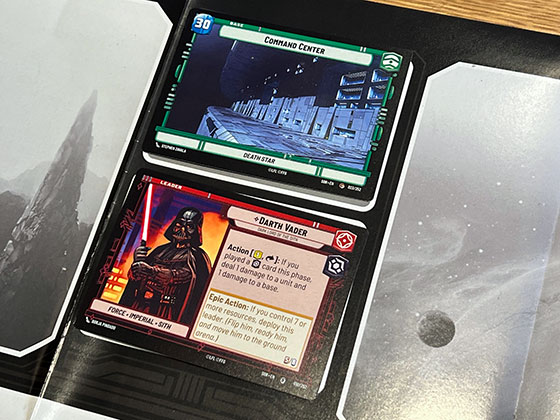
As with all TCGs, Star Wars: Unlimited has some deckbuilding rules, and in this case the main one seems to be that each card can only exist three times in your deck. Players must also choose a base (and these seem to be purely thematic, with no difference to life total, and no added effects – but I expect that will change) and a leader, such as Luke Skywalker or Darth Vader. In the starter deck, each side has three aspect symbols spread across their base and leader, and these aspects form the basis of the cards in each deck. A player may play a card that does not share an aspect with their leader or base, but it will cost them an aspect penalty of one additional resource for each aspect not shown on the leader or base.
Star Wars: Unlimited does a good job of getting players into the action quickly, with no cards wasted on mana or resource generation alone. Instead, during setup, the players draw six cards and then choose two of them to place face down as resources. It’s advisable to prioritise keeping cards that cost one to three resources at the start of the game, so it’s fairly sensible to put more expensive cards into your resource pool during this step, especially if you know you have multiple copies of that same card to come later. The first player to destroy their opponent’s base will win, and typically (at least in the starter sets) both bases have 30 points of health.
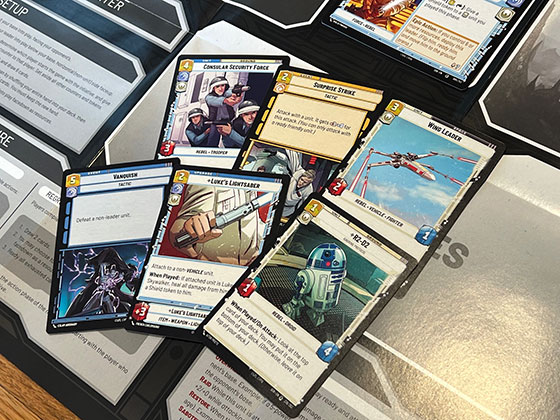
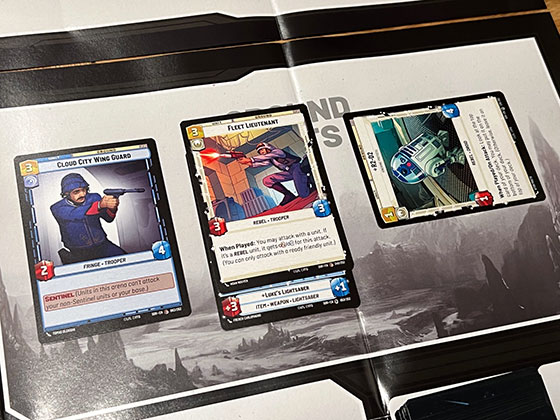
The turn structure in Star Wars: Unlimited is quite different to other TCGs, because there is effectively a shared replenishment step and then an action phase where players take turns to take actions – rather than one player taking all the steps of their turn and then the other doing the same. In practice, this means that a player might choose to play a card (by paying the cost), make an attack (by turning a card sideways and targeting either a base or an opposing card) or take an action printed on a card. The final action a player will take is passing – and if the player does so before their opponent, they will also take the initiative token for the next round.
There is obviously a benefit to taking the initiative, but when a player does so, they have to be aware that they won’t get another action – even if their opponent is then able to do multiple things before passing one after another. When both players have passed, the replenishment step allows both players to draw two cards (normally) and then to choose one card from hand to place face down as a resource. As you can imagine, the first round or two of turns are over fairly quickly, because each player has at most two or three resources to play cards with, and when they do play cards, they are exhausted quite quickly.
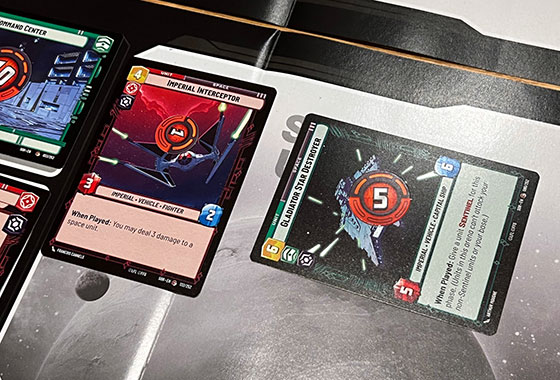
But this turn structure is not the only thing that Star Wars: Unlimited has up its sleeve. It also does interesting things with the types of units on the board. Both players will have access to both space units and ground units, and unless otherwise stated, the two zones will not interact. So quite feasibly (and often intentionally) a player might control over either space or ground areas, whilst their opponent is dominant in the other. I have no doubt that in deckbuilding terms, this adds something to think about, as perhaps it’s completely valid to focus on one area or the other entirely, and I don’t yet know whether there are (for example) ground units that can fire into space, or space bombers that can attack the ground. Whether they exist yet or not, I feel pretty sure they will at some point.
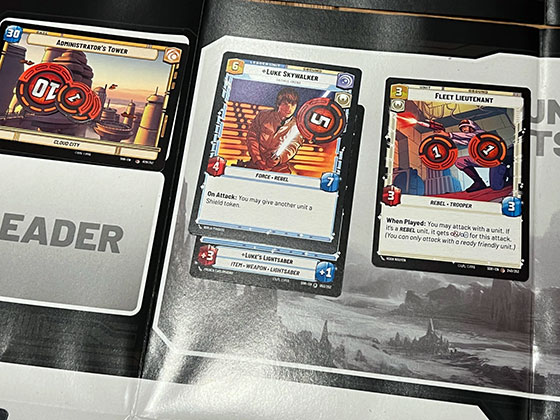
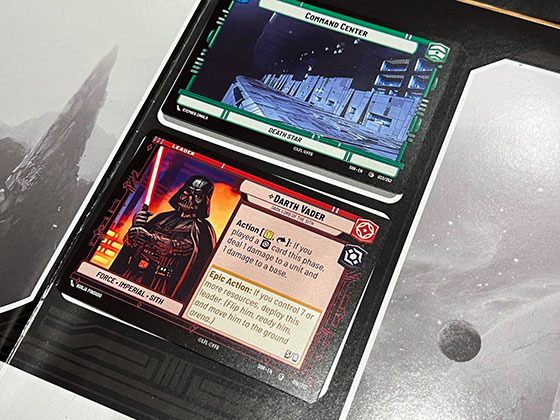
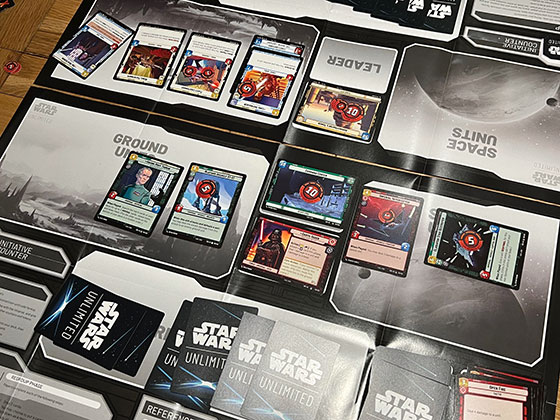
The final, and perhaps most interesting thing about Star Wars: Unlimited structurally is the leaders. In our starter deck we have both Skywalker and Vader (predictable but I won’t knock it) facing off across the table at all times. This means that you don’t need to add them to your deck, and you won’t ever draw them – they are just there from the start. However, leaders don’t begin as combat units in either the ground or the space zones, they just exist at a strategic level and have a single action that can be activated under certain conditions. Vader, for example, allows his controller to pay one resource and tap him to deal one damage to a base and a unit, as long as he’s played a certain aspect card during the phase.
What really makes leaders powerful in Star Wars: Unlimited though, is when their Epic Action triggers. This second feature basically allows the leader card to flip over and enter the fight as a combat unit, and in the Starter Set, both Vader and Skywalker are formidable opponents. Whilst both of these units are ground units in this set, I can definitely imagine future leader cards will include Skywalker in his X-Wing, or Vader in his own specialised Tie Fighter, and these leaders would appear in space. I could probably imagine a Han Solo in the Millenium Falcon as well, even though Han Solo appears as a regular unit in the Rebel starter deck I’ve been playing with. As always with TCG’s, the possibilities are endless and very little is off the table.
So far, I’ve been very impressed with Star Wars: Unlimited. The resource system is simple and reminds me of the use of cards as ink in Disney Lorcana, which allows players to pack their decks with cards they actually want (rather than land in MTG) and it means that resource flooding or drought is nowhere near the same issue as it can be. I also enjoy the turn structure and the way that players share a resource step and then exchange actions one after the other. This is a big change from most card games of this kind, but it really does seem to work. Most of all though, I love the leader system – and I should mention that if a leader is ever defeated, they simply flip and return to their strategic side, albeit with a token to show that they have been defeated and cannot return to the fight.
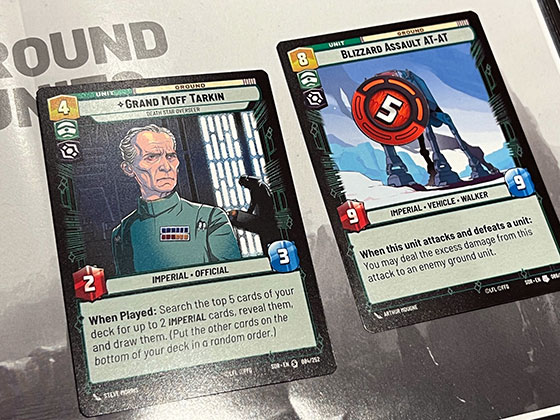
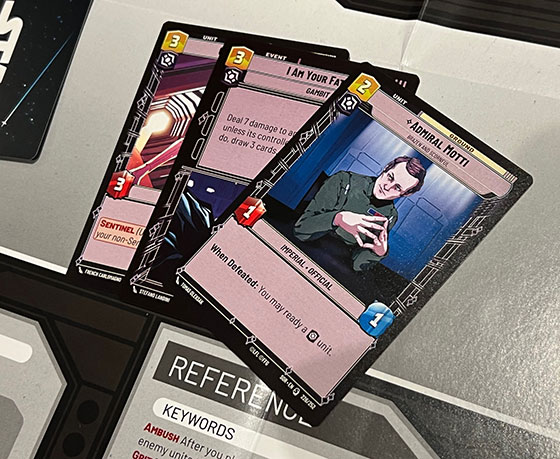
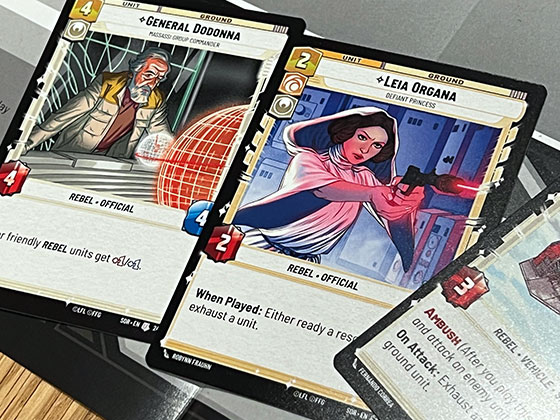
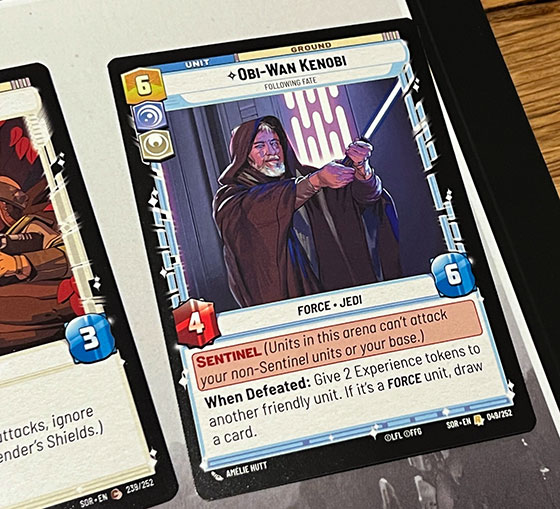
One thing that I haven’t mentioned so far is the artwork in Star Wars: Unlimited which is very stylised, completely unique, and absolutely fantastic. The artwork is clearly based on the core Star Wars movies, with characters such as Skywalker, Leia and Han all based on the actual movie counterparts, but with a cartoonish art style and a really pleasant, bright colour scheme. You’ll no doubt have seen the pictures by now and formed your own judgement, but for me, the artwork is filled with life, popping with colour and a lovely contrast to almost every other dark, moody TCG that I have in my collection.
Overall, I can only comment on the Star Wars: Unlimited Spark of Rebellion Starter Set experience because I haven’t had the chance to draft or deckbuild yet, but I can definitely see the possibilities laid out before me. With different leaders, bases that might possibly have features in exchange for lower life, and the different aspects to work with, plus the two fields of battle, there’s a lot going on. That said, the turn structure is actually simpler than it is in many other similar games, and getting Star Wars: Unlimited to the table and taught is a breeze – even in my case with children under ten years old. I am also pretty sure that the game will receive a huge amount of support following the initial launch, so there should be a long-term interest for those who enjoy the starter set.