
‘Castles of Mad King Ludwig: Second Edition’ Board Game Review
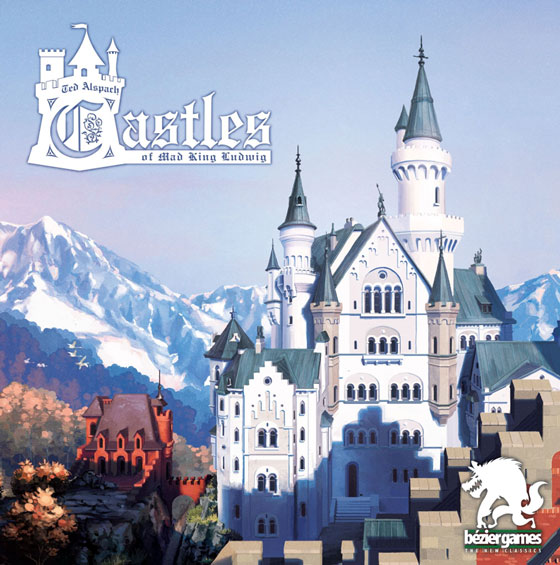
It’s been almost ten years since the original Castles of Mad King Ludwig was released, and whilst lots of things have changed in the gaming world, relatively few titles have sought to replicate the tile combination of auctions and placement that made this game so popular – perhaps Isle of Skye being the notable exception. This relatively evergreen design has meant that when Bezier Games took Castles of Mad King Ludwig: Second Edition back to print, it needed only cosmetic upgrades to make it feel modern, whilst a few organisational changes within the box help make setup and teardown an absolute breeze.
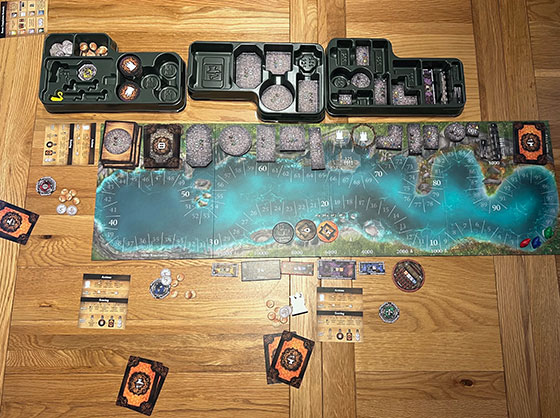
Castles of Mad King Ludwig: Second Edition is a game for one to four players that really excels at three or four. The solo mode is basically a high-score challenge and whilst I am not going to cover it here, I definitely appreciate its inclusion, as well as its simplicity. As a learning tool, it’s a fantastic addition. Inside the box you’ll find a fairly generous and very beautiful selection of components, which curiously include four GameTrayz inserts that clearly have lots of room to spare – this is because they are large enough to accommodate the full expansion bundle that was available as a separate release at the same time as the main game.
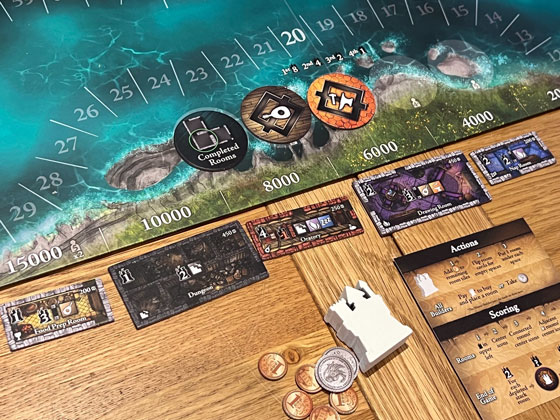
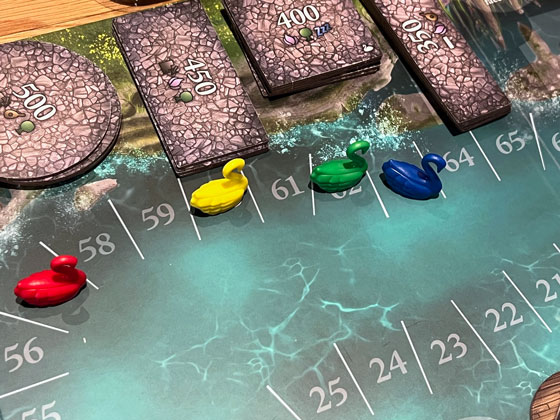
Thanks to those GameTrayz, it’s simple to set up Castles of Mad King Ludwig: Second Edition. Players simply lay out the scoreboard and set up room tiles and cards based on the number of players. Bonus cards are dealt and everyone gets a foyer tile and (beautiful) swan token to track their score, along with fifteen (thousand) coins. After this, the game begins – but what are you actually trying to do in Castles of Mad King Ludwig: Second Edition?
That’s actually a really simple question to ask, and thanks to the theme and the familiar concept of “construct your dream castle” Castles of Mad King Ludwig: Second Edition is very easy to explain. Players imagine themselves as master builders constructing a castle for Ludwig II of Bavaria (responsible for commissioning the castle that inspires Disney’s famous movie intro) and must consider his whims (open scoring objectives) and the bonus cards they hold secretly in hand to achieve the best score. Every room has a points value printed on it, and many rooms (if not most) are influenced by sets of the same room type, rooms adjacent to them, being the only room of their type and so on.
The view of each castle is top down, so starting with their foyer, players will connect new rooms (at any available entrance) and build outwards from there. I’ll explain in a moment how the room auction mechanic works, but players will always have several rooms to choose from based on the number of players and their position in the turn order, but if there are no rooms they like, they can always buy stairs (to lead underground) or corridors (which are easy to place and have many openings to add rooms to later.) There are some slightly fiddly rules about how rooms can be placed, such as what happens when a space is formed in the middle of several room tiles, or how some tiles have open spaces on one side that cannot be blocked, but these largely follow common sense.
In terms of how you actually acquire rooms, Castles of Mad King Ludwig: Second Edition really shines. At the beginning of the game, one player will be assigned the Master Builder token. That player will draw a number of tile cards based on how many players there are, and will then set the value of those tiles by placing them under the values (which differ slightly based on player count) beneath the board. Then, each other player will take one tile (or a stairs/corridor tile) and by paying the amount shown on the board to the Master Builder. They must then place that tile immediately in their castle. After all other players have done this, the Master Builder will have whatever cash was spent by the other players (plus whatever they have) to buy from the remaining tiles. A player may also opt to simply take five coins from the bank, if they either do not want to pay for a tile, or cannot pay for one.
I absolutely love this mechanic, and whilst I prefer Castles of Mad King Ludwig: Second Edition at three or four players because you see more tiles and there’s so much more to take into account, at two it still feels unique and exciting because it’s such a head-to-head conflict. At higher player counts, you’re playing Castles of Mad King Ludwig: Second Edition for your highest personal score and it’s unlikely you’ll be able to watch everyone else and try to work out what they are doing – but at two, it’s the complete opposite. As the Master Builder you can try to make your opponent pay high costs for tiles you think they want, whilst as the opponent, you may choose to take coins rather than do so because as a result, you deny the Master Builder those coins.
The auction step at all player counts is a quick, well-executed mechanic that really does elevate Castles of Mad King Ludwig: Second Edition beyond a pure gateway game. The beauty of it is that anyone can understand it, and very quickly, it becomes clear that being the Master Builder is hugely powerful. Because the Master Builder passes to the left every round, everyone gets to take roughly the same number of turns doing it, and it just feels so fun to set out the market and try to conspire to either make yourself lots of money, or to plan in a way that might leave the tile you want still available at the end of the draft.
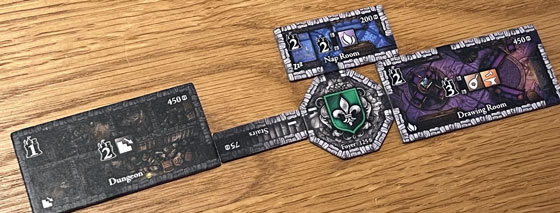
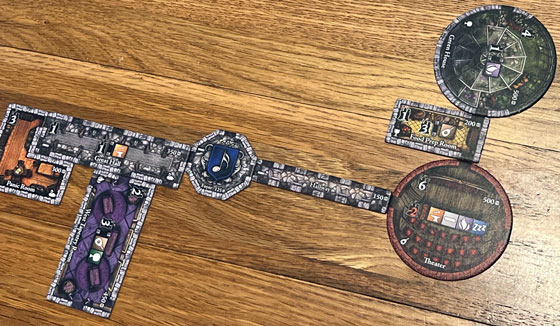
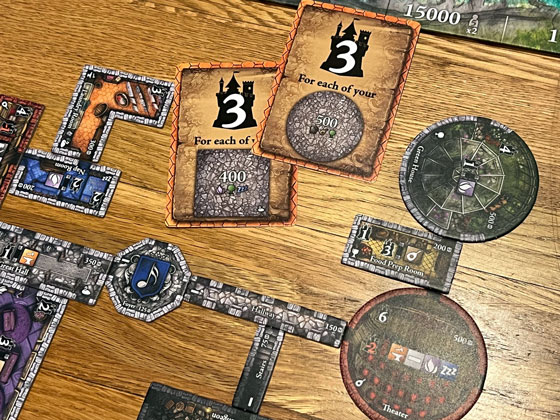
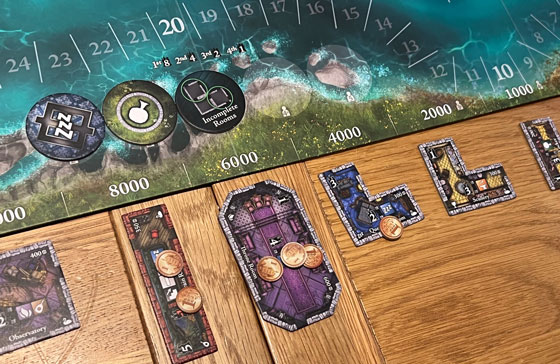
The tile placement and scoring in Castles of Mad King Ludwig: Second Edition is then almost a completely separate game – and whilst it is clearly linked to the auction, it is completely different in terms of mechanics. As with another popular Bezier Games product (Suburbia) the mixture of shared both shared and secret goals means that people may occasionally want the same tiles, but not always, and there is so much variety in the tiles that it’s pretty rare for one player to feel locked out. The bonus cards and tokens are also good, but not so good that a solid tile strategy that uses synergies and combos well enough can’t beat them.
I also love how the castles that emerge from Castles of Mad King Ludwig: Second Edition actually look and feel quite plausible, whilst also being wacky. You could build a long corridor that leads to a grand dining hall and theatre with a dungeon and torture chamber beneath it – thematically providing your honoured guests with pomp and splendour whilst prisoners rot beneath in terror. You could focus on outdoor buildings, with hallways leading to greenhouses and grand balconies that evoke the kind of scenic vistas you might actually expect to see from the terraces of a Bavarian castle. It’s the kind of world building that creates table talk, and I really value that.
In summary, Castles of Mad King Ludwig: Second Edition is a nice re-release of an evergreen classic that has gateway level rules, but lots of potential for advanced strategies and tactics over multiple plays. The gameplay is simple, but the scoring can get a little complex, and so I’d recommend that kids and adults of about ten and upwards be considered as your ideal opponents. The auction mechanic is very clever, and it matches well with simple enough tile placement that tells as a story as it expands across your table. On that note, you’ll need quite a bit of room as these castles can really spread out! Definitely a game I recommend, and one I hope to experience more of through the already available expansion pack.