
‘Star Wars: Shatterpoint’ Board Game Review

Long terms readers of Nerdly will know a couple of things – firstly, that we love Star Wars, and secondly, that we’re big fans of miniatures combat games. Among the very best examples of modern skirmish games that we’ve experienced is undoubtedly Marvel: Crisis Protocol from Atomic Mass Games, and you can read our reviews for both the base game and many of the additional packs right here. When I read that Atomic Mass were producing a skirmish game in the style of Crisis Protocol but based on the Star Wars universe, I was unbelievably excited. Star Wars: Shatterpoint is that game, and I have been lucky enough to get around ten games of it played in the last four or five weeks.
Star Wars: Shatterpoint is a proper miniatures combat game that takes the complexity curve upwards in comparison to games like Crisis Protocol, and certainly when set alongside more mainstream games like those in the Unmatched series (which we also love.) The box contains a huge number of miniature sprues and includes a total of twenty miniatures (which make for sixteen individual units due to grouping on some support units) and several buildings. If you’re not an experienced model maker, you will very likely need to take your time whilst building these, and some of the small and fiddly bits (some drone extras, lightsabres etc) will cause frustration.
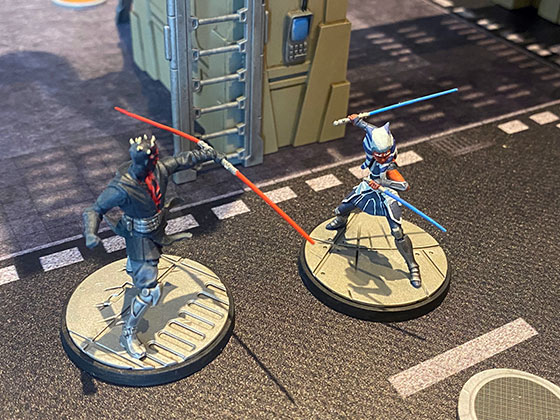
If you are also a painter as well as a model-maker, Star Wars: Shatterpoint is probably going to be one of your most treasured possessions. The scale here is slightly larger than most – probably around 40mm rather than the usual 28-32mm, which means that the models are large and extremely detailed. To make the example work, characters like Ahsoka and Maul have their facial markings etched into the model itself, and these models are at a scale where details like eyes can actually be painted fairly well. By the way – I say they CAN be painted fairly well, not that I could personally achieve that!
Another indication that Star Wars: Shatterpoint is more focussed on core gamers is the ruleset – which primarily exists as a living document online. When accepting this review copy, I was actually warned that the game ships without a manual, but mine did – I’m not sure if that’s normal or not. Either way, much as with Crisis Protocol, things will change over time and especially as new expansions are released, so anyone getting into the Star Wars: Shatterpoint should understand that they will need to download new additions and tweaks to the rules over time. What does come in all boxes are cards that clearly articulate the cost, statistics and damage tree for each unit – and I’ll explain more about that later.


Once you’ve built and painted your models (or not) you’ll choose a squad. Each squad comprises of a Primary Unit, a Secondary Unit and then a Support Unit – and the latter of these typically includes at least a couple of bases with a few models on it. In the Star Wars: Shatterpoint core set, there are two “light” and two “dark” side teams that you can build. This feels fairly generous compared to some core sets, but then again I guess the RRP of this game is over £150, so it’s quite expensive in relative terms. The light side includes characters like Ahsoka, Anakin and Bo-Katan, whilst the dark includes Maul, Asajj Ventress and Gar Saxon. Support units include Clone Troopers and Droids, as well as Mandalorians that represent both good and bad sides.
Squad building is quick and simple, with your Primary Unit (let’s say Maul or Anakin for this example) showing a printed number of squad building points on their card, and choosing a Secondary and Support Unit according to what they can afford. In the core set, this is simple and straightforward because more or less any combination is possible across both dark and light sides, but I would imagine that as more and more expansions are released, this will get more complex. There is some blurb in the manual about not being able to mix your squads across timelines, but everything in the core box is focussed on the Clone Wars timeline, so that’s not a major issue here.
Next, you’ll set up the battlefield and the mission. Specifically, you’ll place out some of the large, detailed building pieces onto a 3×3 foot play space. Note that my table (and possibly yours) will need to be larger than 3×3 to actually set out all your cards and periphery elements, so be warned that Star Wars: Shatterpoint is an absolutely massive game. The struggle track is an interesting feature which tracks the status of the battle as the two sides vie for the current Struggle (aka an objective in any other game.) Players can swing the struggle marker towards them by holding objective points, but they can also build momentum for their side by wounding opposing characters and by a few other in game effects. The first player to win two (out of three) struggles will win the game.
Once battle is joined, players will draw cards from their own deck to determine the order of their character activation. If they draw a character that they don’t wish to use, they may place that character in reserve (using it later to replace a draw) and then draw the next card, but this second result MUST be accepted. I found this a bit odd to be honest, as I have become accustomed to characters like Anakin or Maul (who are elite battlefield combatants) having agency over their activation when compared to more basic troops such as clone troopers or droids. The reservation system helps, but this mechanic does introduce a very game-like element of randomness that feels slightly out of place in what is otherwise a very measured and serious experience.



In any case, when activated a character will typically move, attack and/or use either a passive or activated special ability and can take two of these specific actions. Early in the game, the focus will be on positioning characters and potentially getting them to cover activated objective points (which will be set based on the current struggle) but later, the focus will shift to combat. Some units have abilities that affect others, such as Captain Rex’s “Get a Move on Soldier” which allows them to move an allied character with the appropriate tag outside that other units’ normal turn. By using these synergistic abilities, Star Wars: Shatterpoint offers a lot of flexibility to the players for nudging their team towards objectives in ways that allow for clever play.
When combat starts, Star Wars: Shatterpoint gets really interesting, offering one of the most unique features I’ve seen in any game – and probably not something I’d expect to see in a miniatures game. This feature is the combat tables – and each character has at least one. When attacking, the stance dictates how many dice will be rolled and what happens to die faces other than hits and critical hits – sometimes allowing them to add up to more hits. Countering this will be the defence die shown on the stance card of the character being attacked.
The result is a comparison between the total number of successes the attacker rolls (or constructs based on their stance) and the number of successful blocks rolled or constructed by the defender. Let’s imagine that the balance of this is plus three to the attacker – in this case, the attacking character could move three spaces along their attack track to resolve the outcome shown – usually an amount of damage and – at anyone beyond say one or two hits – some other effect such as pinning, exposure or pushing. This system is absolutely fantastic, and with some characters (especially force attuned ones) having two stances to choose, it feels very, very thematic.
Because of the stance cards and the way that the damage builds up in different ways, the attacking player has real control over the outcome of combat. Dealing three hits has always been “quite big” in most skirmish games because combat is designed to be a close run thing, but in Star Wars: Shatterpoint, it feels just great to look at your chart and then ask yourself “what would be better for me hear – pushing this character off the objective spot, or leaving them exposed because I can then attack again and seriously wound them?” Whilst this seems quite daunting at first in terms of assessing the stance and what is best etc, I found it very simple in practice because you don’t need to worry about it until you’ve actually resolved the number of hits. After a few practice rolls, it comes very naturally.


Between the large, detailed miniatures and the excellent scenery, Star Wars: Shatterpoint has a fantastic table presence, but beyond pure aesthetics, the game actually stands up to serious competition in this space. Yes, Star Wars: Shatterpoint is a little complex, but that complexity leads to tight, enjoyable and thematic gameplay. These characters really feel correct based on how they behave – Maul for example is an absolute weapon, but in many cases he hurts himself as he increases his hit rate, which rapidly leaves him exhausted. Anakin on the other hand feels skilful and nuanced, reflecting his peak strength before his decline into rage.
I am already a huge fan of Star Wars: Shatterpoint and I am already debating whether I need to replace Crisis Protocol with it longer term. The jury is still out on that, although I may simply be saying that because I’ve got a lot of CP stuff that further expands the replay value. I would have thought that with a few choice expansions, Star Wars: Shatterpoint rapidly becomes the skirmish game of choice in this household. The IP, the quality of the miniatures and the exceptional gameplay all Star Wars: Shatterpoint to another level, and with the price as the only barrier for entry, I would recommend it to anyone who is interested in either Star Wars or skirmish games generally.