
‘Dominion: Allies’ Expansion Review
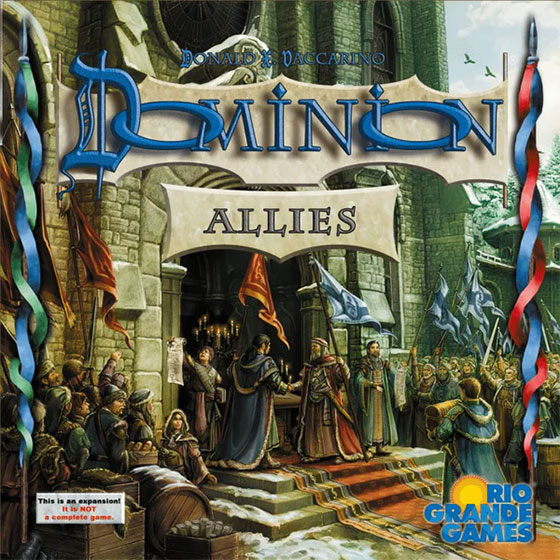
I might be wrong, but I bet that when Dominion was released in 2008, designer Donald X. Vaccarino would have no idea that his creation would still be as popular as it is in 2022. Whilst not usually regarded as a gateway game in any sense of the word, there’s no doubt that Dominion remains the definitive example of how to create a deckbuilding game – to the extent that almost every other game in this genre draws inspiration from it. Even more amazing is the number of expansions that Dominion has spawned, and it is one of those expansions – Dominion: Allies that we are reviewing today.
Firstly, a small disclaimer. My personal Dominion collection consists of the base game (Second Edition) and around four or five expansions, and I am acutely aware that there is a proportion of the Dominion player base who are very, very serious about the game – this review is probably not for them/you. I will be giving an overview of the different cards and in particular any new mechanics, but my perspective on Dominion, in general, is very casual. I really enjoy the game, but I don’t have the experience to look across existing expansions (especially those I don’t own) and to talk about the different combinations.
With that said, I should give a bit of an overview of what Dominion is about in a more general sense. Basically, Dominion is a card game in which each player starts with an identical set seven coppers and three estates. They will then draw a hand of five cards, and use what they have (coppers) to buy a single card from the (usually) ten stacks on the table. They will then discard any cards used, the new card and any cards left in their hand and then draw up to five again. When they need to draw up and their deck is empty, they will shuffle their discard and start the process again.
There are two key things to understand about Dominion based on what I’ve just said. Firstly, regarding the ten decks on the table – these decks are really why Dominion expansions exist. The base game comes with about twenty piles (plus several sets of generic cards like copper, silver, gold and the holdings cards like estates) to choose from. Each expansion from there on out comes with a further ten to twenty-five decks. Every set then has a randomiser for each deck, and one way to play Dominion is simply to shuffle your randomisers and then draw ten – and then you use those ten decks to play. Each expansion manual also features specific combinations of cards to play with other expansions to get a specific thematic feel.
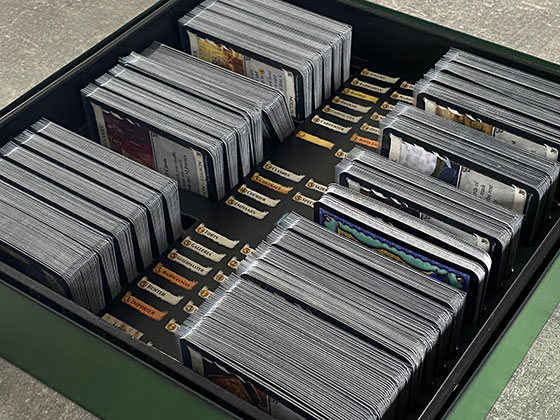
The other thing to know about Dominion is that what I’ve described above is only really valid for your first few turns. The basic rules are that a player can only buy one card and take one action (which is to play one card that says action on it.) As players buy new cards, they will use their action to play them, but cards might have plus one buy, plus one action (or any amount of other rule-breaking effects) printed on them. By the mid to late game then, your turn might look more like – putting down two silver cards for four monies, then putting down a card with plus two actions and plus one buy on it, then playing two further actions, collecting any bonus money shown, and then making two buys instead of one. Turns never get massively complex, but the development from turn one to the final turn in a game of Dominion is always significant.
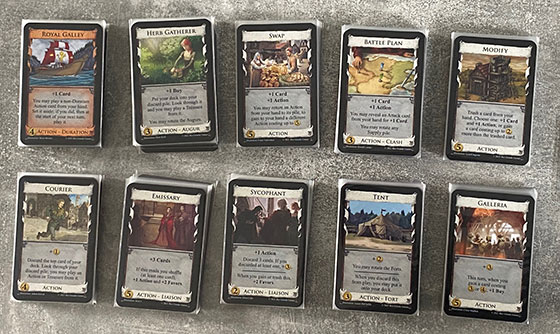
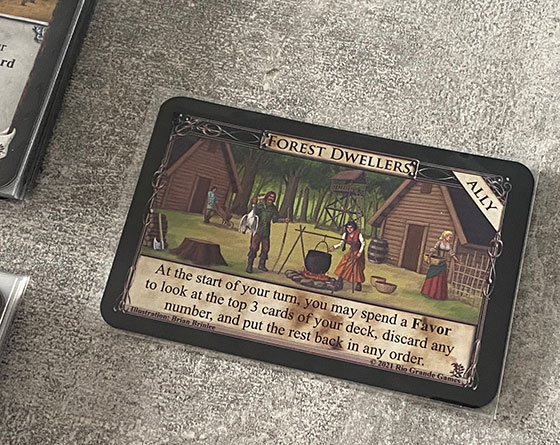
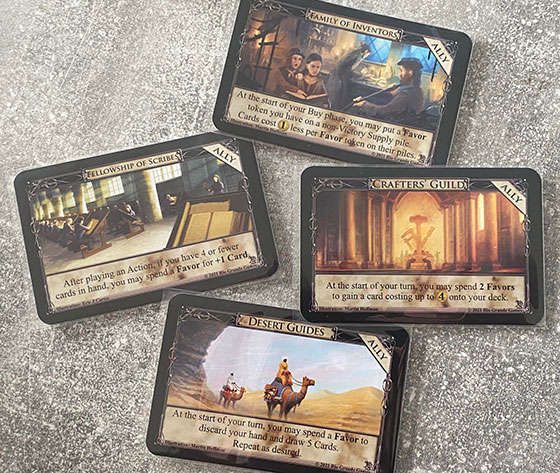
Anyway, with all that said, the whole point of Dominion: Allies is that it introduces over twenty new stacks of cards based on the theme of Allies (hence the name.) The first thing that Dominion: Allies adds is an actual ally deck and a mechanic known as “favours.” Favours can be gathered from various cards in the set known as Liaisons, and when a favour is gained, the player gaining it will add it to a specific mat in front of them. They can then trade these favours for other things during the game – in particular based on what the Ally card you have chosen to use says. Some allies attack other players, some allow a particularly big turn thanks to huge card draws and others offer bonuses like gold or for a player to take a card without paying for it.
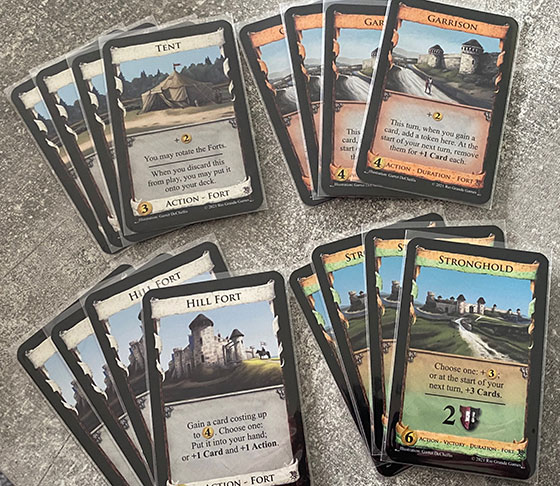
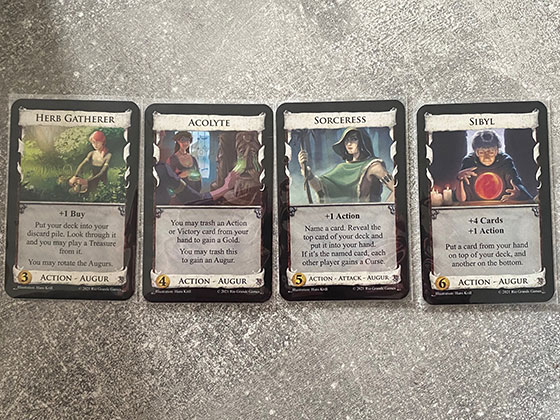
The other (sort of) new concept in Dominion: Allies is that of split piles. When I mentioned the ten piles above, I really meant ten piles of around ten identical cards – so each player might buy one or more of each card, and will therefore be more likely to draw into those cards. In Dominion: Allies, the split piles consist of four different cards, each of which occurs four times and is ordered by cost. The first card, among other abilities, always offers the ability to “rotate” the stack, which means to put the current set of four cards (or whatever is left) to the bottom of that split stack. It’s important to note that only the first card in each pile does this – so if only one player has that and then has the chance to rotate the pile, they will have an element of control that no one else can compete with.

The split piles are really interesting and offer a genuine mixed bag. The Wizards, for example, consist of Student, Conjurer, Sorcerer and Lich and do some very interesting things. The Student effectively allows a player to quickly trash (which means remove from play) low value treasure cards and gain favours. The Conjurer then makes up for this by allowing the player to draw very cheap cards quite quickly. Sorcerer allows the player to draw an additional card and take another action (a neutral state) and then basically it tasks every other player with naming a card on their deck, and if they don’t draw it – they gain a curse (which clogs up their hand.) Lich, then allows a massive amount of card draw but at the cost of having to skip your next turn – wow.
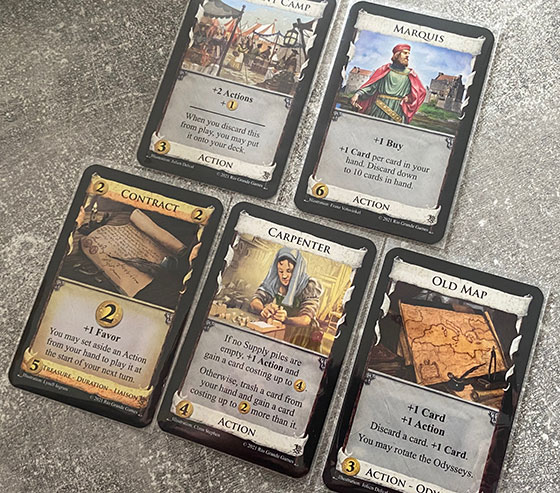
The other split piles include Augurs, Odyssey, Townsfolk, Forts and Clash’s – each of which has a different focus. That’s four different cards multiplied by six different decks (including Wizards) which gives Dominion: Allies the feeling of massive variety. There are, of course, about another twenty decks of individual cards as well – these include the likes of Carpenter (which does a different thing depending on whether the other decks are now empty) or Innkeeper, which gives the player plus one action and then one of three effects (draw a card, draw three and discard three, or draw five cards and discard six.)
There are also some reasonably mean attack cards in Dominion: Allies such as Barbarian – which basically makes each opposing player trash cards from the top of their deck, potentially either gaining a much worse card in its place, or being forced to take a curse card. Either way, this is really bad and it feels like a beating when it happens to you – I’m already hearing that a number of players are refusing to include it in their games. Each Dominion set tends to include a few attack cards like this, and there’s always a choice to exclude them from your game if you don’t like confrontation, or indeed to include more of them if you do.
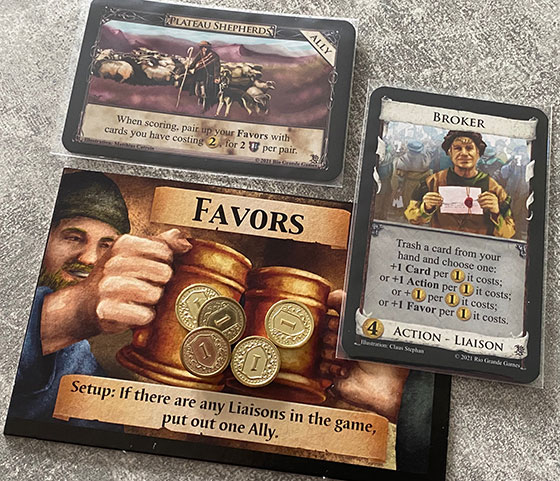
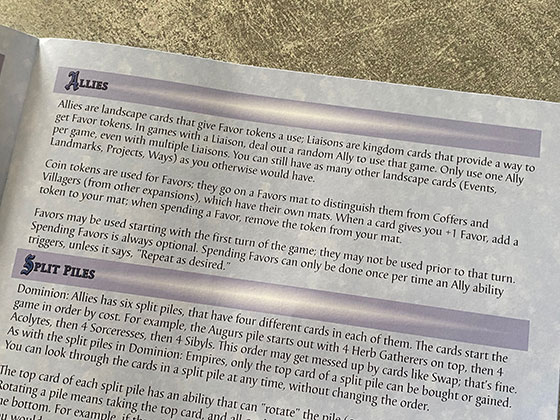
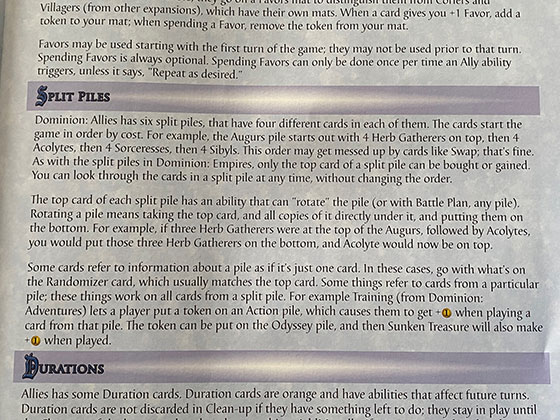
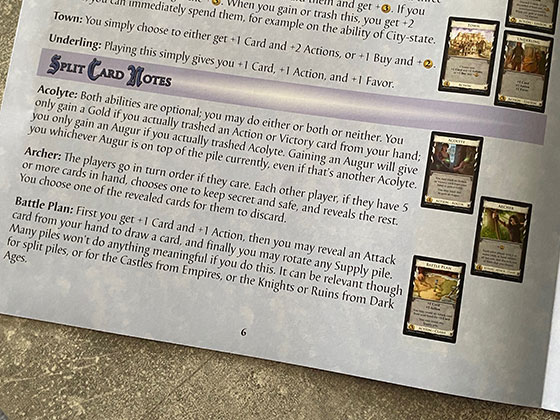
For me, Dominion: Allies is a fantastic value expansion. As with every set, it includes a ton of cards which usually include good artwork (not every single one in this set does) and remains on theme. In this particular set, the inclusion of a thick deck of Ally cards and over twenty new decks, many of which are split into four, feels like real value. Very quickly, Dominion: Allies has become one of my favourite Dominion expansions and I suspect I will always use 1-2 of the split piles in my games going forward, and I also like the Allies and favours mechanic too. It’s similar to Way’s from Dominion: Menagerie, but I would argue that it’s easier to explain alongside the token mechanic.
Overall, Dominion: Allies is a really solid expansion, but it does contain some complex cards and ideas (aside from Favours) which you may not wish to explain to brand new players. Considering purchasing it if you are experienced in Dominion, or if you’ve already got a few games and expansions under your belt and you’re looking for something that really changes the experience.
**** 4/5
Dominion: Allies is available online at 365Games.co.uk, or at your local games store. Don’t know where yours is? Try this handy games store locator